Q1. Please give a brief self-introduction and tell us why you applied to MAP.
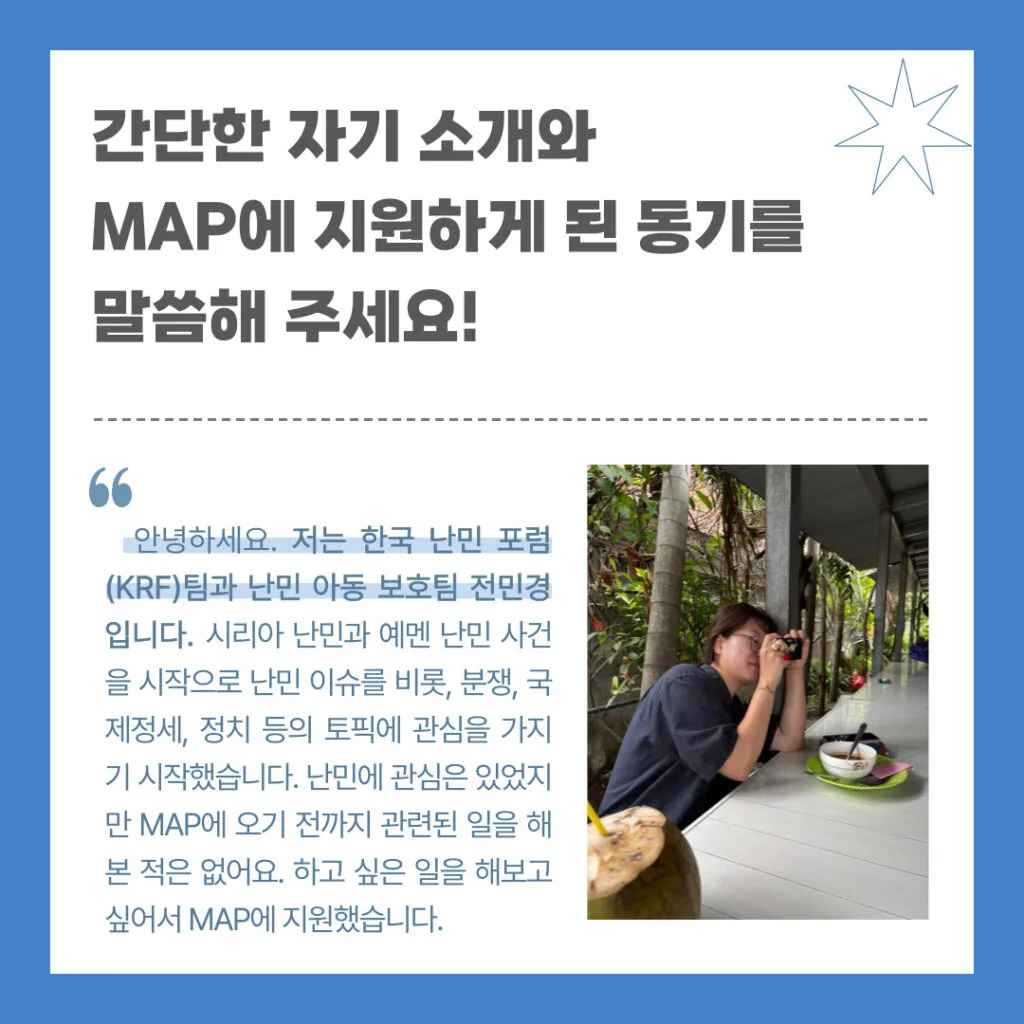
Hello. I am Jeon Min-gyeong of the Korea Refugee Forum (KRF) team and the Refugee Child Protection team. I began to take an interest in refugee issues, as well as in topics such as conflict, international affairs, and politics, starting with the cases of Syrian and Yemeni refugees. I was interested in the refugee field, but I had never done related work before coming to MAP. I applied to MAP because I wanted to do work that I truly wanted to do.
Q2. What exactly do you do on your team at the moment?
On the KRF team, I assisted with the overall preparation process of the Korea Refugee Forum. The Korea Refugee Forum was held to strengthen dialogue and cooperation among various stakeholders, including refugees themselves, on domestic refugee issues. While preparing the forum, I kept thinking about how KRF could function well as a place for dialogue and cooperation among participants, and how that might affect Korea’s response to refugees. My hope was that the stakeholders we met through the forum would keep talking even after KRF ended. In a way, I think KRF is closer to a living platform than to a forum that closes once the event is over. I hope that the seeds of dialogue and cooperation we planted through this forum will bear fruit. On the Refugee Child Protection team, I took on two tasks. The first was assisting with the crisis child support project, and the second was monitoring through home visits. The crisis child support project helps keep children safe by quickly supporting the families of children in crisis situations. I remember thinking about how to make sure a child could receive treatment in a timely way and how to support a child to grow up in a safe environment. The home visits are also memorable. Seeing a brightly smiling child and the guardian holding that child’s hand, I spent time thinking about what more we, and I, could do.
Q3. What has been the most memorable moment for you so far?
Every moment at MAP made me happy, but if I had to choose only one, I would without hesitation choose the morning of the KRF day itself, when the conference hall was packed with participants. I remembered the time I had spent thinking about how to make a more inclusive forum and the effort I had put into preparing, hoping for a successful event. Even now that the forum is over, many tasks remain, but I am glad that there are so many follow-up tasks. That is probably why it is such a memorable time.
Q4. What do you think our society needs most in order to live together with refugees?
I think mutual understanding is the most important thing. I still remember a conversation with a friend when I was in high school. While we were talking about refugees, I was asked, “Then how about using your home as a place where they can stay?” I wondered why, if a Korean friend suddenly had to flee, giving up the room next to mine would be fine, but doing the same for a refugee felt difficult. I also thought that there are too many structural problems to be solved through individual effort. I think this kind of problem arises when we turn refugees into objects without ever meeting them. I hope people will see refugees as people who live in society together with us, and I think that increasing opportunities for contact is important to bring about this change in perception.
Q5. What “change” have you felt while working at MAP? Or what “change” would you like to make?
I am by no means free from the prejudices I mentioned earlier, so I am learning a great deal through my work. I feel the change by talking and having conversations with refugee activists who work inside and outside the office. Previously I also perceived refugees as a group, but I have come to see them not as members of the group called refugees but as individuals, as people who live in the same era as I do. I want to study their lives further and learn what should be done to improve them. I know better than anyone that I still have a long way to go, so I am learning and studying a lot.
Q6. How should MAP approach people who find refugee issues difficult?
I hope there will be more points of contact with refugees. Many of the people around me look awkward or uncomfortable when they hear the word refugee. However, I think these moments will gradually decrease if there are opportunities to meet refugees in person, such as “Dialogue with Refugees.” If the moments we spend meeting, talking, laughing, and sharing meals with them increase, I think we will be able to see refugees as members of a society we live in together.