Q1. Please give a brief self-introduction and tell us why you applied to MAP.
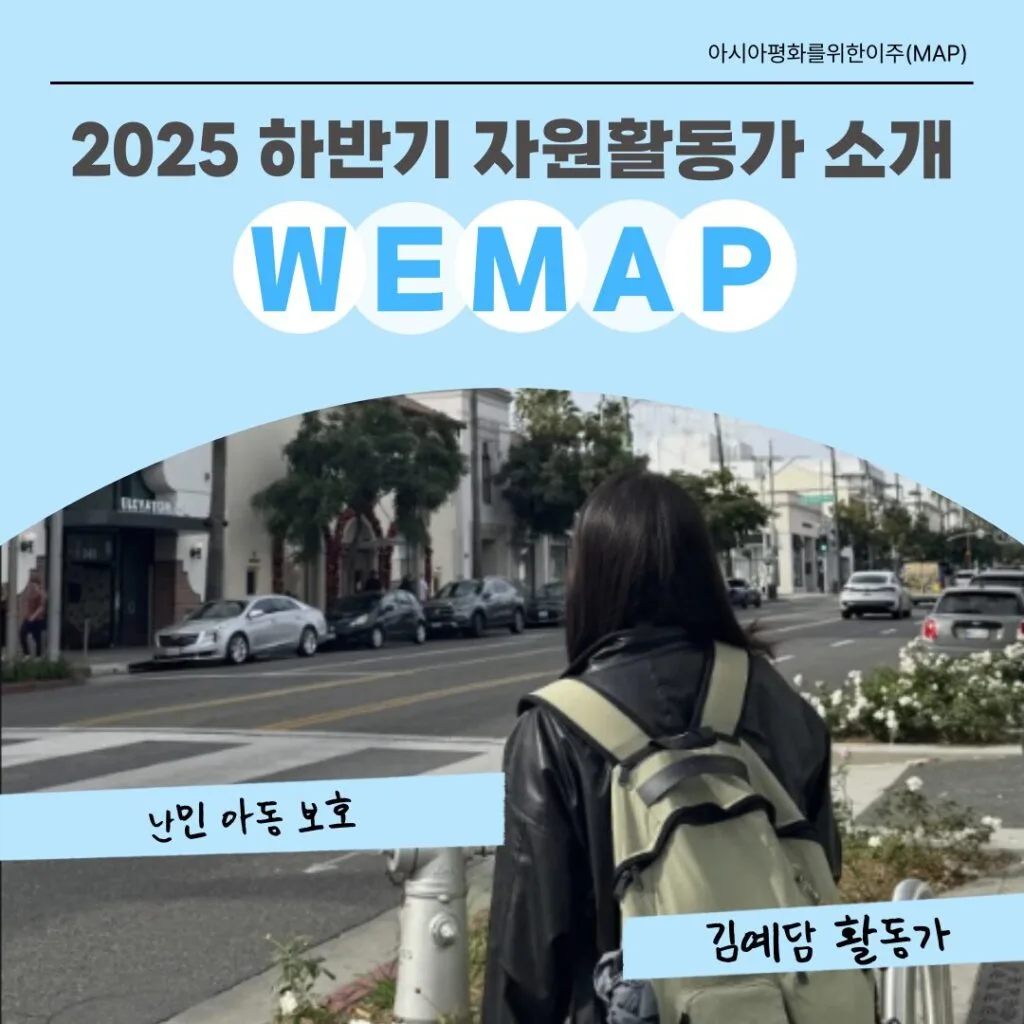
Hello. I am Kim Ye-dam, a volunteer at Migration to Asia Peace (아시아평화를향한이주) in the second half of 2025. I am currently in charge of the childcare and medical expense support project for refugee children on the Child Protection Team. During my time as an exchange student, I came to think about what it means to live as a stranger in a foreign place. After coming to Korea, I became more clearly aware of the strangers who live alongside us, and I was especially drawn to the existence of refugees, who are easily erased, so I applied to MAP.
Q2. What exactly do you do on your current team?
I am currently in charge of the Good Samaritan Support (GS) and Dear Mami (디어마미) support projects on the CP Team. The Good Samaritan project is a program that provides living expenses and medical expenses to refugee children aged 18 months or younger in single-parent households living in Korea, and the Dear Mami project is a program that supports mothers so that they can buy their children special gifts beyond simple subsistence, such as picture books and snacks. In addition, by regularly monitoring the families by phone, asking after them and checking whether there are any problems with the children’s care, I help the children grow up in a stable environment.
Q3. What has been the most memorable moment for you so far in your activities?
What I remember most is the moment I received good feedback from a family I had visited in person. At the end of the 5th cohort of GS, I compiled the feedback we received from guardians about the program overall, and one person left, as feedback from the home visit, “It felt like I had gained a Korean family.” As soon as I read that sentence in the office, I had a hard time hiding my reddening eyes… I felt proud that I had contributed, even if only a small part, to making sure that strangers who live through time alongside us are not left out.
Q4. What do you think our society needs most in order to live together with refugees?
I think it is important to put in place the basics so that refugees are seen not merely as passive recipients of help but as “active members” of our society. That means enabling refugees to keep interacting with society by making use of their language skills, cultural backgrounds, or existing skills (like the Dialogue with Refugees program run by MAP!). If such continued interaction takes place, I think refugees can gain a true sense of belonging to Korean society and finally take their place as members who live together with us.
Q5. What “change” have you felt while volunteering at MAP? Or what “change” do you want to make?
Since I started working with MAP, I have come to see refugees as distinct neighbors who live together with us. While handling concrete support projects on the CP Team, I learned that small bits of help, gathered together, can act as psychological stability for refugee families that goes beyond subsistence. Based on this experience, I want to bring about change that helps refugees find their place instead of being pushed to the margins of our society, and become members of a community in which they feel a sense of belonging.
Q6. How should MAP approach people who find the refugee issue difficult?
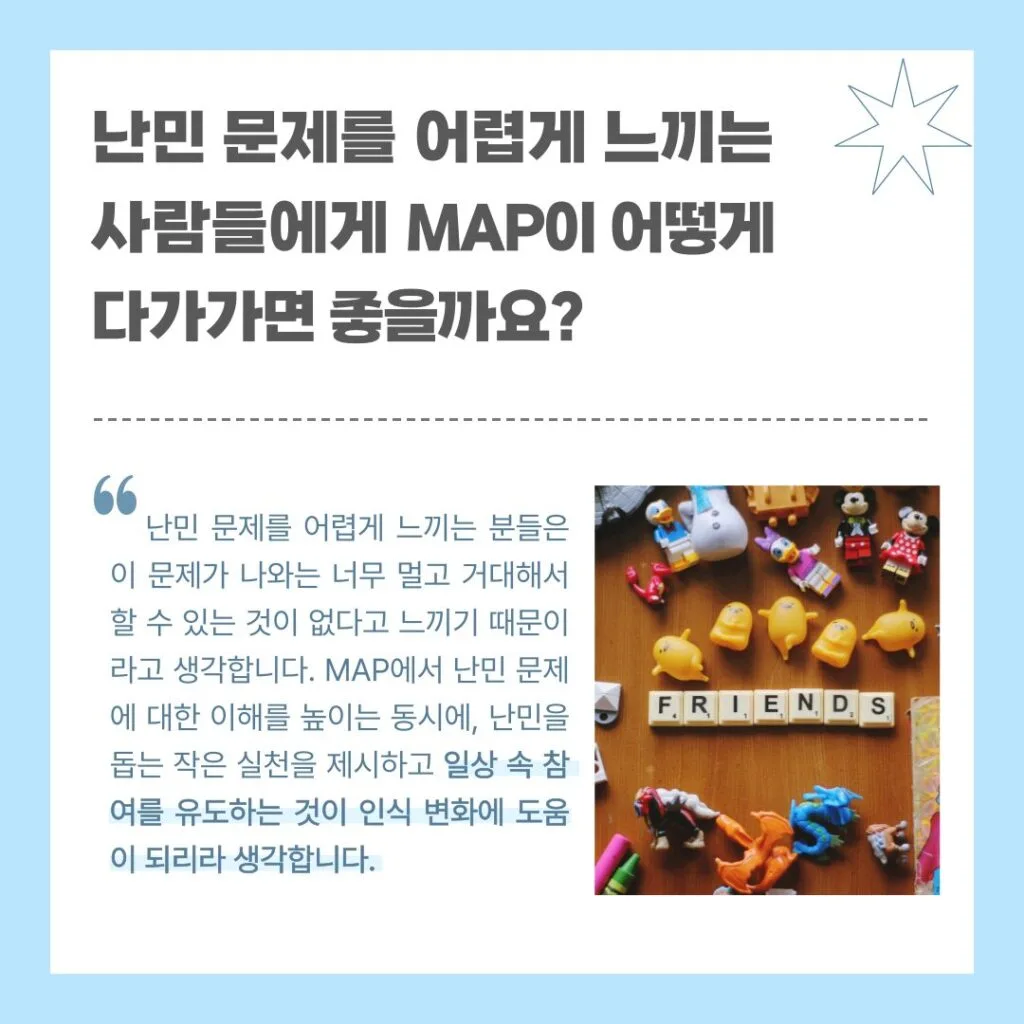
I think people find the refugee issue difficult because it feels too far away and too big, so that they feel there is nothing they can do. I think it would help change perceptions if MAP, while raising understanding of the refugee issue, also suggested small actions that help refugees and encouraged participation in everyday life.