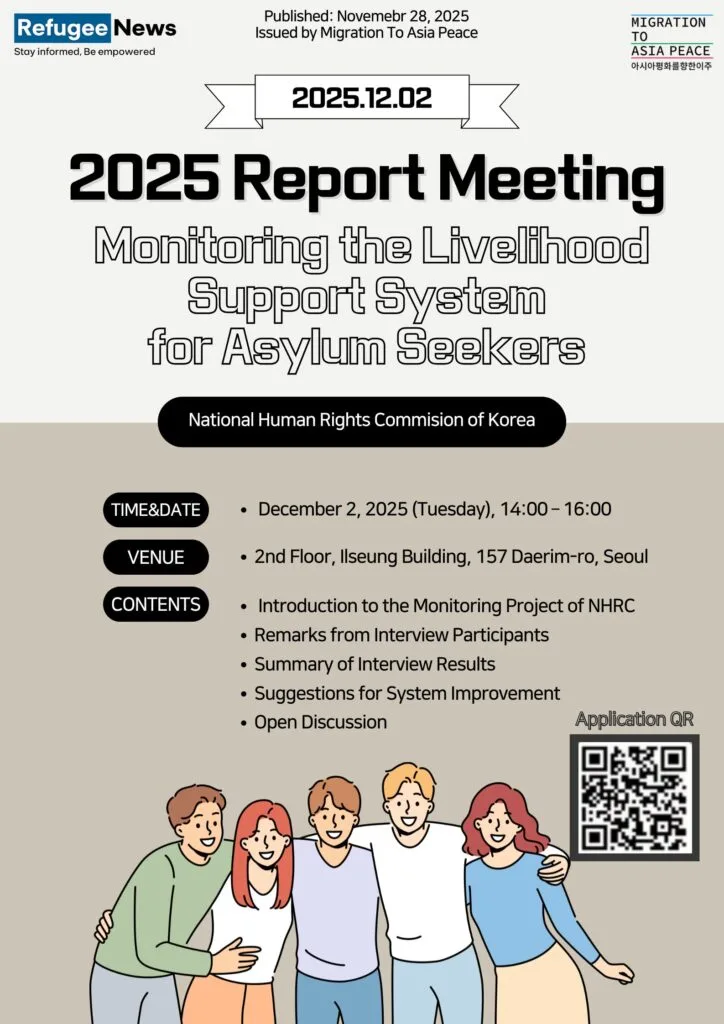
The Refugee Rights Network has examined the problems with the livelihood support system. As part of a monitoring project by the National Human Rights Commission of Korea, they interviewed asylum seekers who are in difficult situations. “We look forward to your interest and participation in the report meeting.
- Date & Time: December 2, 2025 (Tuesday), 14:00 – 16:00
- Location: Migrant Center Friend (2nd Floor, Ilseung Building, 157 Daerim-ro, Seoul)
- Registration:https://docs.google.com/forms/d/e/1FAIpQLSdP2Hmd7E2CM61DoO3gEbJ19PKoIc2FIOqZL0NGxAYfQn88eA/viewform
This monitoring was conducted from May to November 2025 by activists from the Refugee Rights Network. 22 asylum seekers who could not find work and were facing financial hardship participated in the survey. They checked if the livelihood support system is easy to access and if the support provided is adequate.
The National Human Rights Commission hopes this meeting will highlight the crisis vulnerable refugees face and the limits of the current system. We hope this will lead to real discussions on how to improve the system.
Below is a summary of the monitoring results:
1. Crisis in Basic Living (Livelihood, Medical Care, Housing of Refugee Applicants)
- Continued lack of income due to the employment ban (for the first 6 months) or visa issues.
- Many cases where people cannot afford food, rent, or utility bills.
- High burden of medical costs.
- Severe financial hardship when surgery or expensive treatment is needed.
- The crisis is worse for vulnerable groups, such as pregnant women, people with disabilities, or those raising children.
2. Poor Access to Information about Livelihood Support
- Many people did not apply because they did not know the system existed.
- Many were not informed by the immigration office.
- People relied on informal networks like NGOs, friends, or communities to get information.
3. Inconsistent and Unfair Application Process
- The acceptance and processing of applications differed depending on the officer in charge, even under the same conditions.
- Some officials were rude or refused applications during the process (e.g., saying “Go work” or “Leave the country”).
- Some applications were wrongly rejected because the person was re-applying for refugee status or their parents didn’t have visas.
4. Structural Barriers in the Procedure
- Delayed or unissued Alien Registration Cards (ARC) → Cannot open a bank account → Cannot receive support money.
- Lack of language support (insufficient support for languages other than Korean and English).
- Difficulty obtaining proof documents like birth certificates or family relationship certificates.
5. Rights Not Protected during Review and Notification
- No information provided about how long the review will take.
- Approval or rejection notices sent via short text messages without explanation about reasons.
- Applicants had to ask directly multiple times to check their results.
6. Insufficient Amount and Duration of Support
- The support money only covers a small part of basic living costs.
- It is completely insufficient for medical bills, rent, or childcare costs.
- There were no cases where support was given for the maximum legal period (6 months).
- Actual duration: 2 to 5 months, varying randomly by case.
- Even within one family, members received support for different periods, making it impossible to plan.
7. Other Issues
- Support payments stopped without notice.
- Criteria for review were not made public.
*This news is based on the official announcement from the National Human Rights Commission of Korea.