[The Korea Refugee Rights Network’s Position on the Protection of Afghan Refugees] (20210825)
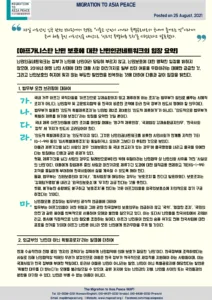
The Korea Refugee Rights Network’s Position on the Protection of Refugees in Afghanistan (20210825)
<On the morning briefings of the Ministry of Justice and the Ministry of Foreign Affairs on August 25, 2021>
The Korea Refugee Rights Network states its position as follows on the fact that the government does not proudly call refugees refugees, does not state a clear position on refugee protection, is eager only to placate some opposing public opinion as it was in responding to the Yemeni refugee situation in 2018, and repeats only unjust remarks that do not fit the purpose of refugee protection.
1. On the Ministry of Justice morning briefing
A. The measures for Afghan nationals residing in Korea stem from a legal obligation that the “Government of the Republic of Korea” must observe, and are not a favor arbitrarily granted by the Ministry of Justice.
Article 33 of the Convention relating to the Status of Refugees and Article 2, paragraph 1 of the Convention against Torture both “legally prohibit” return to a place where persecution, torture or cruel treatment is expected. The current situation in Afghanistan, judging only from what has already been made public through the media, amounts to a situation comparable to a “civil war” occurring after 20 years, and to a substantial change of the state in which there is no longer a country to return to. For this reason, UNHCR also issued a position in August 2021 requesting that all countries in the world refrain from returning “Afghan nationals”.
Therefore, the measure of “allowing Afghans residing in Korea to stay without forcibly returning them to Afghanistan” is an obligation that the Korean government must fulfill under treaties Korea has ratified, such as the Refugee Convention and the Convention against Torture, and a concrete system must be built within that framework; it is not a matter to be granted in a benevolent manner.
B. The “special humanitarian stay measure” announced by the Ministry of Justice is not the “Humanitarian Stay Permit” under Article 2, subparagraph 3 of the Refugee Act.
The Ministry of Justice hastily created a system and keeps changing its wording out of concern for public opinion, so this time it intends to grant the status of “special humanitarian stay,” in place of the “temporary special stay” status previously applied to Myanmar nationals. As a result, cases are also seen in which the media misunderstand this as the “Humanitarian Stay Permit” under the Refugee Act.
However, the “special humanitarian stay” status that the Ministry of Justice intends to grant is not the “Humanitarian Stay Permit,” the status under the Convention against Torture pursuant to Article 2, subparagraph 3 of the Refugee Act, but merely a summary of a policy that “the Ministry of Justice will specially try to permit stay on humanitarian grounds.” In other words, it is clearly a different status from the “Humanitarian Stay Permit” under the Refugee Act, which is confirmed under international law and carries rights concerning treatment.
C. When preparing measures for Afghans staying in Korea, three things must be considered: “permanent stability of stay,” “the non-refoulement obligation under international law,” and “social settlement in Korea.”
According to current reports, there appears to be no possibility that the situation in Afghanistan will change in the short term. In that case, for Afghans to whom the non-refoulement obligation under international law applies, the “right not to be cracked down on for working” must be granted in the form of a work permit, and all other social rights must not be taken away, and a stable stay permit in a form equivalent to that of refugees must be granted to them. This is because Afghan people are also members of society who must live together in Korean society without discrimination.
At present, even “Humanitarian Stay Permit holders” from Syria, Yemen and elsewhere, who have a better status than the “special temporary stay permit,” are unable to settle stably in Korean society and complain of suffering because of their unstable status. Afghans must not again be left as ambiguous “marginal persons.”
D. The “special humanitarian stay measure” is not “humanitarian.”
Civil society, including the Korea Refugee Rights Network, has pointed out the limits of “temporary special stay measures” such as the other stay status (G-1-99) granted to Myanmar nationals after the Myanmar coup, and has argued that permanent measures should be created in preparation for the situation in Afghanistan, which is expected to be prolonged. However, today’s government announcement appears to be “the same as that” or even “a step backward.”
For persons staying legally, the previous stay status can be extended, or if extension is difficult, the other status (G-1-99) can be granted. In that case, however, a “work permit” must always be granted together. In Korean society, where there is no economic support whatsoever, it is impossible to make a living without employment, so granting a “special humanitarian stay permit” without permitting employment is in effect no different from forced return.
The policy that, for persons whose period of stay has expired, a departure order will be issued and departure will be deferred “if they have a person in Korea such as an identity guarantor” has the following problems.
First, persons whose period of stay has expired also have a ground for a refugee application under the Refugee Convention, namely the risk of persecution by the Taliban, just like persons with legal stay status. They are “de facto refugees” who were not recognized as refugees because this risk was not properly confirmed in the refugee status determination process for various reasons, and who then could not return to their home country and came to reside without registration. Issuing a departure order to them and deferring the departure deadline without a work permit amounts to telling them to wander around Korea without even an alien registration card. For these de facto refugees, just as for persons staying legally, the fine for overstaying must be waived and the other (G-1-99) status must be granted in the same way, so that they can continue their lives in Korean society.
Second, the Ministry of Justice announced that it would take “protective measures” in cases where there is “no identity guarantor” or where there is a “criminal offense.” Protective measures mean issuing a “deportation order” and “detaining indefinitely” in an “immigration detention center.” Are these criteria truly objective? Does it mean that a refugee who “knows someone in Korean society” is not detained, while a refugee who knows no one is detained?
Criminal offenses also have strict removal standards under general criminal case handling standards. In particular, refugees and Humanitarian Stay Permit holders cannot be returned unless they have committed an “extremely serious crime.” Because they have already been punished through criminal penalties, they must be settled in Korean society without double punishment. However, it is clearly unlawful to return people unconditionally whenever there is a “criminal offense,” without judging its seriousness. The Ministry of Justice, which should dispel misunderstandings about refugees and declare the principles of refugee protection, must clearly recognize that announcing that it will strictly detain in immigration detention centers “people whom some citizens dislike,” and talking about “the safety of citizens” together with talk of refugee protection, fuels misunderstanding about refugees.
Third, what will be done after they are detained in an immigration detention center? UNHCR has stated its position that Afghans must not be returned. Moreover, in the current situation it is also practically impossible for the Korean government to return them. Does the Korean government intend to put Afghans on a plane in handcuffs and return them to Kabul? Is there actually such a commercial flight? Unless all of this is satisfied, return is impossible. Taking “protective measures” despite the impossibility of return means detaining them arbitrarily for a long time in an immigration detention center, forcing them to choose between returning to life under the Taliban and being detained indefinitely in Korea. The government must not make scapegoats of some refugees under the pretext of showing strictness.
E. On the Ministry of Justice’s official remarks that encourage hatred of refugees
The Ministry of Justice, which has a duty to protect refugees and to prevent discrimination and hatred against them, must actively explain when there are misunderstandings and inform citizens of the accurate facts. However, it does not mention the dangers facing Afghans or the Korean government’s duty to protect them, and instead repeatedly uses terms such as giving top priority to the “national interest,” taking “strict measures,” and considering the “safety of citizens,” creating misunderstanding and anxiety.
Portraying Afghans who face such serious danger “generally lumped together” as beings opposed to the “safety of citizens,” presuming that they are beings who would “violate the law” unless “strict measures” are taken, and repeatedly mentioning that “refugees are opposed to the national interest” only erase refugees from Korean society once again and directly encourage hatred of refugees. If the government, eager only to block the voices of some opposing opinion, exposes refugees naked to trial by public opinion, it will instill fear of Korean society in Afghan refugees before they can even breathe a sigh of relief, and will traumatize not only Afghan refugees but all refugees.
2. On the Ministry of Foreign Affairs’ announcement that they are “not refugees but persons of special merit”
The “local assistants” currently being transported are, precisely speaking, “refugees” who need protection under the Refugee Convention. Therefore, the remark by a Ministry of Foreign Affairs official that “they are not refugees but persons of special merit” is highly inappropriate. The remark that “they are not refugees” in particular is so. Because the fact that they assisted the Korean government has created a fear of persecution within the meaning of the Refugee Convention, they are people whose resettlement the Korean government must actively support, and this is a responsibility that the international community has given to the Korean government.
Nevertheless, today’s announcement by the Ministry of Foreign Affairs appears to be aware only of the criticism from some quarters that the government is “trying to bring in refugees.” The transfer of local assistants to Korea that the Korean government is currently carrying out is a matter-of-course procedure being carried out by many countries abroad, including the United States, the United Kingdom, Canada, India and Japan. In other words, it is a procedure in which each government brings in the people for whom it must take responsibility and supports their resettlement as refugees. By contrast, the remarks that they are not refugees and that they fall under “persons of special merit” rather than refugees may cause the misunderstanding that they “receive more special treatment,” and may cause discrimination against refugees in the same situation and conflict among refugees or with citizens. This attitude of the government clearly shows how the current government views this matter, on which hundreds of lives depend. Refugee support must not be “homework that one does not want to do.”
If local assistants are recognized as “persons of special merit” and granted permanent residency, they may obtain a more stable status than recognized refugees, whose status is unstable. However, it is inappropriate to proceed in a way that rewards contributions, rather than granting the refugee status that people who are clearly refugees at risk of persecution are rightfully entitled to receive. This is because it turns the refugee status that the Korean government must naturally grant under its obligations under international human rights law into a kind of “benevolent medal bestowed on those who followed the Korean government well,” which may cause misunderstanding about refugees in Korean society. Refugee is not a name that cannot be spoken.
Contact: Lee Il, Attorney, Advocates for Public Interest Law (APIL) (02-3478-0529); Kim Jin, Attorney, Duroo (02-6200-1914)