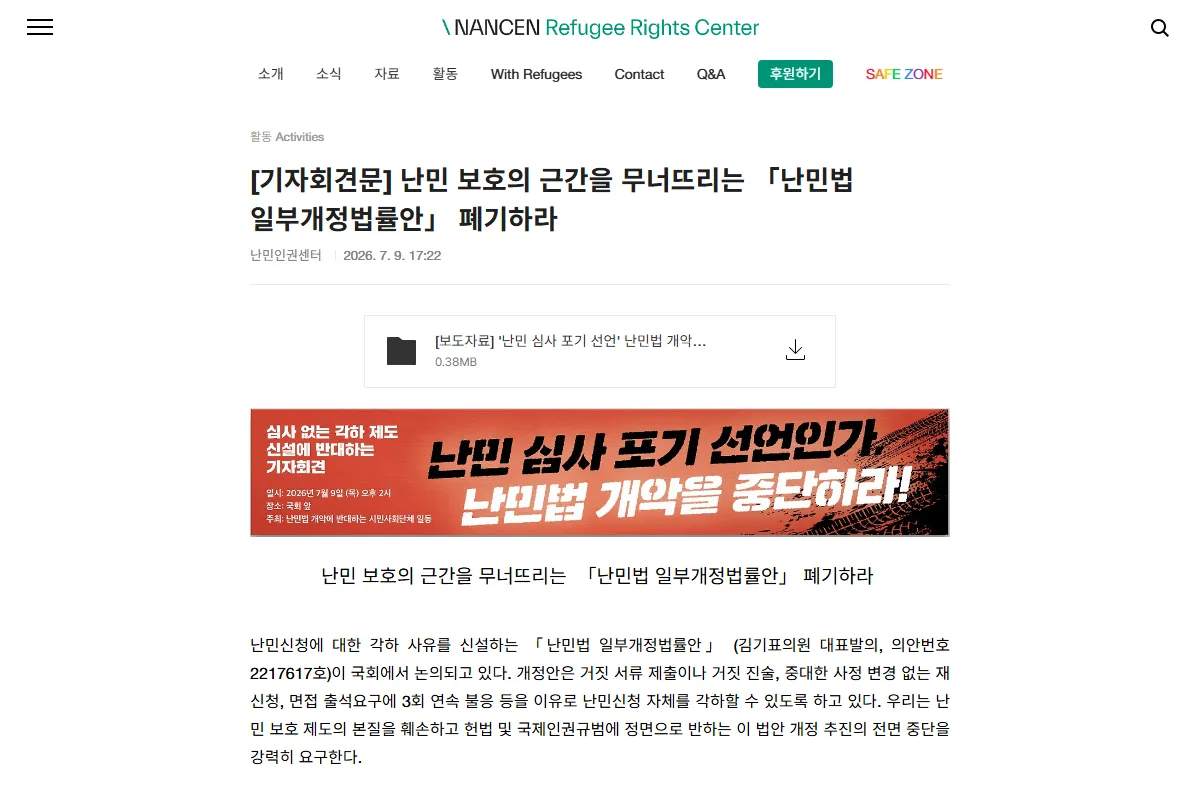
[Press release] ‘Declaration of Abandoning Refugee Screening’: Press Conference Urging Withdrawal of the Regressive Refugee Act Amendment (edited version).pdf
0.38MB
Scrap the “Partial Amendment Bill to the Refugee Act” That Undermines the Foundation of Refugee Protection
The “Partial Amendment Bill to the Refugee Act”, which creates new grounds for dismissing asylum applications (introduced by Representative Kim Ki-pyo, bill number 2217617), is under discussion in the National Assembly. The bill would allow the asylum application itself to be dismissed on grounds such as submission of false documents or false statements, reapplication without a significant change of circumstances, and failure to respond to a summons to an interview three times in a row. We strongly demand the complete halt of this push to amend the law, which undermines the essence of the refugee protection system and flatly contradicts the Constitution and international human rights norms.
Above all, this bill has a serious problem in that it deprives asylum seekers of the very opportunity to have their case examined on the merits. The bill allows the Minister of Justice to dismiss a refugee status application at his or her discretion, without any procedural safeguards. States parties to the Refugee Convention bear an obligation under international law to substantively examine whether a person who has applied for asylum is a refugee under the Convention. UNHCR has also made clear that no application, not even a “manifestly fraudulent” one, may be dismissed at the stage of receipt. International human rights bodies have repeatedly pointed out that Korea’s “airport port-of-entry referral screening system” already risks violating the principle of non-refoulement in this respect, and in March 2026 the UN Human Rights Committee found, in the case of a Congolese asylum seeker who had been detained for a long time in the transit zone of Incheon Airport, that the Korean government had violated its obligations under the International Covenant on Civil and Political Rights. In this way, the bill seeks to extend an exclusion method similar to the port-of-entry referral screening, whose problems have already been pointed out by the international community and whose unlawfulness has been confirmed, to the general refugee status determination procedure as a whole. This runs against international standards of refugee protection and is a regressive amendment that seriously lowers the level of protection of Korea’s refugee system.
First, the provision that makes “concealment of facts, such as submission of false documents” a ground for dismissal, that is, the provision to dismiss an application without even examining it because of the submission of false documents or the like, shows complete ignorance of the reality of refugees. Asylum seekers often obtain documents only with the help of third parties, so it is difficult for them to verify the authenticity of those documents themselves. Because of the nature of being a refugee, they also cannot ask the government of their home country for confirmation because of threats to their safety. In the end, even if refugees want to prove that they “did not conceal facts”, they are structurally unable to prove it at all. Moreover, this provision risks encouraging the gradual concretization of a statement over the course of the asylum process to be defined as “concealment of facts”. For example, many LGBTQ refugees cannot fully state their sexual orientation or gender identity at the initial application stage because of their long experience of hiding their identity and their fear of stigma. If revealing this for the first time in a later reapplication were also evaluated as a “false statement” or “concealment of facts”, the result could be that the most vulnerable asylum seekers, who need the most careful examination, are excluded before any examination on the merits. The bill tries to secure the legitimacy of the sanction by setting the requirement of “cases clearly established by a court judgment or the like”, but courts have no procedure for officially confirming whether a document or statement is genuine or fake. With a standard this vague, the provision ends up turning every asylum seeker into a target of potential suspicion and sanction. As a result, it will become harder for asylum seekers to submit documents or to disclose their own experiences.
Second, the provision that requires dismissal of a refugee status application solely for failure to respond to a summons to appear also has serious problems. Above all, there is no adequate system for confirming whether the summons was properly delivered to the applicant. Asylum seekers without a status of stay have no identification and find it difficult to activate a mobile phone, and it is also common for them not to live in housing where mail is reliably delivered. A bigger problem lies in the administrative limitation that, even if they faithfully report a change of address or contact details to the immigration authorities, that information is not automatically linked to the department in charge of refugee screening. Add frequent moves, unstable working conditions and language barriers, and it can easily happen that a summons is not noticed in time. Even so, the bill turns away from this reality, places the responsibility for non-appearance entirely on the applicant, and has applications dismissed based only on the number of times, without even a proviso that takes into account justifiable reasons such as illness or a family emergency. This is a violation of procedural rights.
Third, the dismissal provision that restricts reapplication is also a provision that ignores the reality of Korea’s refugee system and excessively infringes on the rights of applicants. The core problem of Korea’s refugee system is not repeat applications. The more fundamental problems are structural defects within the system, such as a chronic shortage of screening staff and lack of expertise, long delays in screening, insufficient access to information, interpretation, translation and legal assistance, and treatment policies that restrict stay and the right to survival. In fact, Korea’s refugee recognition rate is about 1 to 2 percent, the lowest among OECD countries. Because there is no procedural foundation to support the fairness of refugee screening, many asylum seekers are unable to sufficiently prove their experience of persecution and need for protection in the initial screening, and even after a denial they cannot access effective means of remedy. In the end, the increase in reapplications is to a large extent a result of this failure of the system. Even so, the government puts the frame of “abuse of asylum applications” on refugees, distorting the failure of the system into a problem of the individual morality of asylum seekers.
We must ask a fundamental question about this reality. Is it justifiable to require a person who was not sufficiently guaranteed basic procedural rights, such as interpretation and legal assistance, in the initial application process to also prove a “significant change of circumstances” as a requirement for later reapplication? What the screening authorities should check first is not whether there are new circumstances but whether the person received a fair examination with adequate procedural rights in the first place. The Ministry of Justice’s own statistics show that 91 people were recognized as refugees through reapplication and 222 people received humanitarian stay permits. This shows that reapplication functions not as a simple abuse of the system but as a real means of relief that corrects cases in which people were not sufficiently protected in the initial screening. The responsibility for failing to sufficiently prove the need for protection at the first application stage because of institutional limitations must not be placed on the individual applicant alone. Uniformly restricting even reapplication, while maintaining the already lowest refugee recognition rate in the world and with no measures for the structural limitations, will only result in excluding refugees who need protection and exposing them to the risk of refoulement.
What the government and the National Assembly should change is not the reapplication system but the structural limitations of refugee screening. The backlog and inefficiency of refugee status determination is not a problem that can be solved by restricting reapplication or expanding the grounds for dismissal. The system should be improved in the direction of strengthening the quality of examination on the merits and procedural rights, by increasing specialized screening staff, systematically guaranteeing interpretation and translation support, and providing adequate legal assistance from the initial stage. In addition, “positive fast-track screening”, which quickly grants status to applicants from conflict-affected countries or countries with a clear risk of persecution, should be pursued together, rather than a “negative fast-track screening” that quickly filters out some asylum seekers. Above all, the first thing to do is to correct the problems of arbitrary judgment and abuse of discretion revealed in existing practices such as the port-of-entry referral screening and the guidelines restricting the status of stay of reapplicants. The refugee system is a system to protect human life and safety, not administrative efficiency. What is needed now is not to increase the grounds for quickly excluding asylum applications, but to make clear the principle of guaranteeing substantive examination, strengthen procedural rights, and conduct the examination on the merits thoroughly and promptly. We therefore make the following demands of the National Assembly and the government.
One, immediately halt the push for the “Partial Amendment Bill to the Refugee Act”, which creates new grounds for dismissing asylum applications.
Two, stop the policy stance of imposing the stigma of “abuse” on asylum seekers while turning a blind eye to the structural problems of the refugee system.
Three, give priority to improving the arbitrary exercise of discretion in existing practices, such as the port-of-entry referral screening and the screening to restrict the status of stay of reapplicants.
Four, strengthen the procedural foundation of examination on the merits, including increasing specialized screening staff, making interpretation and translation support mandatory and guaranteeing legal assistance, and carry out “positive fast-track screening” for applicants from countries with a clear risk of persecution.
We express deep concern about this attempt at amendment, which shakes the foundation of refugee protection. The National Assembly must immediately halt this amendment discussion, which chills the right to apply for asylum, and the government must discard its policy stance of stigmatizing applicants while turning a blind eye to the structural problems of the refugee system. What international human rights norms require is not more exclusion but fair and thorough examination. We strongly urge that the refugee system be improved in the direction of guaranteeing the procedural rights of asylum seekers and realizing substantive protection.
All civil society organizations opposing the regressive amendment to the Refugee Act
가족구성권연구소, 광주민중의집, 광주전남이주노동자인권네트워크, 노무사사무소 별, 목포5•18부상자회, 목포아트시네마, 사단법인 목포민주화운동계승사업회, 성적권리와 재생산정의를 위한 센터 셰어SHARE, 연구공동체 ‘건강과대안’, 소수자난민인권네트워크, 시네마엠엠/정성우, 이주민과함께, 이주민센터 친구, 이행移行: 이주민 인권을 위한 행정사 모임, 인권교육온다, 장애여성공감, 차별금지법제정연대, 전남교육회의, 천주교인권위원회, 화성외국인보호소방문시민모임 마중, 건강권실현을위한보건의료단체연합(건강사회를위한약사회·건강사회를위한치과의사회·노동건강연대·인도주의실천의사협의회·참의료실현청년한의사회·행동하는간호사회), 난민인권네트워크(TFC(The First Contact for Refugee), 공익법센터 어필, 공익변호사와 함께하는 동행, 공익사단법인 정, 공익인권법재단 공감, 공익인권센터 드림(DREAM), 국제난민지원단체 피난처, 글로벌호프, 난민인권센터(NANCEN), 동두천난민공동체, 동두천가톨릭센터, 동작FM, 민주사회를 위한 변호사모임 국제연대위원회, 비영리단체 겨자풀, 사단법인 두루, 성가소비녀회 의정부관구 동두천 베타니아, 성가소비녀회 의정부관구 파주 베타니아, 수원글로벌드림센터, 순천이주민지원센터, 아시아의친구들, 아시아평화를향한이주MAP, 이주여성을위한문화경제공동체 에코팜므, 이주민지원공익센터 감동, 외국인이주노동자인권을위한모임, 의정부 EXODUS, 이주민센터 친구, 천주교제주교구이주사목센터 나오미, 재단법인 동천, 재단법인 화우공익재단, 제주평화인권연구소 왓, 참여연대, 파주EXODUS, 한국이주인권센터), 외국인이주·노동운동협의회(남양주시외국인복지센터, (사협)다문화너머서, 모두를위한이주인권문화센터, 부천이주노동복지센터, 순천이주민지원센터, 아산이주노동자센터, 아시아인권문화연대, 외국인이주노동자인권을위한모임, 원불교서울외국인센터, 의정부이주노동자센터, 이주민센터동행, 인천외국인노동자센터, 파주이주노동자센터샬롬의집, 포천나눔의집이주민지원센터, (사)한국이주민건강협회위프렌즈, (사)한국이주여성인권센터), 이주구금대응네트워크((사)한국알트루사 난민과함께살기, DLG 공익인권센터, 공익법단체 두루, 공익법센터 어필, 공익인권법재단 공감, 난민인권센터, 대한불교조계종 사회노동위원회, 소수자난민인권네트워크, 아시아평화를향한이주MAP, 울산이주민센터, 외국인·이주노동운동협의회, 이주노동자노동조합(MTU), 이주노동자인권·노동권 실현을 위한 대구경북지역연대회의, 이주노동자평등연대, 이주민지원공익센터 감사와 동행, 이주여성인권포럼, 천주교인권위원회, 트랜스보더링랩(Trans-boder-ing Lab), 화성외국인보호소방문시민모임 마중), 이주노동자평등연대(건강권 실현을 위한 보건의료단체연합(건강권 실현을 위한 행동하는 간호사회, 건강사회를 위한 약사회, 건강사회를 위한 치과의사회, 노동건강연대, 인도주의실천의사협의회, 참의료실현청년한의사회), 노동당, 노동사회과학연구소, 노동전선, 녹색당, 대한불교조계종사회노동위원회, 성공회용산-혜화나눔의집, 민변노동위원회, 사회진보연대, 이주노동자노동조합(MTU), (사)이주노동희망센터, 이주노동자운동후원회, 이주민센터친구, 인권운동네트워크 바람, 전국민주노동조합총연맹, 전국불안정노동철폐연대, 지구인의정류장, 천주교인권위원회, 필리핀공동체카사마코, 한국비정규노동센터)