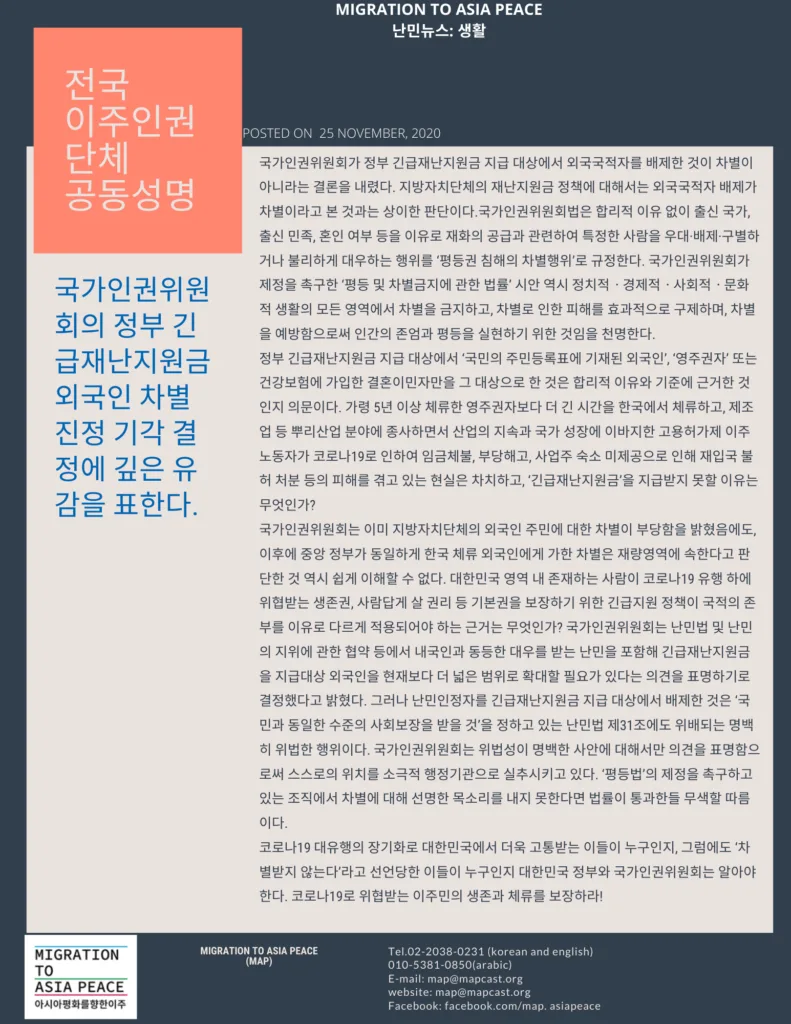
Joint Statement of Migrant Rights Organizations Nationwide
We Express Deep Regret at the National Human Rights Commission’s Decision to Dismiss the Complaint on Discrimination Against Foreigners in the Government Emergency Disaster Relief Payments.
The National Human Rights Commission of Korea (NHRCK) has concluded that excluding foreign nationals from the recipients of the government’s emergency disaster relief payments is not discrimination. This judgment differs from its earlier view that excluding foreign nationals from the disaster relief policies of local governments is discrimination.
The National Human Rights Commission of Korea Act defines as a “discriminatory act that violates the right to equality” any act that, without a reasonable ground, favors, excludes, distinguishes or disadvantages a specific person in the supply of goods on grounds such as country of origin, ethnic origin or marital status. The draft of the “Act on Equality and the Prohibition of Discrimination”, whose enactment the NHRCK has urged, also declares that its purpose is to prohibit discrimination in every area of political, economic, social and cultural life, to provide effective remedies for harm caused by discrimination, and to realize human dignity and equality by preventing discrimination.
It is doubtful whether limiting the recipients of the government’s emergency disaster relief payments to “foreigners entered in a citizen’s resident registration,” “permanent residents” and marriage migrants enrolled in health insurance rests on reasonable grounds and criteria. Setting aside the reality that migrant workers under the Employment Permit System (EPS) have stayed in Korea longer than permanent residents with five or more years of residence and work in core manufacturing industries, contributing to the continuity of those industries and to national growth, and that because of COVID-19 they are suffering harm such as unpaid wages, unfair dismissal, and refusals of re-entry because employers did not provide housing, what reason is there that they should not receive the “emergency disaster relief payment”?
The NHRCK had already found that discrimination by local governments against foreign residents was unjust. It is equally hard to understand why it then judged that the same discrimination imposed on foreigners staying in Korea by the central government falls within the area of discretion. What is the basis for applying an emergency support policy, which is meant to guarantee the basic rights of people within the territory of the Republic of Korea, such as the right to survival and the right to live with dignity that are threatened under the COVID-19 pandemic, differently depending on whether a person holds nationality?
The NHRCK stated that it had decided to express the opinion that the range of foreigners eligible for emergency disaster relief payments should be expanded beyond the present one, including refugees who receive treatment equal to that of nationals under the Refugee Act and the Convention relating to the Status of Refugees. However, excluding recognized refugees from the recipients of emergency disaster relief payments is a plainly unlawful act that also violates Article 31 of the Refugee Act, which provides that refugees “shall receive the same level of social security as nationals.” By expressing an opinion only on matters where the unlawfulness is obvious, the NHRCK is degrading its own position to that of a passive administrative agency. If an organization that urges the enactment of an “equality act” cannot speak clearly about discrimination, the law will mean nothing even if it passes.
The government of the Republic of Korea and the NHRCK must know who is suffering more in Korea as the COVID-19 pandemic drags on, and who are the people who have nonetheless been declared “not discriminated against.” Guarantee the survival and residence of migrants threatened by COVID-19!
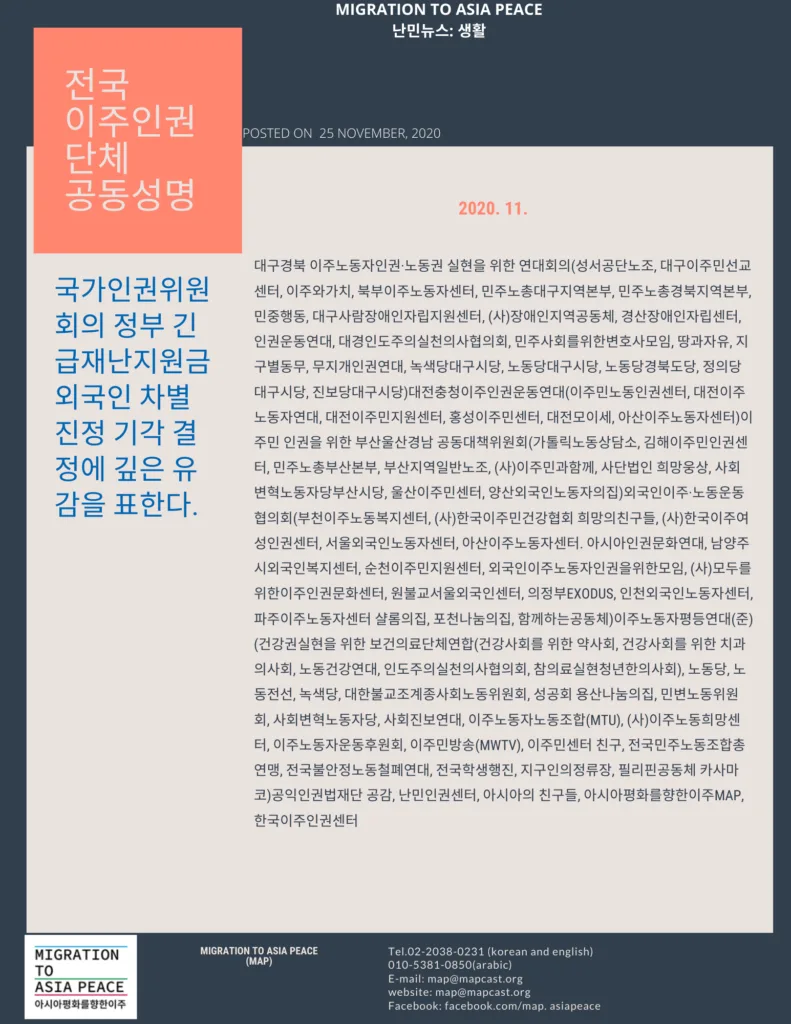
November 2020
Solidarity Council for the Realization of Human Rights and Labor Rights of Migrant Workers in Daegu and Gyeongbuk (성서공단노조, 대구이주민선교센터, 이주와가치, 북부이주노동자센터, 민주노총대구지역본부, 민주노총경북지역본부, 민중행동, 대구사람장애인자립지원센터, (사)장애인지역공동체, 경산장애인자립센터, 인권운동연대, 대경인도주의실천의사협의회, 민주사회를위한변호사모임, 땅과자유, 지구별동무, 무지개인권연대, 녹색당대구시당, 노동당대구시당, 노동당경북도당, 정의당대구시당, 진보당대구시당)
Daejeon-Chungcheong Migrant Human Rights Movement Solidarity (이주민노동인권센터, 대전이주노동자연대, 대전이주민지원센터, 홍성이주민센터, 대전모이세, 아산이주노동자센터)
Busan-Ulsan-Gyeongnam Joint Committee for Migrant Human Rights (가톨릭노동상담소, 김해이주민인권센터, 민주노총부산본부, 부산지역일반노조, (사)이주민과함께, 사단법인 희망웅상, 사회변혁노동자당부산시당, 울산이주민센터, 양산외국인노동자의집)
Council of Migration and Labor Movements for Foreigners (부천이주노동복지센터, (사)한국이주민건강협회 희망의친구들, (사)한국이주여성인권센터, 서울외국인노동자센터, 아산이주노동자센터. 아시아인권문화연대, 남양주시외국인복지센터, 순천이주민지원센터, 외국인이주노동자인권을위한모임, (사)모두를위한이주인권문화센터, 원불교서울외국인센터, 의정부EXODUS, 인천외국인노동자센터, 파주이주노동자센터 샬롬의집, 포천나눔의집, 함께하는공동체)
Migrant Workers Equality Solidarity (preparatory) (건강권실현을 위한 보건의료단체연합(건강사회를 위한 약사회, 건강사회를 위한 치과의사회, 노동건강연대, 인도주의실천의사협의회, 참의료실현청년한의사회), 노동당, 노동전선, 녹색당, 대한불교조계종사회노동위원회, 성공회 용산나눔의집, 민변노동위원회, 사회변혁노동자당, 사회진보연대, 이주노동자노동조합(MTU), (사)이주노동희망센터, 이주노동자운동후원회, 이주민방송(MWTV), 이주민센터 친구, 전국민주노동조합총연맹, 전국불안정노동철폐연대, 전국학생행진, 지구인의정류장, 필리핀공동체 카사마코)
공익인권법재단 공감, 난민인권센터, 두레방, 아시아의 친구들, 아시아평화를향한이주MAP, 한국이주인권센터