-
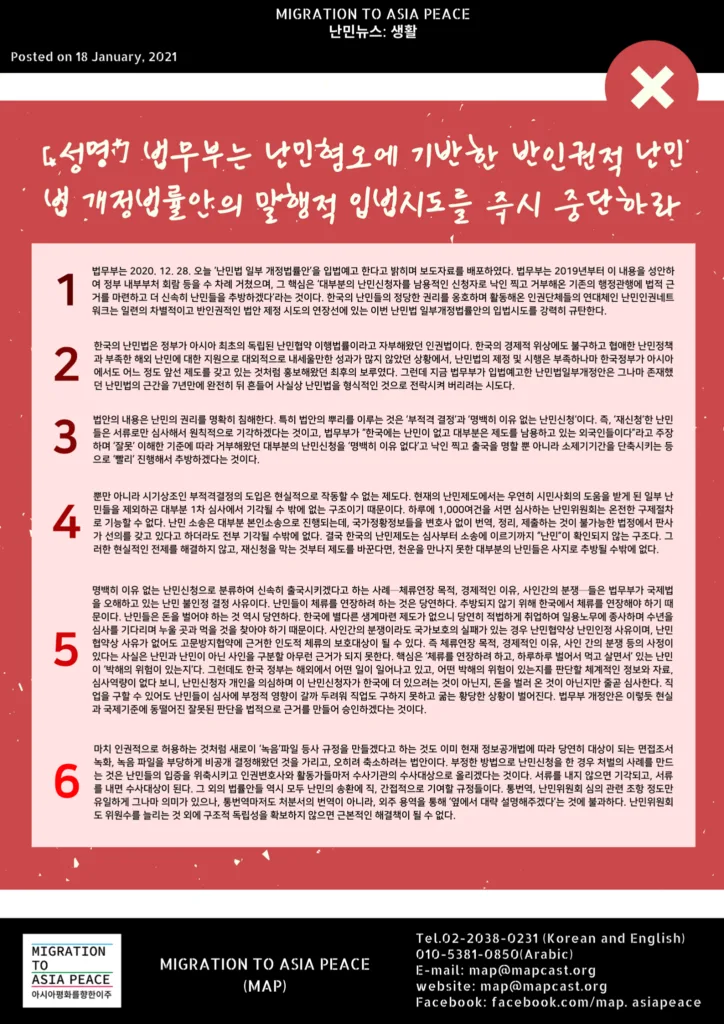
Today, December 28, 2020, the Ministry of Justice distributed a press release announcing the advance notice of legislation for a “Partial Amendment Bill to the Refugee Act.” The Ministry of Justice has drafted this content since 2019 and has circulated it among government ministries several times, and its core is to “provide a legal basis for the existing administrative practice of stigmatizing and rejecting most asylum seekers as abusive applicants, and to deport refugees more quickly.” The Korea Refugee Rights Network (난민인권네트워크), a coalition of human rights organizations working to defend the legitimate rights of refugees in Korea, strongly condemns this attempt to legislate a partial amendment bill to the Refugee Act, which is an extension of a series of discriminatory and anti-human-rights attempts at legislation.
-
Korea’s Refugee Act is a human rights law that the government has taken pride in as the first independent law in Asia implementing the Refugee Convention. At a time when Korea had few achievements to show externally, owing to its narrow refugee policy and insufficient support for refugees abroad despite its economic standing, the enactment and implementation of the Refugee Act was the last bastion by which the Korean government promoted itself as having a somewhat more advanced system than others in Asia, however inadequate. Now, the partial amendment to the Refugee Act that the Ministry of Justice has announced in advance is an attempt to completely shake the foundation of the Refugee Act, which had existed at least until now, after only seven years, and to reduce the Refugee Act in effect to a formality.
-
The content of the bill clearly violates the rights of refugees. At the root of the bill in particular are the “ineligibility decision” and the “manifestly unfounded refugee application.” That is, refugees who “reapply” would in principle be rejected after a review of documents alone, and most of the refugee applications that the Ministry of Justice has rejected according to criteria it has “mistakenly” understood, claiming that “there are no refugees in Korea and most are foreigners abusing the system,” would be stigmatized as “manifestly unfounded,” with departure ordered and the period for filing a lawsuit shortened, so that they can be processed “quickly” and deported.
-
Moreover, the introduction of an ineligibility decision, which is premature, is a system that cannot work in reality. This is because, under the current refugee system, apart from some refugees who happen to receive the help of civil society, most are bound to be rejected at the first examination. The Refugee Committee, which reviews about 1,000 cases a day on paper, cannot function as a full remedy procedure. Refugee lawsuits are mostly conducted by the applicants themselves, and in a court where it is impossible to translate, organize and submit country information without a lawyer, all of them are bound to be dismissed even if the judge acts in good faith. In the end, Korea’s refugee system is a structure in which “refugees” are not identified, from examination through litigation. If the system is changed by starting with blocking reapplications, without resolving this practical premise, most refugees who are not blessed with extraordinary luck will inevitably be deported to places of death.
-
The cases that the Ministry of Justice says it will classify as manifestly unfounded refugee applications and send out of the country quickly (the purpose of extending stay, economic reasons, disputes between private individuals) are grounds for non-recognition that rest on a misunderstanding of international law by the Ministry of Justice. It is natural for refugees to try to extend their stay, because they must extend their stay in Korea in order not to be deported. It is also natural for refugees to have to earn money. Because Korea has no particular system for securing a livelihood, they must find a place to lie down and food to eat by legally working at day labor while waiting for years for their examination. Even a dispute between private individuals is a ground for recognition under the Refugee Convention where there is a failure of state protection, and even without a ground under the Refugee Convention, a person may be a subject of protection through humanitarian stay under the Convention against Torture. In other words, the fact that there are circumstances such as the purpose of extending stay, economic reasons or disputes between private individuals gives no basis at all for distinguishing refugees from non-refugees. The key is whether a refugee who is “trying to extend their stay and living by earning day by day” is “at risk of persecution.” Yet the Korean government has no systematic information, data or examination capacity to judge what is happening abroad and what risks of persecution exist, so it keeps doubting individual asylum seekers, examining only whether they are trying to stay longer in Korea or whether they came to make money. Even when they could find a job, refugees fear it will have a negative effect on their examination, so they cannot find work and go hungry, an absurd situation. The Ministry of Justice amendment seeks to give legal grounds to, and approve, such mistaken judgments that are detached from reality and international standards.
-
The plan to newly create a provision on copying “audio recording” files, as if granting something permissible on human rights grounds, is also a bill that conceals the Ministry’s unjust non-disclosure decisions regarding the video and audio recordings of interview records, which are already naturally subject to disclosure under the current Official Information Disclosure Act, and rather seeks to narrow that access. Creating examples of punishment for applying for refugee status by improper means will chill refugees’ efforts to prove their cases and will make even human rights lawyers and activists targets of investigation by investigative agencies. If you do not submit documents, you are rejected; if you submit documents, you become a target of investigation. The other bills are likewise all provisions that directly or indirectly contribute to the return of refugees. Only the provisions on interpretation and translation and on the deliberations of the Refugee Committee have any meaning at all, but even the interpretation and translation is not a translation of the written decision but merely “someone beside you roughly explaining it” through an outsourced service. As for the Refugee Committee, unless its structural independence is secured in addition to an increase in the number of members, it cannot be a fundamental solution.
-
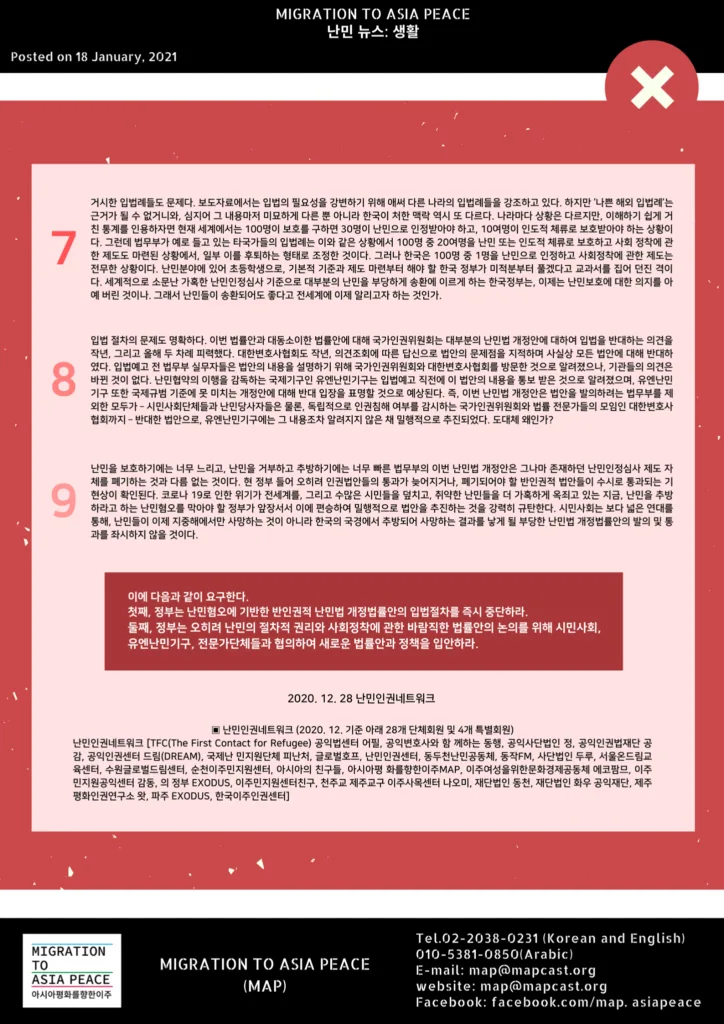
The legislative precedents cited are also a problem. The press release makes an effort to emphasize the legislative precedents of other countries in order to insist on the necessity of the legislation. But “bad foreign precedents” cannot serve as a basis, and even their content differs subtly, and the context Korea faces is also different. Although the situation differs from country to country, to cite rough statistics that are easy to understand, in the world today, of 100 people seeking protection, 30 should be recognized as refugees and about 10 should be protected through humanitarian stay. The legislative precedents of other countries that the Ministry of Justice cites are adjustments, in the form of partial rollbacks, made in a situation where about 20 of every 100 people are protected as refugees or through humanitarian stay and systems for social settlement are in place. Korea, however, recognizes 1 in 100 as a refugee and has no system for social settlement at all. It is as if the Korean government, which must first establish the basic standards and systems in the field of refugees, has thrown away the textbook and is trying to solve calculus. Has the Korean government, which unjustly returns most refugees under refugee recognition standards notorious around the world for their harshness, now abandoned its will to protect refugees altogether? Is it trying to announce to the whole world that it is fine for refugees to be returned?
-
The problem with the legislative procedure is also clear. The National Human Rights Commission of Korea expressed opposition to most of the Refugee Act amendment bills, which are nearly the same as this bill, twice, last year and this year. The Korean Bar Association also, last year, in its reply to a request for comments, pointed out the problems of the bills and in effect opposed all of them. Before the advance notice of legislation, Ministry of Justice officials are known to have visited the National Human Rights Commission and the Korean Bar Association to explain the content of the bill, but the positions of these institutions have not changed. UNHCR, the international organization that oversees the implementation of the Refugee Convention, is known to have been informed of the content of the bill only immediately before the advance notice of legislation, and UNHCR is also expected to express opposition to an amendment that falls short of international norms and standards. In other words, this Refugee Act amendment bill is one that everyone except the Ministry of Justice, which seeks to introduce it, opposes, from civil society organizations and the refugees themselves to the National Human Rights Commission, which independently monitors human rights violations, and the Korean Bar Association, a body of legal experts, and it has been pursued secretly, without even its content being made known to UNHCR. Why on earth?
-
The Ministry of Justice’s Refugee Act amendment, which is too slow to protect refugees and too fast to reject and deport them, is tantamount to abolishing the refugee status determination system itself, which at least existed until now. Under the current government, we confirm the strange phenomenon in which human rights bills are delayed or anti-human-rights bills that should be scrapped are passed time and again. At a time when the crisis caused by COVID-19 is hitting the world and countless citizens and is squeezing vulnerable refugees even harder, we strongly condemn the government, which should be blocking hatred of refugees that calls for refugees to be expelled, for instead taking the lead in riding on that hatred and secretly pushing the bill. Civil society, through broader solidarity, will not stand by while the unjust Refugee Act amendment bill is introduced and passed, a bill that will result in refugees dying not only in the Mediterranean but also after being deported from Korea’s borders.
We therefore make the following demands.
First, the government must immediately stop the legislative procedure for the anti-human-rights Refugee Act amendment bill, which is based on hatred of refugees.
Second, the government must instead consult with civil society, UNHCR and expert organizations to draft new bills and policies that are desirable for refugees’ procedural rights and social settlement.
December 28, 2020. Korea Refugee Rights Network (난민인권네트워크)
▣ Korea Refugee Rights Network (난민인권네트워크) (as of December 2020, the following 28 member organizations and 4 special members)
난민인권네트워크 [TFC(The First Contact for Refugee) 공익법센터 어필, 공익변호사와 함 께하는 동행, 공익사단법인 정, 공익인권법재단 공감, 공익인권센터 드림(DREAM), 국제난 민지원단체 피난처, 글로벌호프, 난민인권센터, 동두천난민공동체, 동작FM, 사단법인 두루, 서울온드림교육센터, 수원글로벌드림센터, 순천이주민지원센터, 아시아의 친구들, 아시아평 화를향한이주MAP, 이주여성을위한문화경제공동체 에코팜므, 이주민지원공익센터 감동, 의 정부 EXODUS, 이주민지원센터친구, 천주교 제주교구 이주사목센터 나오미, 재단법인 동천, 재단법인 화우 공익재단, 제주평화인권연구소 왓, 파주 EXODUS, 한국이주인권센터]