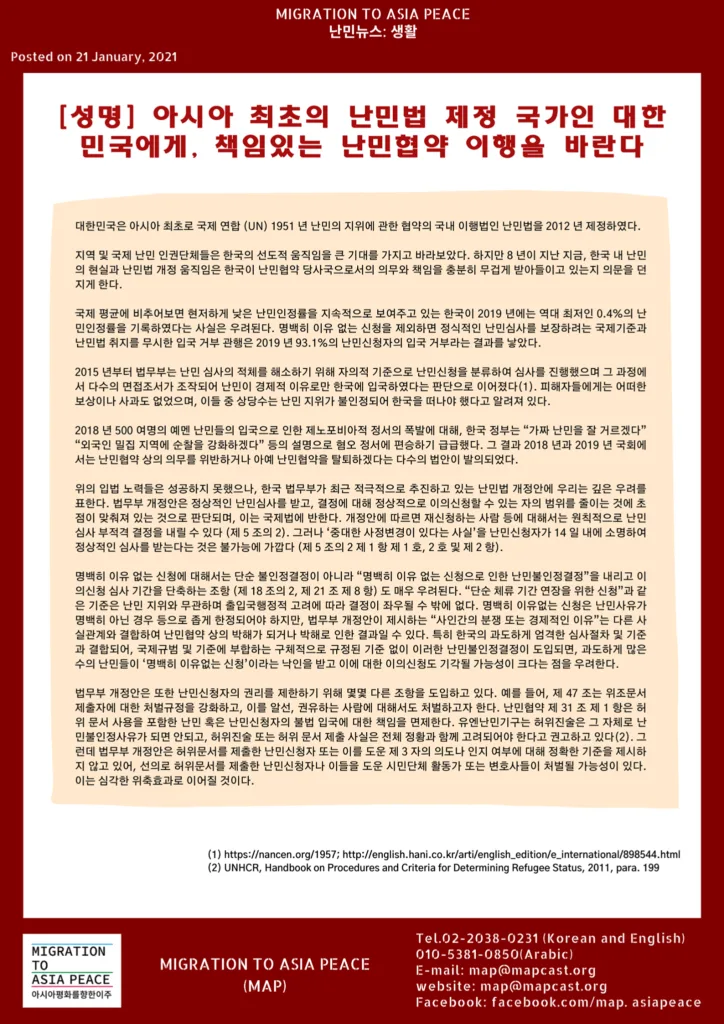
[Statement of the Asia Pacific Refugee Rights Network] We Call on the Republic of Korea, the First Country in Asia to Enact a Refugee Act, to Implement the Refugee Convention Responsibly.
In 2012, the Republic of Korea became the first country in Asia to enact the Refugee Act, the domestic implementing law of the 1951 United Nations (UN) Convention relating to the Status of Refugees.
Regional and international refugee rights organizations watched Korea’s pioneering move with great expectations. Eight years later, however, the reality of refugees in Korea and the moves to amend the Refugee Act raise the question of whether Korea takes its obligations and responsibilities as a State party to the Refugee Convention seriously enough.
It is worrying that Korea, which has continued to show a refugee recognition rate markedly low by international standards, recorded the lowest recognition rate ever, 0.4%, in 2019. Excluding manifestly unfounded applications, the practice of refusing entry, which ignores the international standards and the purpose of the Refugee Act that seek to guarantee formal refugee status determination, resulted in 93.1% of asylum seekers being refused entry in 2019.
From 2015, in order to clear the backlog of refugee status determination, the Ministry of Justice classified refugee applications by arbitrary criteria and processed them accordingly, and in that process many interview records were manipulated, leading to the judgment that refugees had entered Korea only for economic reasons.1 The victims received no compensation or apology, and it is known that many of them were not recognized as refugees and had to leave Korea.
In response to the explosion of xenophobic sentiment caused by the arrival of about 500 Yemeni refugees in 2018, the Korean government was quick to ride on the sentiment of hatred, with explanations such as “we will filter out fake refugees well” and “we will strengthen patrols in areas with many foreigners.” As a result, in 2018 and 2019 numerous bills were introduced in the National Assembly that would violate the obligations under the Refugee Convention or even withdraw from the Refugee Convention altogether.
These legislative efforts did not succeed, but we express deep concern about the amendment to the Refugee Act that the Korean Ministry of Justice has recently been actively pursuing. We judge that the Ministry of Justice amendment focuses on reducing the range of people who can receive a regular refugee status determination and regularly file an objection to the decision, which is contrary to international law. Under the amendment, a decision of ineligibility for refugee status determination can in principle be made against people such as those who reapply (Article 5-2). However, it is nearly impossible for an asylum seeker to explain “the fact that there has been a significant change in circumstances” within 14 days and receive a regular examination (Article 5-2, paragraph 1, items 1 and 2, and paragraph 2).
We are also deeply concerned about the provisions (Article 18-2 and Article 21, paragraph 8) that, for manifestly unfounded applications, would make a “decision of non-recognition of refugee status due to a manifestly unfounded application,” rather than a simple non-recognition decision, and shorten the period for examining objections. Criteria such as “an application merely for extending the period of stay” are unrelated to refugee status and can only be decided according to immigration administration considerations. Manifestly unfounded applications should be narrowly limited to cases where the grounds for refugee status are clearly absent, but the “disputes between private individuals or economic reasons” presented in the Ministry of Justice amendment can, combined with other facts, amount to persecution under the Refugee Convention or be a consequence of persecution. In particular, combined with Korea’s excessively strict examination procedures and standards, if such a non-recognition decision is introduced without concretely defined criteria that conform to international norms and standards, we are concerned that an excessive number of refugees will be stigmatized as having a “manifestly unfounded application” and that their objections are likely to be dismissed as well.
The Ministry of Justice amendment also introduces several other provisions to restrict the rights of asylum seekers. For example, Article 47 strengthens the penalties for submitting forged documents and also seeks to punish those who arrange or encourage this. Article 31, paragraph 1 of the Refugee Convention exempts refugees or asylum seekers from liability for illegal entry, including the use of false documents. The UN Refugee Agency (UNHCR) recommends that a false statement should not in itself be a ground for non-recognition of refugee status, and that the fact of a false statement or the submission of false documents should be considered together with the whole of the circumstances.2 However, the Ministry of Justice amendment does not provide precise criteria on the intent or knowledge of asylum seekers who submit false documents or of third parties who help them, so asylum seekers who submit false documents in good faith, and civil society activists or lawyers who help them, may be punished. This will lead to a serious chilling effect.
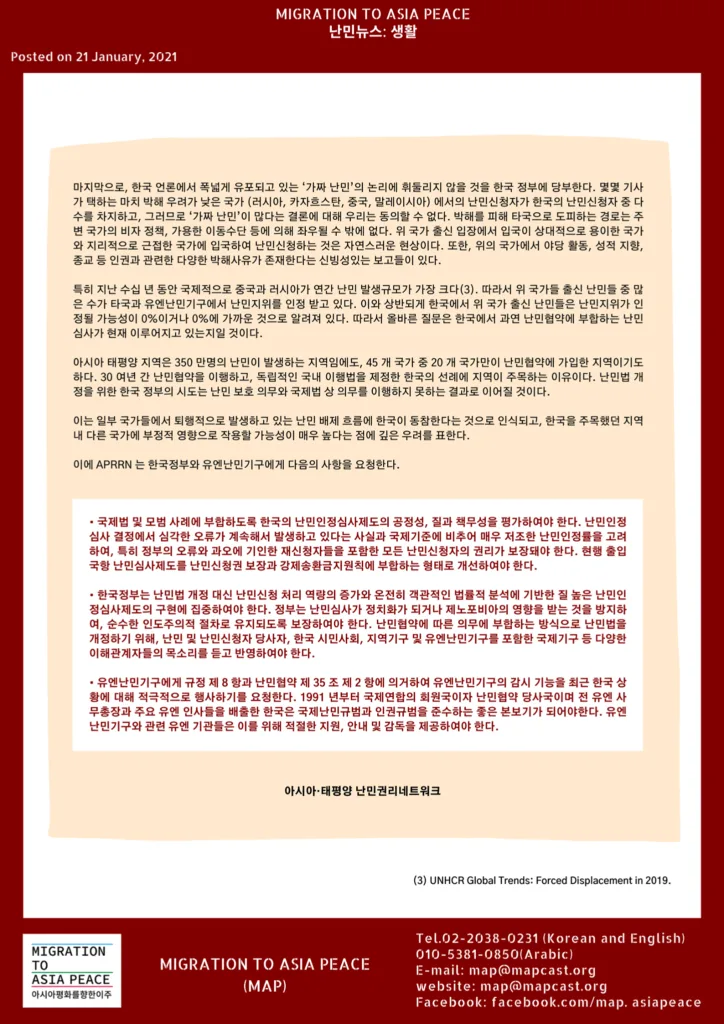
Finally, we urge the Korean government not to be swayed by the logic of “fake refugees” that is widely circulated in the Korean media. We cannot agree with the conclusion drawn by some articles that asylum seekers from countries with a supposedly low risk of persecution (Russia, Kazakhstan, China, Malaysia) make up the majority of Korea’s asylum seekers and that there are therefore many “fake refugees.” The routes by which people flee persecution to other countries are inevitably determined by the visa policies of neighboring countries, available means of transport, and so on. For people from these countries, it is natural to enter and apply for asylum in a country that is relatively easy to enter and geographically close. In addition, there are credible reports that there are various grounds for persecution related to human rights in these countries, such as opposition political activity, sexual orientation and religion.
In particular, over the past several decades, China and Russia have been the countries producing the largest numbers of refugees annually in the world. Accordingly, many refugees from these countries are recognized as refugees by other countries and by UNHCR. In contrast, refugees from these countries in Korea are known to have a 0% or close to 0% chance of being recognized as refugees. The right question, therefore, would be whether refugee status determination in conformity with the Refugee Convention is actually being carried out in Korea at present.
The Asia Pacific region produces 3.5 million refugees, yet it is also a region where only 20 of 45 countries have acceded to the Refugee Convention. This is why the region is watching the precedent of Korea, which has implemented the Refugee Convention for over 30 years and enacted an independent domestic implementing law. The Korean government’s attempt to amend the Refugee Act will result in a failure to fulfill its obligations to protect refugees and its obligations under international law.
We are deeply concerned that this would be perceived as Korea joining the regressive trend of excluding refugees occurring in some countries, and that it is highly likely to have a negative effect on other countries in the region that have been watching Korea. Accordingly, APRRN requests the following of the Korean government and UNHCR.
• The fairness, quality and accountability of Korea’s refugee status determination system should be assessed in line with international law and good practice. In view of the fact that serious errors in refugee status determination decisions continue to occur and that the refugee recognition rate is very low by international standards, the rights of all asylum seekers, including reapplicants whose reapplications are due to errors and mistakes of the government, must be guaranteed. The current refugee status determination system at immigration offices must be improved into a form that conforms to the right to apply for asylum and the principle of non-refoulement.
• Instead of amending the Refugee Act, the Korean government should focus on increasing its capacity to process asylum applications and implementing a high-quality refugee status determination system based on fully objective legal analysis. The government should ensure that refugee status determination does not become politicized or influenced by xenophobia and remains a purely humanitarian procedure. In order to amend the Refugee Act in a way that conforms to its obligations under the Refugee Convention, it must listen to and reflect the voices of diverse stakeholders, including refugees and asylum seekers themselves, Korean civil society, regional organizations, and international organizations including UNHCR.
• We request that UNHCR actively exercise its supervisory function under paragraph 8 of its Statute and Article 35, paragraph 2 of the Refugee Convention with regard to the recent situation in Korea. Korea, which has been a member of the United Nations since 1991, a State party to the Refugee Convention, and the home of a former UN Secretary-General and other prominent UN figures, should be a good example of compliance with international refugee norms and human rights norms. UNHCR and the relevant UN agencies should provide appropriate support, guidance and oversight for this purpose.
English version.