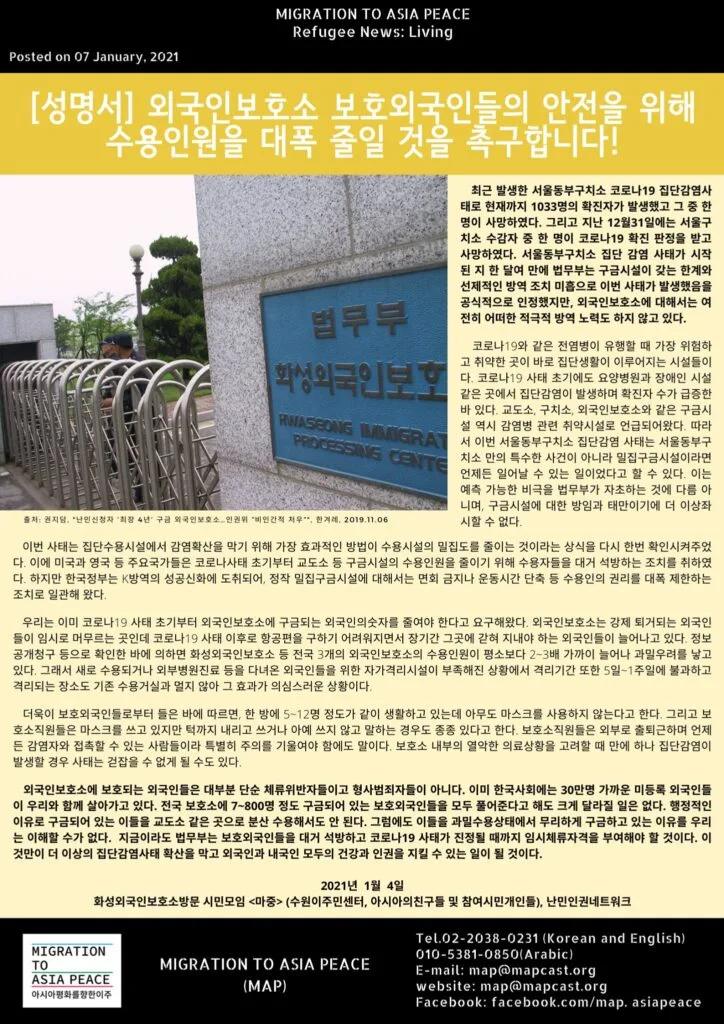
The recent mass COVID-19 infection at Seoul Eastern Detention Center has so far produced 1,033 confirmed cases, one of whom died. And on December 31, one inmate of Seoul Detention Center tested positive for COVID-19 and died. About a month after the mass infection at Seoul Eastern Detention Center began, the Ministry of Justice officially acknowledged that the incident occurred because of the limits of detention facilities and insufficient preemptive quarantine measures, but it is still making no active effort at disease control for immigration detention centers.
When an infectious disease such as COVID-19 is spreading, the most dangerous and vulnerable places are facilities where people live in groups. In the early days of the COVID-19 crisis, too, mass infections occurred in places such as nursing hospitals and facilities for people with disabilities, and the number of confirmed cases rose sharply. Detention facilities such as prisons, detention centers and immigration detention centers have also been cited as facilities vulnerable to infectious disease. Therefore, the mass infection at Seoul Eastern Detention Center was not an event unique to Seoul Eastern Detention Center, but something that could happen at any time in any overcrowded detention facility. This is nothing other than the Ministry of Justice bringing a predictable tragedy upon itself, and because it is neglect and negligence toward detention facilities, we can no longer stand by.
This incident once again confirmed the common-sense point that the most effective way to prevent the spread of infection in congregate facilities is to reduce their density. Accordingly, major countries such as the United States and the United Kingdom took measures from the early days of the COVID-19 crisis to release large numbers of inmates in order to reduce the population of detention facilities such as prisons. But the Korean government, intoxicated by the success myth of “K-quarantine,” has consistently responded to overcrowded detention facilities only with measures that drastically restrict the rights of inmates, such as banning visits and shortening exercise time.
From the early days of the COVID-19 crisis, we have already demanded that the number of foreigners detained in immigration detention centers be reduced. Immigration detention centers are places where foreigners subject to deportation stay temporarily, but since COVID-19 it has become hard to obtain flights, and the number of foreigners who are confined there for long periods is increasing. According to what we have confirmed through information disclosure requests and other means, the populations of the three immigration detention centers nationwide, including Hwaseong Immigration Detention Center, have grown to nearly two to three times the usual level, raising concerns about overcrowding. As a result, there is a shortage of self-isolation facilities for foreigners who are newly admitted or who return from visits to outside hospitals, the isolation period is only 5 days to a week, and the isolation location is not far from the existing living rooms, so its effectiveness is doubtful.
Moreover, according to what we have heard from detained foreigners, 5 to 12 people live together in one room and no one uses a mask. And we are told that detention center staff wear masks but often pull them down to the chin or speak without wearing them at all. Detention center staff commute from outside and can come into contact with infected people at any time, so they should take particular care. Considering the poor medical conditions inside the detention centers, if a mass infection occurs, even by a slim chance, the situation could spin out of control.
Most of the foreigners held in immigration detention centers are people who have merely violated residence rules and are not criminal offenders. Already close to 300,000 undocumented foreigners live with us in Korean society. Even if all of the detained foreigners, who number about 700 to 800 in detention centers nationwide, were released, it would not change things much. Those who are detained for administrative reasons must also not be dispersed to places such as prisons. Even so, we cannot understand the reason why they are being forcibly detained in overcrowded conditions. Even now, the Ministry of Justice should release detained foreigners in large numbers and grant them temporary residence status until the COVID-19 crisis subsides. This is the only way to prevent further spread of mass infection and to protect the health and human rights of both foreigners and citizens.
January 4, 2021
Citizens’ Group Visiting Hwaseong Immigration Detention Center
(Suwon Migrant Center, Friends of Asia, and individual participating citizens)
– Signatory organizations below –
공익법센터 어필, 국제이주문화연구소, 난민인권센터, 난민×현장, 두레방, 번역공동체 ‘잇다’, (사)이주민센터 친구, 성공회용산나눔의집, 성미산학교, 성적권리와 재생산정의를 위한 센터 셰어(SHARE), 수요평화모임, 아시아의창, 열린군대를위한시민연대, 외국인노동운동협의회, 외국인이주노동자인권을위한모임, 이주민과함께, 이주민센터 동행, 이주민지원공익센터 감동, 이주와인권연구소, 정만천하–이주여성협회, 평화페미니즘 연구소(FIPS), 피스모모, 한국이주여성인권센터, 한베평화재단