
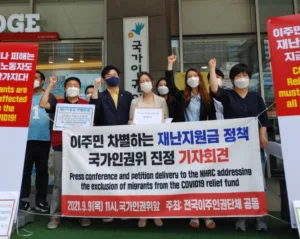
On September 9, migrant rights organizations from across the country, including the Korea Refugee Rights Network, held a joint press conference in front of the National Human Rights Commission of Korea and submitted a petition to the Commission regarding the government’s disaster relief payment policy that discriminates against migrants and refugees.
The respondents are the heads of the ministries in charge of the “Whole-of-Government Task Force for the COVID-19 Recovery National Support Payment”: the Minister of Economy and Finance, the Minister of the Interior and Safety, and the Minister of Health and Welfare. Seven migrants, including migrant workers, ethnic Korean Chinese, international students and family members of Humanitarian Stay Permit holders, took part as petitioners, and most of them are health insurance subscribers. The petitioners consider that the Korean government’s disaster relief payment policy violates human rights and principles such as human dignity and worth and the right to pursue happiness (Article 10 of the Constitution), the right to a life worthy of human beings (Article 34 of the Constitution) and the principle of non-discrimination under international human rights law.
If a person’s human rights guaranteed by the provisions of Articles 10 to 22 of the Constitution of the Republic of Korea have been violated, or the person has been subjected to discrimination, by a state organ, the person may file a petition with the National Human Rights Commission. After a petition is filed, an investigator in charge is assigned and conducts the investigation. If a human rights violation or discriminatory act is recognized, the Commission recommends that the respondent take remedial measures or correct or improve the relevant laws, systems, policies and practices. Handling a case usually takes three months.
——————————————————————————————-
The petition submitted this time names households with children and refugees as cases requiring special guarantees of the right to equality. Below is the part concerning refugees and Humanitarian Stay Permit holders.
In its “Statement of Opinion on Improving Discrimination Against Foreigners in the Payment of Government Emergency Disaster Relief Payments” of November 9, 2020, your Commission expressed to the Minister of the Interior and Safety the opinion that “when promoting the emergency disaster relief payment project in the COVID-19 disaster situation, refugees who receive equal treatment with Korean nationals under the Refugee Act and the UN Convention relating to the Status of Refugees should be included, and the scope of foreigners eligible for payment should be expanded in consideration of the period of stay, contribution to the country and society, and so on.”
Article 30 of the Refugee Act provides that recognized refugees staying in the Republic of Korea receive treatment under the Refugee Convention notwithstanding other laws. Article 23 of the “Convention relating to the Status of Refugees” provides that the Contracting States shall accord to refugees lawfully staying in their territory the same treatment as is accorded to their nationals with respect to public relief and assistance.
The detailed implementation plan for the payment in this case excludes from eligibility all persons who have been recognized as refugees or are under examination to be recognized, such as recognized refugees, Humanitarian Stay Permit holders and refugee applicants. Among the petitioners, none has been recognized as a refugee, but we ask your Commission to take into account, in judging the payment policy in this case, that the existing recommendation of your Commission is not being accepted.
On June 10, 2021, your Commission also recommended that the Minister of Justice, in order to improve the human rights of Humanitarian Stay Permit holders staying in Korea, amend the relevant laws so that the status and treatment of Humanitarian Stay Permit holders conform to the purpose of complementary protection under international norms, and amend the relevant guidelines and so on so that the treatment of Humanitarian Stay Permit holders improves even before the laws are amended (Decision of June 10, 2021, No. 21 Jeongchaek 0018). Just as that recommendation recognized the need for complementary protection of Humanitarian Stay Permit holders and confirmed, in light of decisions and guidelines of UNHCR and the European Union and various overseas cases, that we should move toward guaranteeing those under complementary protection a stable stay status and treatment as close as possible to those of refugees, the payment in this case, too, should be made not only to recognized refugees but also to Humanitarian Stay Permit holders who fall under complementary protection, as support for the economic hardship caused by the prolonged COVID-19 pandemic.