Q1. Please give a brief self-introduction and share your motivation for applying to MAP!
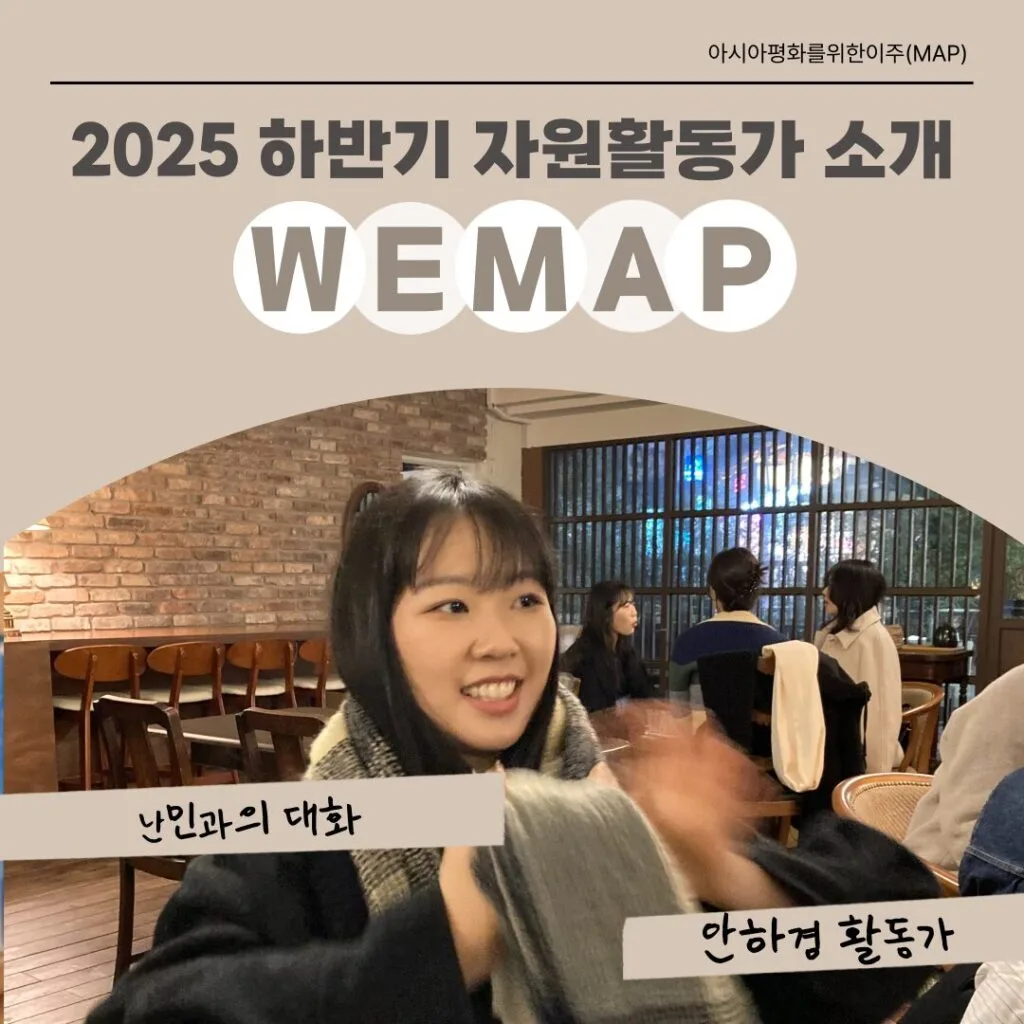
Hello! I am Ahn Ha-gyeong, a volunteer at Migration to Asia Peace. Since July this year I have worked as a coordinator of “Dialogue with Refugees,” running the program so that refugees’ stories can reach more people. My main job is as a graduate student; I began my studies with the wish to record the stories of diverse migrants, and I am still continuing on that path. When I learned about the “Dialogue with Refugees” program, I truly shouted “Eureka!” I applied right away, thinking that I could actually build together a program I had only vaguely imagined on my own.
Q2. What specifically do you do on your current team?
I am in charge of various tasks related to the “Dialogue with Refugees” program, including event planning, running events, interpretation, preparing and submitting various documents, and publicity. In particular, I spend the most time inviting refugee speakers from across the country and coordinating schedules. The character of the program differs depending on the audience, so I think a lot about whom to invite and what kind of “dialogue” would be best. It is also important to exchange fully with the refugee speakers and get to know one another, so at times we chat and have a good time together. Recently I was able to share many conversations with the speakers while discussing the direction of the program.
Q3. What has been the most memorable moment for you so far?
I attended the Global Citizen Peace Camp right after I started. This year it was held in Jeonju and Jinan, and I can confidently say it was the highlight of 2025. It was not only a precious time with refugees; through the “Peace Declaration Workshop” held especially this year, I was also able to think deeply about what to do in order to actively protect peace. I was also reminded again how important it is to listen to and stand in solidarity with the stories of refugees who have directly experienced war, persecution, and the climate crisis. I also remember how everyone made an effort to overcome the language barrier, Mazoon’s swimming skills that put a seal to shame, and the Kabuli Palau (an Afghan dish) we ate while chatting late into the night.
Q4. What do you think our society needs most in order to live together with refugees?
Communication and dialogue come to mind first, but I think patience is even more important. To build a society in which everyone, whatever their background, can live together, a mindset of trying to understand one another and trying to focus fully on the other person is important. And that mindset is completed by patience. What I learned at the Peace Camp is not to be afraid of clashing. Even though conflict is bound to arise when different people talk, I learned how important it is to keep trying to communicate with the other person. In particular, it seems that there is a lot we assume about refugees and then pass over, so I hope there will be more opportunities and time to meet them directly, talk, ask questions, clash, and debate.
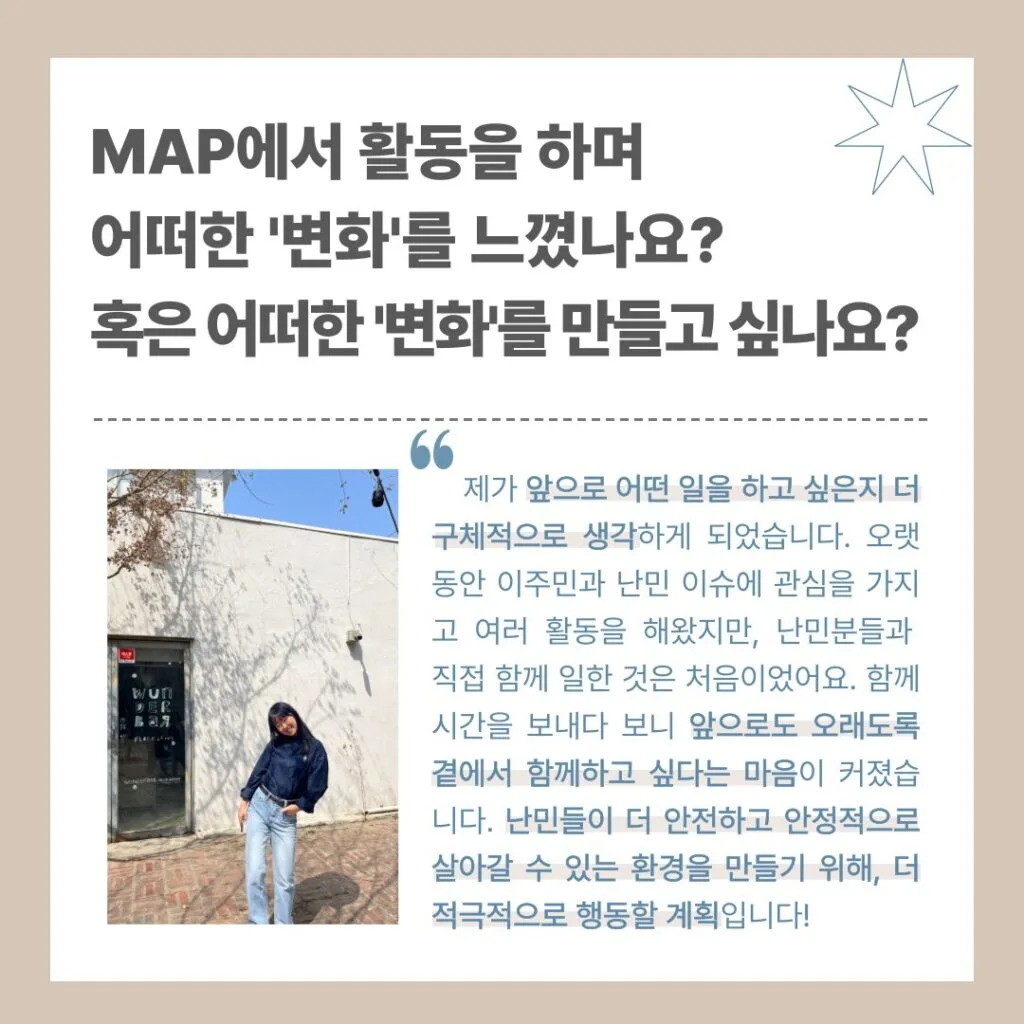
Q5. What ‘change’ have you felt while being active at MAP? Or what ‘change’ would you like to make?
I came to think more concretely about what I want to do in the future. I have long been interested in migrant and refugee issues and have been involved in various activities, but this was the first time I worked directly alongside refugees. As we spent time together, my wish to stay by their side for a long time grew. To create an environment in which refugees can live more safely and stably, I plan to act more actively!
Q6. How do you think MAP should approach people who find the refugee issue difficult?
This is also what I am thinking about most these days with the “Dialogue with Refugees” speakers. The refugee issue can feel difficult, and it is easy to think it has nothing to do with oneself. In Korea in particular, refugees often appear only as a “statistic” amid a complicated international situation. In that context, some people even feel burdened by the attempt to understand refugees, and there are many cases in which people want to understand but have no suitable way to approach. So our conclusion was that MAP should reach out to the world in more diverse ways. This also means that we should expand our language and our spaces so that more people can naturally reach refugees’ stories. I hope that someday MAP will move into TikTok as well 😀