Q1. Please give a brief self-introduction and tell us why you applied to MAP.
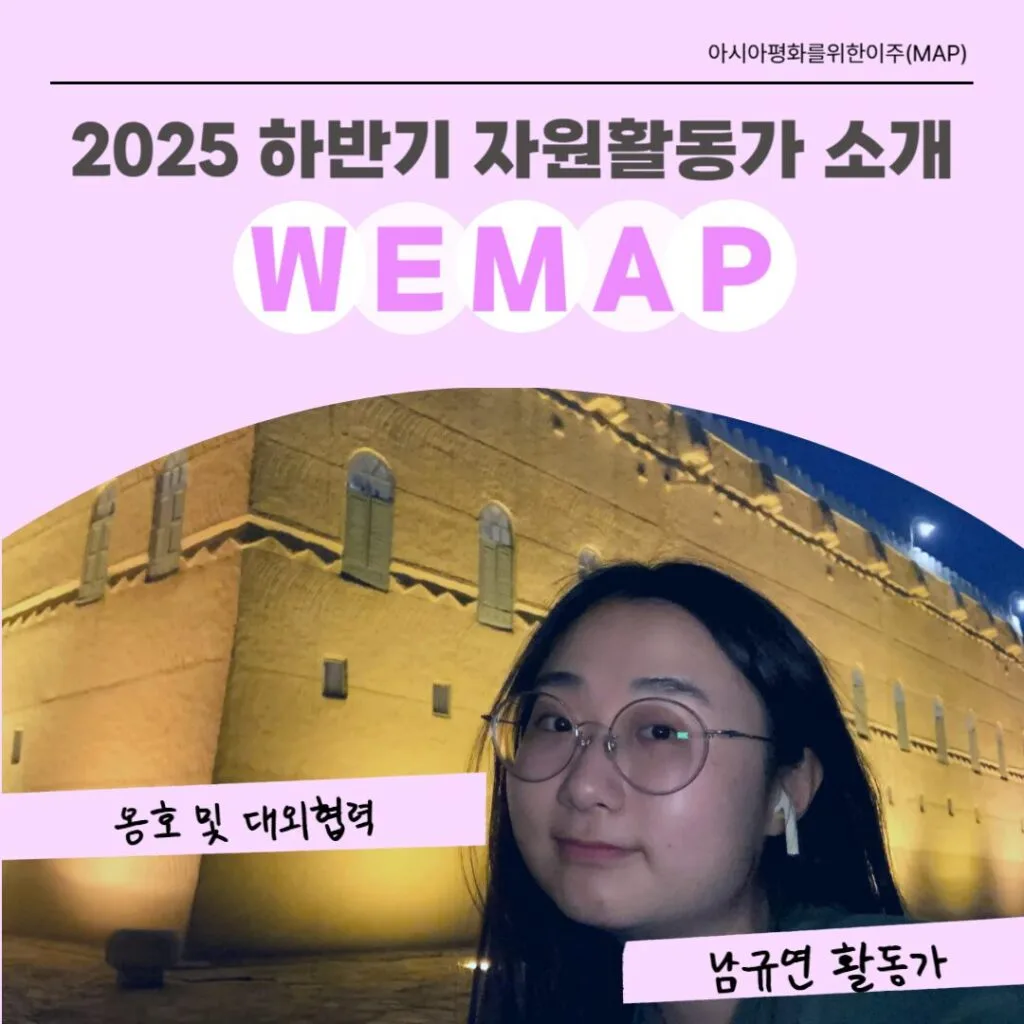
Hello! I am Nam Gyu-yeon, a volunteer on the AP Team! Since high school, I have been interested in the causes of negative perceptions of refugees, the Middle East, and Islam, and in ways to resolve them. To understand this more deeply, I studied Arabic and political science and diplomacy. However, as I looked at society, I felt a gap between ideals and reality, and I began to wonder what kind of life I should live. Then, on a short-term training program in Saudi Arabia that I joined by chance, I saw the lives of migrant workers with my own eyes and became interested in “migration.” While taking related undergraduate courses, I became convinced that migration was the path I truly wanted to learn about, because it is so closely connected to reality. Later, in “Dialogue with Refugees,” given as a special lecture in one of my classes, I sympathized with MAP’s value of being together with refugees and wanted to join as a volunteer, so I applied.
Q2. What exactly do you do on your current team?
I think the AP Team acts as a “bridge” that connects MAP with society by introducing the many activities MAP carries out to people!
Every week, the volunteers on the AP Team gather and talk about 1) what materials we need to make, 2) how to convey MAP’s story effectively, and 3) how we can better connect MAP with the world. Then we gather the results of the meeting and the news that needs to be shared each week, and we produce and distribute promotional materials about them! Our biggest question is “How can MAP come closer to people?” So it would give us great strength if many of you reading this would come to hear MAP’s story! Please keep paying attention to the stories of MAP that we will share from now on, and please support us 🙂
Q3. What has been the most memorable moment for you so far in your activities?
In fact, I joined through the additional recruitment at the end of August, so I have somewhat less volunteer experience than the other volunteers. For that reason, rather than taking part directly in the moments when MAP connects with the world, I have mainly been in the office, preparing the process of connecting MAP’s news with the world. Still, the time after I started volunteering, when I learned the work of the AP Team one piece at a time, was meaningful because I could gain real-world experience in the field of migration, and I think the moments of talking with the other volunteers during our activities are the most precious moments for me right now. Everyone has their own background and values, but through MAP’s activities they all dream of the goal of advancing refugee rights, and I am simply grateful because there is so much to learn from them.
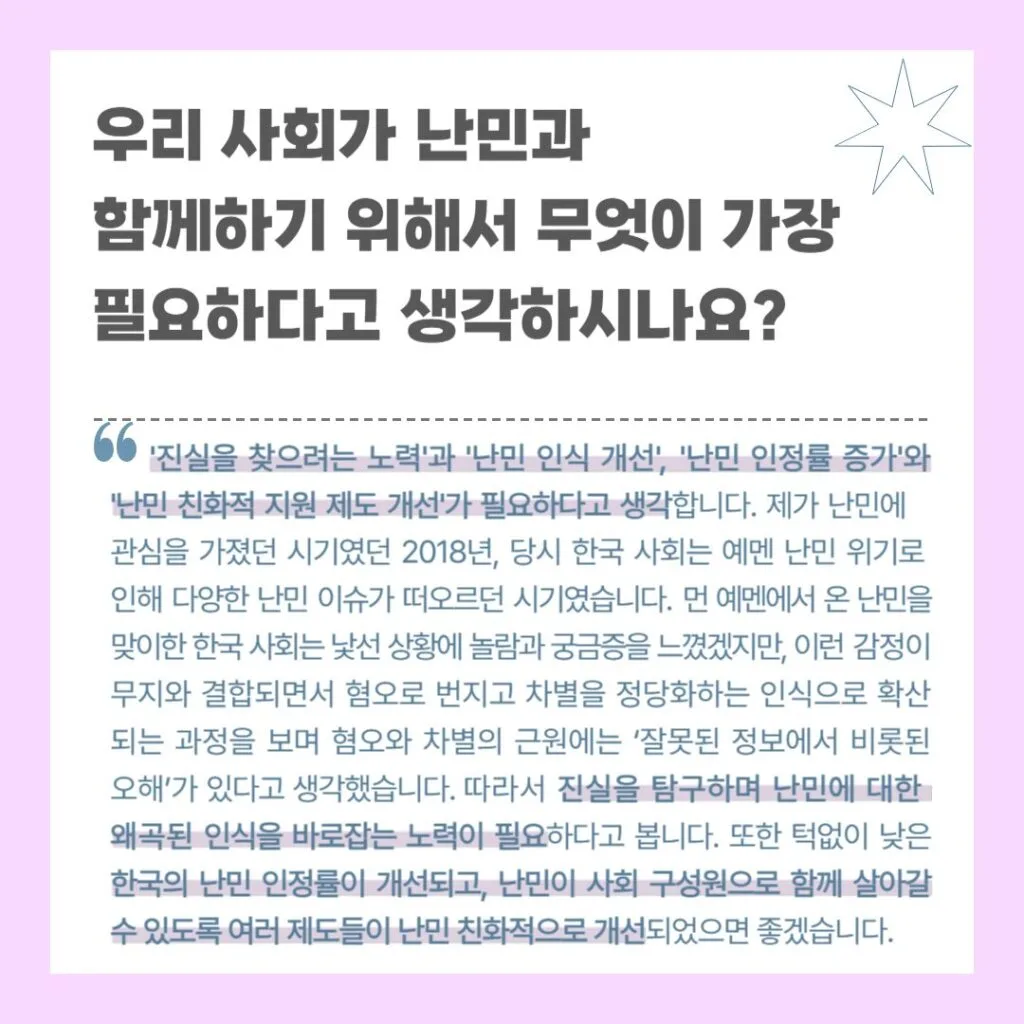
Q4. What do you think our society needs most in order to live together with refugees?
I think we need “efforts to seek the truth,” “better public awareness of refugees,” “a higher refugee recognition rate,” and “improvement of refugee-friendly support systems.” In 2018, when I first became interested in refugees, Korean society was seeing various refugee issues arise because of the Yemeni refugee crisis. Korean society, receiving refugees who had come from far-off Yemen, must have felt surprise and curiosity at the unfamiliar situation, but I watched how these feelings, combined with ignorance, spread into hatred and into attitudes that justify discrimination, and I came to think that at the root of hatred and discrimination lies “misunderstanding that comes from wrong information.” Therefore, I believe efforts are needed to seek the truth and correct distorted perceptions of refugees. I also hope that Korea’s far too low refugee recognition rate improves, and that various systems are improved to be refugee-friendly so that refugees can live together with us as members of society.
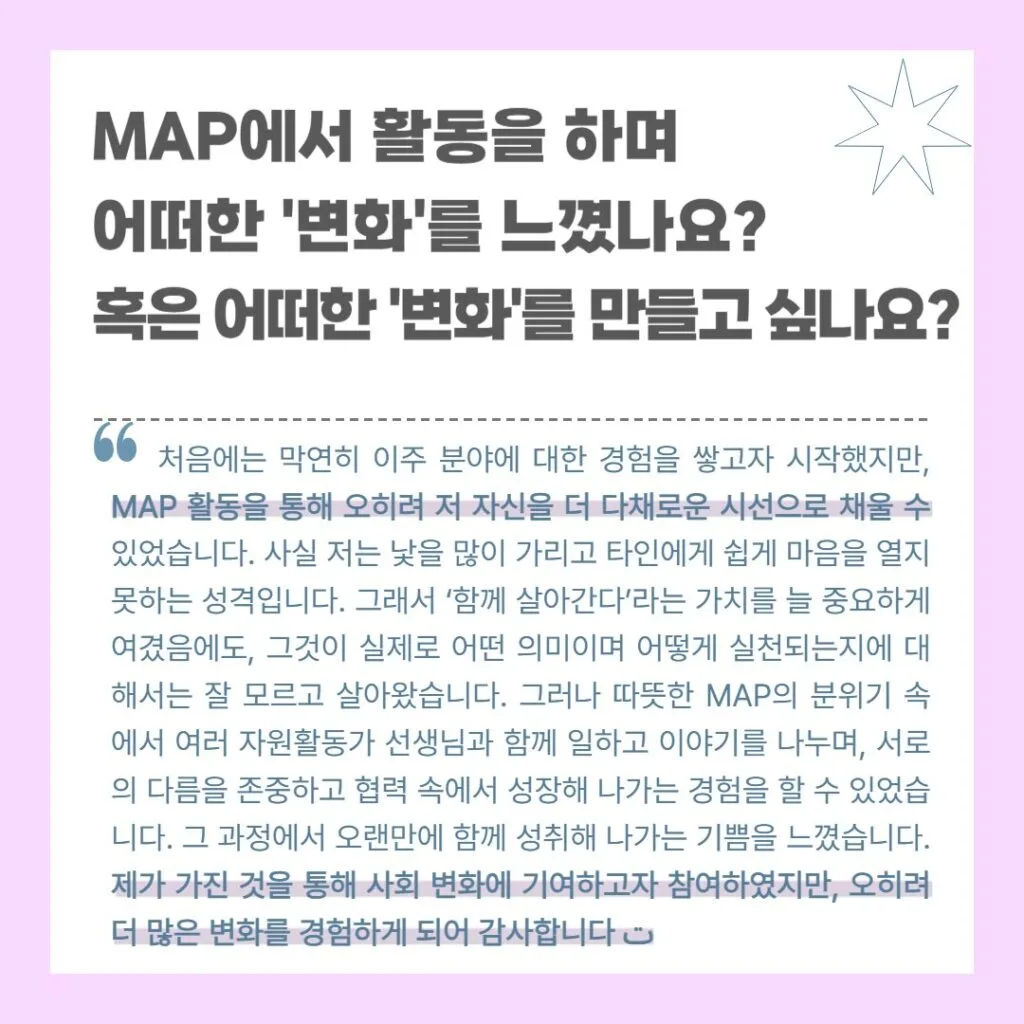
Q5. What “change” have you felt while volunteering at MAP? Or what “change” do you want to make?
At first, I simply started in order to gain experience in the field of migration, but through MAP’s activities I was able to fill myself with a far more varied perspective. In fact, I am a very shy person and do not open my heart to others easily. So even though I had always considered the value of “living together” important, I did not really know what it actually meant or how it is practiced. However, in MAP’s warm atmosphere, by working and talking with many volunteers, I was able to experience respecting one another’s differences and growing through cooperation. In the process, I felt the joy of achieving something together for the first time in a long while. I joined in order to contribute to social change with what I have, but I am grateful that I experienced even more change myself ت
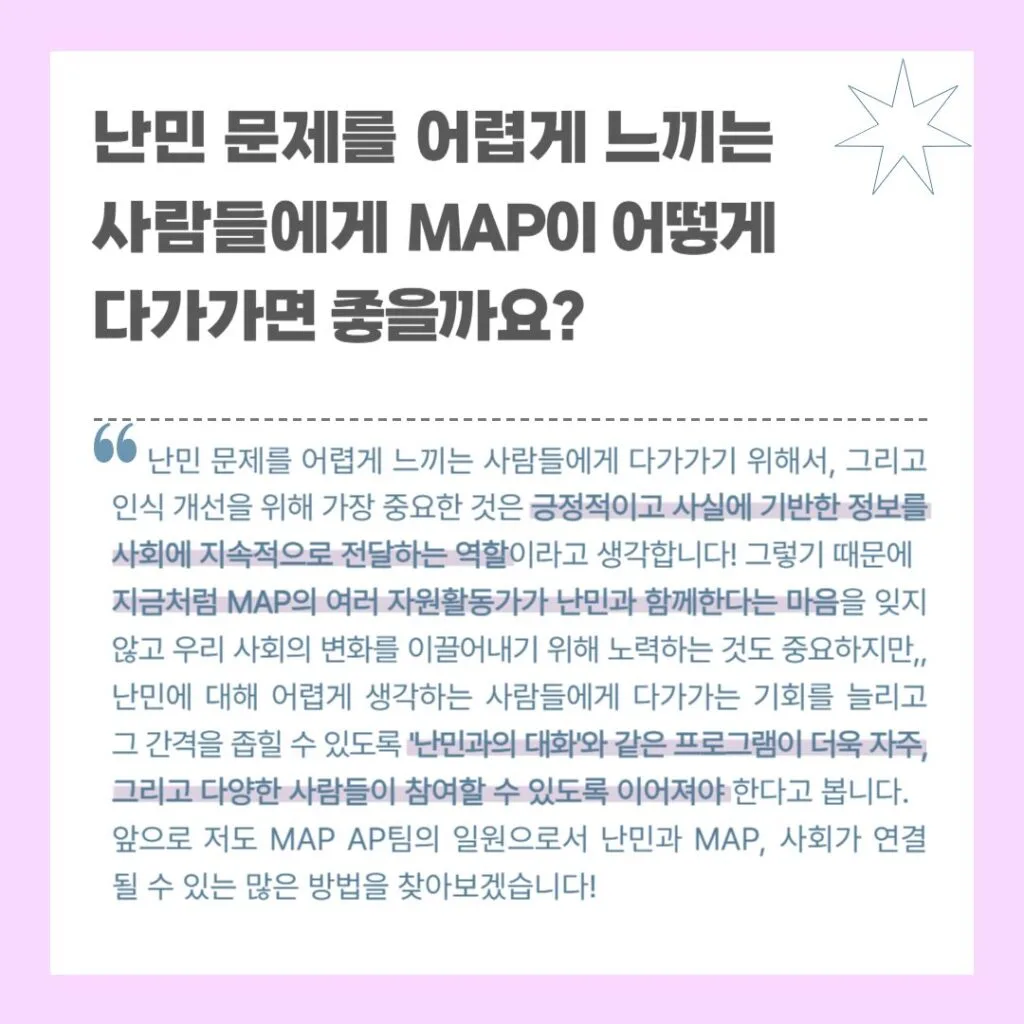
Q6. How should MAP approach people who find the refugee issue difficult?
I think the most important thing, in order to reach people who find the refugee issue difficult and to improve public awareness, is the role of continuously delivering positive, fact-based information to society! So it is important that MAP’s many volunteers, as they do now, do not forget the mindset of being together with refugees and keep working to bring about change in our society, but I also believe that programs such as “Dialogue with Refugees” should continue more often and with a wider variety of participants, so that there are more opportunities to reach people who find refugees a difficult subject and to narrow that gap.
From now on, as a member of MAP’s AP Team, I will also look for many ways to connect refugees, MAP, and society!