Q1. Please give a brief self-introduction and share your motivation for applying to MAP!
Hello. I am Baek Seung-hye, a second-half 2025 volunteer at Migration to Asia Peace. I am on the Refugee News (RN) Team, which posts news about Korean current affairs and living information for refugees. I was looking for an experience other than studying, and I found a school-linked volunteer activity; among the options I applied to be active at the refugee organization, which felt the most unfamiliar to me. I wanted to learn in more detail about refugees’ own stories, rather than the stereotyped image of refugees created by society and the media.
Q2. What specifically do you do on your current team?
I belong to the Refugee News Team and produce news for an audience of refugees living in Korea. Through channels such as the official MAP website, Facebook, and WhatsApp, we deliver a wide range of content and news, including living and health news that helps refugees in their lives in Korea, policy news related to refugees, RISE news on scholarships and internships, and statements demanding the protection of refugees’ rights. We also sometimes produce as Refugee News the items that other teams ask us to publicize. At present I am also handling publicity for the Korea Refugee Forum.
Q3. What has been the most memorable moment for you so far?
The most memorable moment was when I uploaded the news that the Gyeonggi Provincial Assembly had enacted, for the first time in Korea, three ordinances guaranteeing the human rights of migrants and refugees. It received the best response of all the news I have posted so far, and seeing people in the comments happy and offering congratulations, I felt joy and a sense of reward myself.
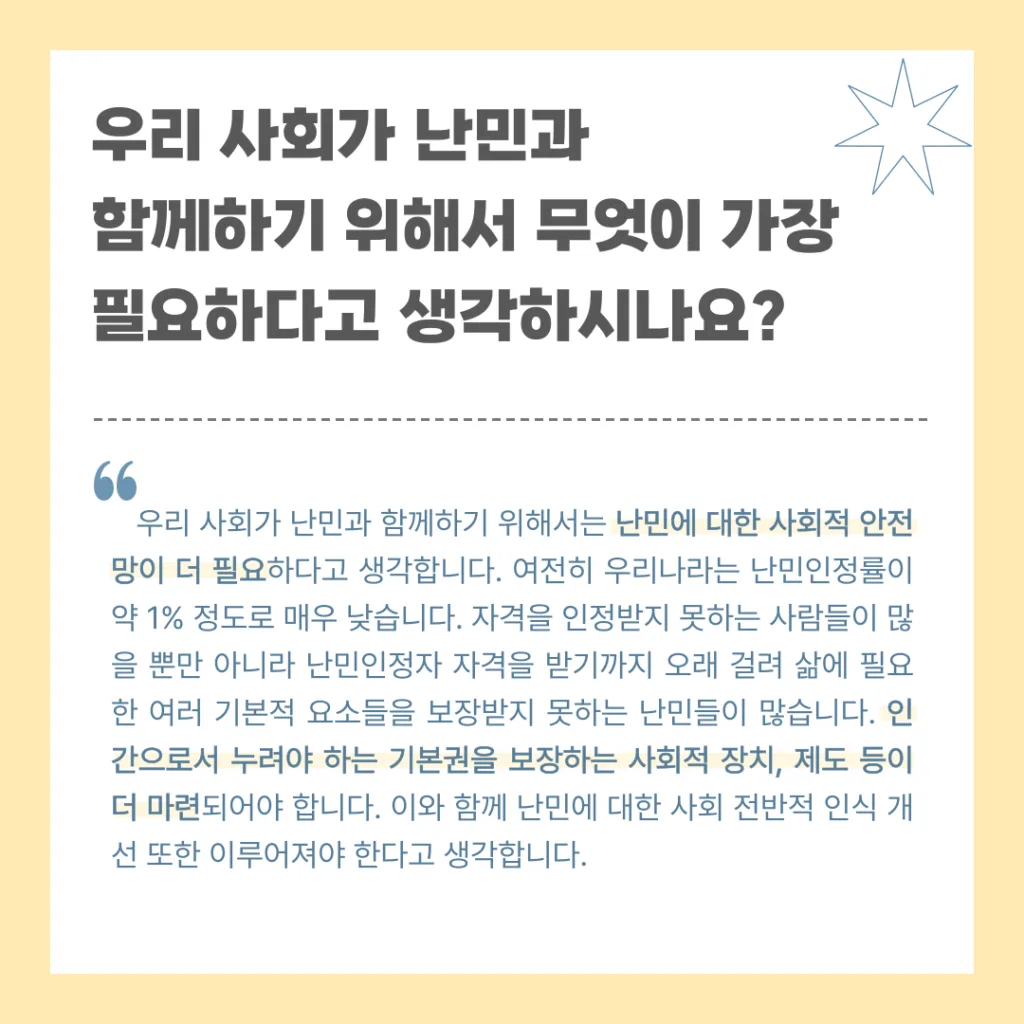
Q4. What do you think our society needs most in order to live together with refugees?
I think that, for our society to live together with refugees, a stronger social safety net for refugees is needed. Korea’s refugee recognition rate is still very low, at about 1%. Not only are there many people who are not recognized, but it also takes a long time to obtain refugee status, so many refugees are not guaranteed the basic elements they need for life. More social mechanisms and systems that guarantee the basic rights every human being should enjoy must be put in place. Together with this, I think the general perception of refugees across society must also improve.
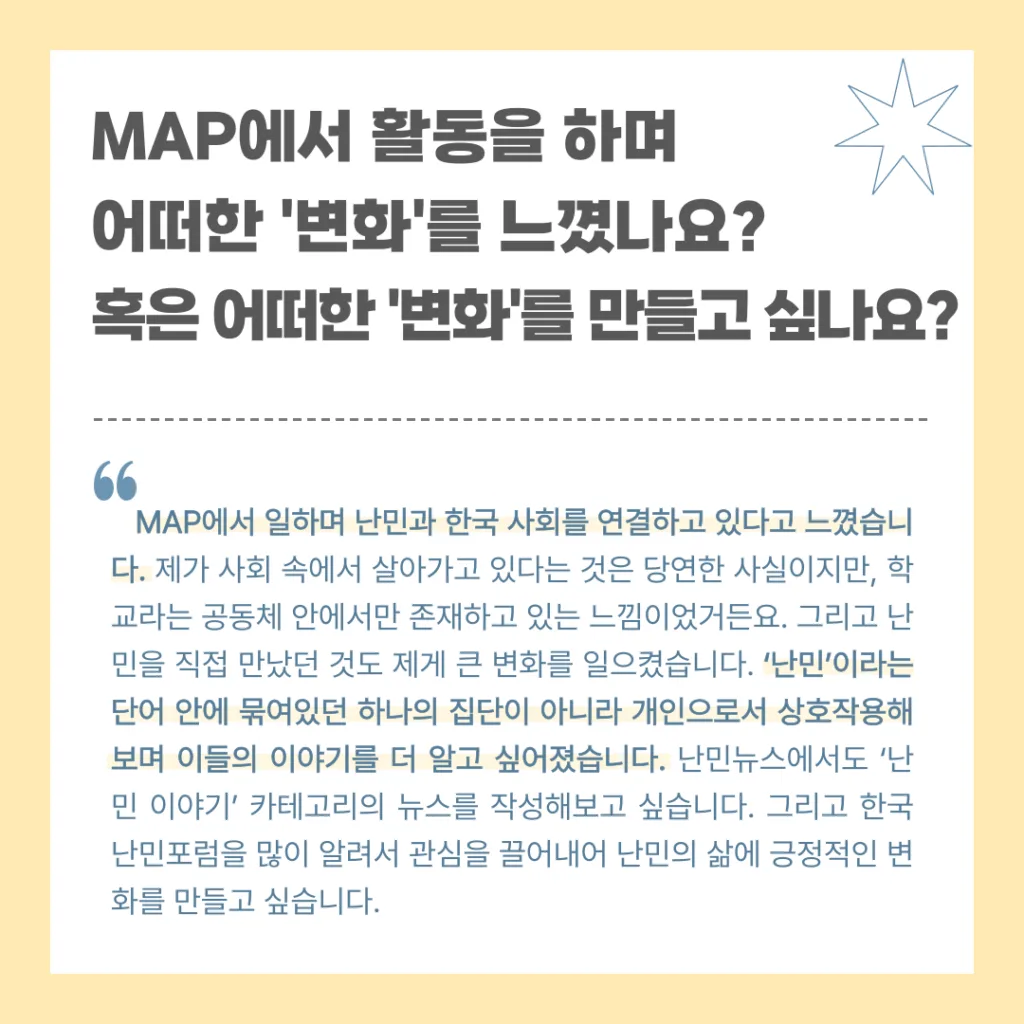
Q5. What ‘change’ have you felt while being active at MAP? Or what ‘change’ would you like to make?
Working at MAP, I felt that I was connecting refugees and Korean society. It is obvious that I live in society, but I felt as though I existed only within the community of school. Meeting refugees in person also brought a great change in me. Interacting with them as individuals, rather than as a single group bound together in the word “refugee,” made me want to know more of their stories. I would also like to write news in the “Refugee Stories” category of Refugee News. And I want to make the Korea Refugee Forum widely known and draw attention to it, so as to bring about a positive change in refugees’ lives.
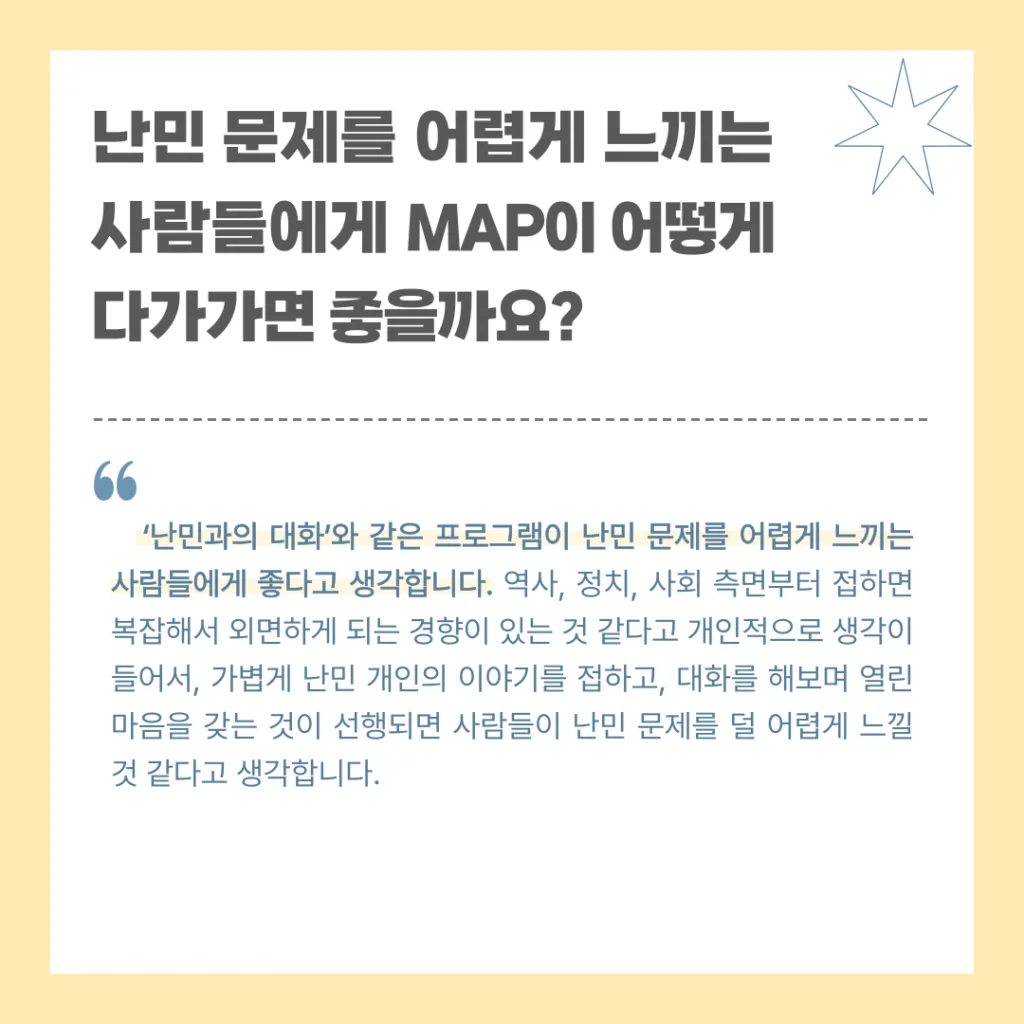
Q6. How do you think MAP should approach people who find the refugee issue difficult?
I think programs like “Dialogue with Refugees” are good for people who find the refugee issue difficult. Personally, I feel that when people first encounter the issue from the angles of history, politics, and society, it is complicated and they tend to turn away, so I think that if they first casually hear an individual refugee’s story, talk with them, and keep an open mind, people would find the refugee issue less difficult.