Q1. Please give a brief self-introduction and share your motivation for applying to MAP!
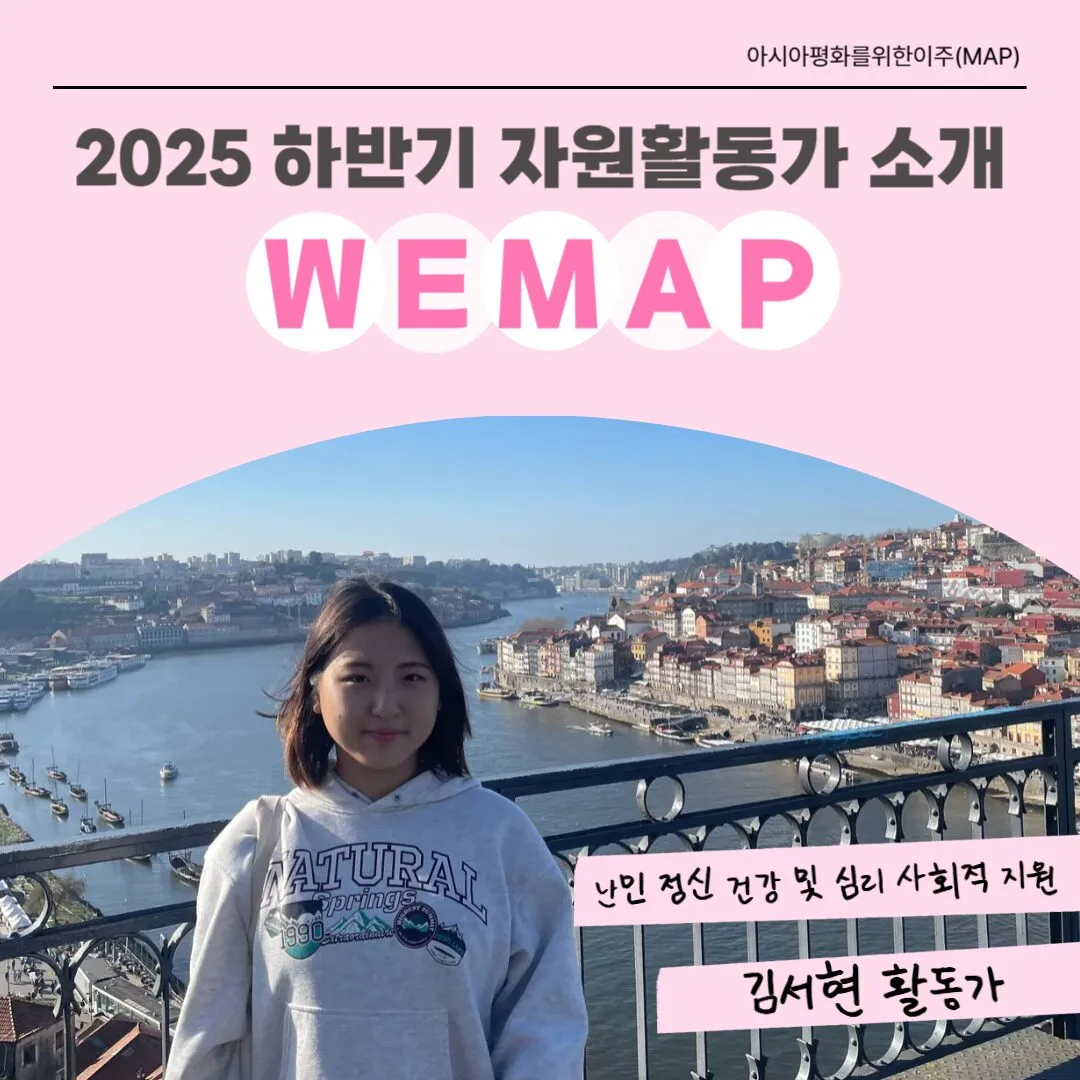
Hello, I am Kim Seo-hyeon, a volunteer on the MHPSS Team! Last semester I took a course called
Q2. What specifically do you do on your current team?
On the MHPSS Team I welcome refugees who come to receive mental and physical health support, and I connect and provide the supplies and medical services they need. For those who newly apply for support, I check their basic information and conduct an interview about what kind of help they need. For refugees who are already receiving support, I regularly order essential food, help with hospital appointments, or accompany them to the hospital to guide and interpret. Sometimes I eat together with refugees who visit MAP or go with them to buy the things they need. Recently I also took part in preparing “MIND RUN,” a running festival for mental health promotion hosted by KBS in which MAP participates.
Q3. What has been the most memorable moment for you so far?
The experience I remember most is going to the hospital with a refugee who needed health support, and in particular accompanying them to a health screening center and helping them receive a regular health checkup. The culture of getting regular checkups seemed unfamiliar and burdensome to them, so persuading them was difficult, but I felt truly relieved to see them finish the whole process safely. What I felt most strongly through this series of activities was that it is harder than I expected for refugees to use medical services. Beyond the language barrier, some medical staff keep their distance because of a lack of understanding of “refugee” status, so I felt sad thinking that it would not be easy for them to go for treatment alone.
Q4. What do you think our society needs most in order to live together with refugees?
I think improving awareness is the most urgent need. There is still a tendency to know little about refugees and to regard all refugees as illegal residents. In particular, because Korea has a low refugee recognition rate and public perception of refugees is not good, I think a change in attitude at the national level must come first, in keeping with the age of globalization. Also, many people misunderstand refugees as “pitiful, poor, and uneducated,” but in reality they are people who hold beliefs and opinions and who have overcome hardships in their home countries and chosen a new life. It is sad that such people cannot find stable jobs because of negative perceptions in society. I hope that perceptions of refugees improve and an atmosphere forms in which we can all live as members of society together.
Q5. What ‘change’ have you felt while being active at MAP? Or what ‘change’ would you like to make?
Through my activities at MAP I came to understand refugees more deeply, and I think the biggest change was that the people around me had a similar experience. My friends and family mostly had no particular thoughts about refugees or held a somewhat negative image. However, seeing me active at MAP, they became interested, and their views gradually changed. They now have a warmer view of refugees and think together about “What can we do together?” Through this experience I felt that it is not difficult for an “unknown group” to become a “known group.”
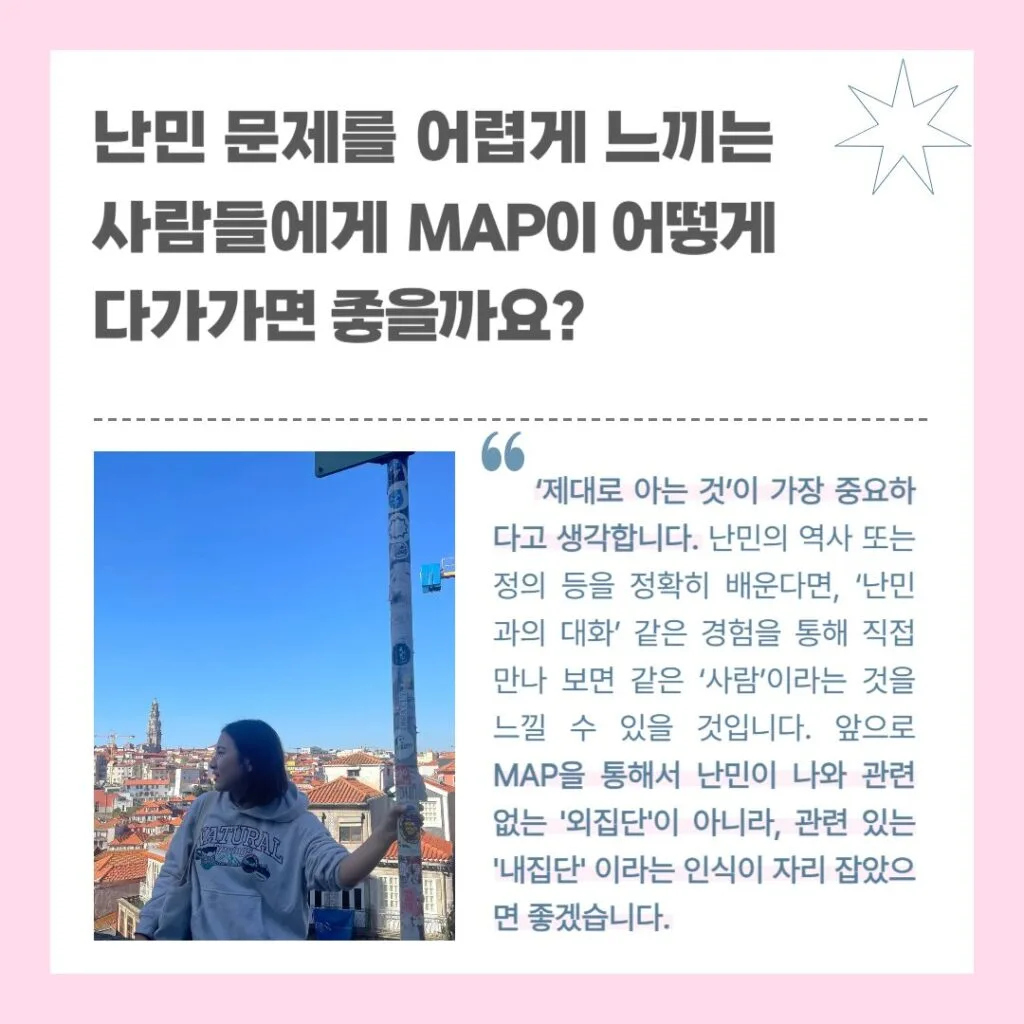
Q6. How do you think MAP should approach people who find the refugee issue difficult?
I think “knowing properly” is the most important thing. If people learn accurately about the history or the definition of refugees, and then meet them in person through experiences like “Dialogue with Refugees,” they will feel that refugees are the same “people.” I hope that, through MAP, the perception takes root that refugees are not an “outgroup” unrelated to me but an “ingroup” that is related to me.