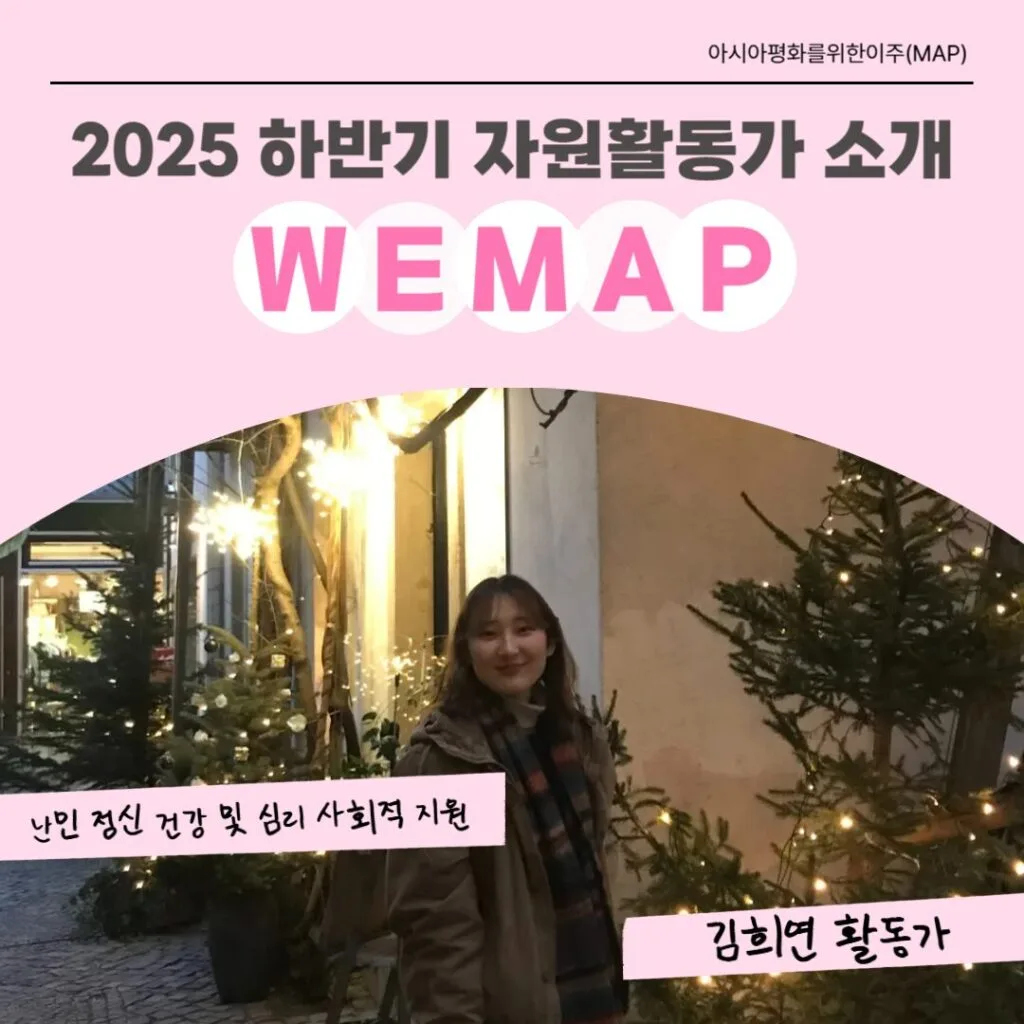
Q1. Please give a brief self-introduction and tell us why you applied to MAP.
Hello! I am Kim Hui-yeon, an MHPSS volunteer. I applied to volunteer at MAP for the dignity and recovery of refugees. I have been interested in international inequality and the rights of vulnerable groups, and I have long dreamed of protecting children exposed to war and violence in particular. I am currently studying development cooperation and global health, and by taking part earlier in a project to improve health care access for undocumented residents, I saw the problem of refugees’ right to health caused by the gap between systems and the field. Through this, I realized how important the role of civil society is in filling the gaps so that refugees can actually reach the services and rights they need. I thought MAP was a place where this kind of solidarity happens, and I applied because I wanted to add my strength to this change.
Q2. What exactly do you do on your current team?
In the
Q3. What has been the most memorable moment for you so far in your activities?
What stayed with me was the moment I visited a child’s home for the child crisis support project and accompanied the family to a consultation at a developmental center. I had been in charge of this case for about a month and had grasped the child’s situation and the difficulties of linking to an institution, but when I actually visited the site, I could see the problem more clearly. Because the family has no car and the area lacks public transportation infrastructure, even getting to the nearest center was not easy. Because communication was difficult, interpretation was needed even during the consultation, so without MAP’s support it would have been hard to connect them to appropriate treatment. This experience made me feel how important it is to understand a family’s specific circumstances closely and to give realistic support. I am still looking for an institution that meets the conditions, and I am working not to give up until the child can receive the treatment they need.
Q4. What do you think our society needs most in order to live together with refugees?
I think refugees must be protected within the system, and their right to use the services they need must be guaranteed. Therefore, we need to strengthen access and support in the refugee status determination process and raise the refugee recognition rate to reduce the number of people who fall into gaps in protection. If refugees are recognized as members of society, they can settle stably in society through legal employment opportunities, and we can practically support their livelihoods and self-reliance. In addition, we need to expand guidance systems so that they can use essential services such as health care, education, and counseling, and strengthen interpretation services so that refugees can actually use them in the field. In particular, while monitoring the children in the support project, I saw that even among participants in the same support project, progress differed depending on the local community, educational institutions, family, and network.
I realized that it is not enough simply to think that things will be fine because a system exists, or that things will be fine because institutions are linked. I felt that it is very important for the various people connected to a child to cooperate and make an effort actively. Through this, I thought we could provide the child with more sustainable and reliable support, and make sure that immediate and stable support is provided when a similar case or another need for support arises. If such institutional and practical support is in place, I think refugees can naturally be accepted not as “others” who need special help but as neighbors and colleagues who live with us in Korean society and enjoy everyday rights and support.
Q5. What “change” have you felt while volunteering at MAP? Or what “change” do you want to make?
Before working at MAP, refugees were vague and conceptual beings to me. But now I can picture concrete people who have faces and names. Over time, through hearing voices on the phone and meeting faces in interviews, I came to know their lives in a more three-dimensional way. In particular, I think of them not as one group but as individuals whose needs differ according to their own situations. So I also realized how important individually tailored support is. I hope for a world where we can reach each other by reaching out when help is needed. I believe that on the days I volunteer, the small effort of contacting, communicating with, and supporting even one more refugee will surely add up to meaningful change. I intend to keep making small but steady efforts in the future.
Q6. How should MAP approach people who find the refugee issue difficult?
I think it is important to provide opportunities to experience refugees as concrete people. In our society today, refugees are easily associated with economic and social hardship, and there is a prejudice that this is due to a lack of individual ability. In reality, however, they are active individuals who found the courage to flee violence and persecution in search of a better life. If MAP offers small practical experiences such as taking part in programs, volunteering, and donating, people can do more than simply obtain information; they can connect directly with refugees, communicate, and experience giving and receiving help. I think that through such experiences, prejudice against refugees will lessen and a sense of wanting to stand in solidarity will form.