Treat People as Persons Rather Than Only as Citizens, and Extend Equality – Youngah Kim (Representative, Migration to Asia Peace, MAP)
1. Introduction
At the end of 2016, the number of foreign residents in Korea exceeded two million (an increase of 159,922, or 8.5%, compared with 2005), and it has grown by an average of 9.26% a year over the past five years. The main factors are said to be the expansion of eligibility for the overseas Korean (F-4) status for ethnic Koreans from China and the increase in applications for permanent residence (F-5) from ethnic Koreans with foreign nationality who meet the requirements for acquiring nationality. This rising trend in foreign residents is expected to continue because of the growth in the foreign labor force caused by a low-birth-rate, aging society, the growth in marriage migrants caused by the increase in international marriages, the inflow of ethnic Koreans with foreign nationality, and the growth in international students. (http://www.index.go.kr/potal/main/EachDtlPageDetail.do?idx_cd=2756)
The increase in foreign residents means that the number of migrants living together in Korea at large, and in local communities at small, is growing. Of all foreigners, 75% are registered with the government, have reported a place of residence and are staying long term, and the number is larger if we add about 210,000 foreigners in an unregistered status (“illegal residence”). While the Korean government is establishing social integration policies for migrants, it is also creating policies to bring in skilled and unskilled foreign workers to fill the still insufficient labor force, and at the same time, in the name of protecting the domestic labor market, it cracks down on illegal employment by illegal residents. The government has steered the inflow of foreigners as a stopgap measure to overcome the crisis of social reproduction in Korean society and has declared Korea a multicultural society, but in the meantime it has not been active in establishing measures to prevent violations of foreigners’ human rights.
In an age of “refugee crisis” in which refugees worldwide have passed 65.6 million, expanding the acceptance of refugees and protecting their human rights is the biggest problem facing the international community. Unlike migrants from other backgrounds, the purpose of accepting refugees is humanitarian protection, not a solution to a country’s reproduction crisis, so how a country accepts and protects refugees is a barometer of that country’s awareness and practice of human rights.
Korea acceded to the 1951 Convention Relating to the Status of Refugees and the 1967 Protocol Relating to the Status of Refugees in 1992. The procedure for recognizing refugees was regulated in the Immigration Control Act and its Enforcement Decree in 1993, but there were continuing complaints about the speed, transparency and fairness of the procedure, and provisions on the treatment of refugees were introduced for the first time in the third revision in 2008. The Refugee Act was then enacted in 2012 and took effect on July 1, 2013, as the first in Asia. It laid the foundation of the refugee recognition system by improving the refugee recognition procedure and addressing the social treatment of recognized refugees. Recently, from 2015, Korea has accepted resettled refugees on a three-year pilot basis. Still, Korea’s refugee recognition rate is only 3.9% (688 people from 1994 to April 2017), far below the world average of 37%. In addition, there is a gap between international law and domestic law, and there are gaps between ministries over guaranteeing refugees’ economic, social and cultural rights.
Hatred of multiculturalism, racism, hostile public opinion toward specific religions, public opinion on LGBTQ refugees, and criticism of the growing abuse of the Refugee Act
2. Definition and Legal Status of Refugees under the Refugee Convention
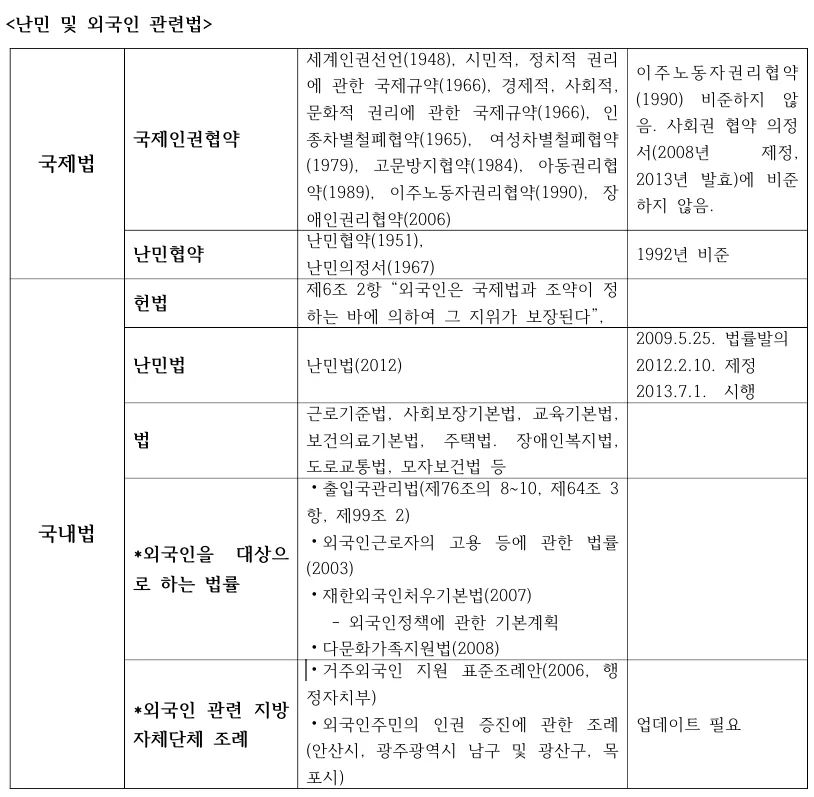
Under international law, refugees first have the basic rights guaranteed by international human rights standards such as the Universal Declaration of Human Rights (1948), the International Covenant on Civil and Political Rights (hereinafter the Civil and Political Rights Covenant; 1966) and the International Covenant on Economic, Social and Cultural Rights (hereinafter the Social Rights Covenant; 1966), together with the Convention on the Elimination of All Forms of Racial Discrimination (1965), the Convention on the Elimination of All Forms of Discrimination against Women (1979), the Convention against Torture (1984), the Convention on the Rights of the Child (1989), the Convention on the Rights of Migrant Workers (1990) and the Convention on the Rights of Persons with Disabilities (2006), and they also have special rights that follow from refugee status. A refugee is a person who “owing to a well-founded fear of being persecuted for reasons of race, religion, nationality, membership of a particular social group or political opinion, is outside the country of his nationality and is unable or, owing to such fear, is unwilling to avail himself of the protection of that country; or who, not having a nationality and being outside the country of his former habitual residence as a result of such events, is unable or, owing to such fear, is unwilling to return to it (Refugee Convention, Article 1 A(2))
In other words, to be recognized as a refugee, the following requirements must be met.
- Being outside the country of nationality, 2) one or more of the five grounds in the Refugee Convention, 3) a fear of being persecuted for those grounds, 4) a reasonable basis for the fear of persecution, 5) absence of protection by the country of nationality
The status and rights of refugees defined by the Refugee Convention are irrespective of whether, or what kind of, status of stay the refugee has received in the country of asylum.
The main rights guaranteed by the Refugee Convention include, as civil liberties, freedom of religion, the right of association, the right to a trial and freedom of movement. As social rights, they include the right to housing, the right to education, the right to public assistance, the right to work, the right to social security and copyright. In addition, refugees have absolute rights such as the prohibition of expulsion and return (Article 33), exemption from penalties for illegal entry and stay, and facilitated naturalization. Everything in the Convention must be applied without discrimination as to race, religion or country of origin (Article 3).
Apart from the absolute rights, the Refugee Convention sets the level of guarantee of each right by comparison with nationals or with foreigners.
- Treatment equal to that generally granted to foreigners / treatment as favorable as possible / treatment no less favorable than that generally granted to foreigners in the same circumstances (e.g. movable and immovable property, self-employment, liberal professions, housing) 2) The most favorable treatment granted to nationals of a foreign country in the same circumstances (e.g. the right of association, employment) 3) Treatment equal to that of nationals (e.g. the right to a trial, copyright and industrial property, rationing, elementary education, public relief, labor law and social security)
4. Definition, Legal Status and Treatment of Refugees under Domestic Law
1) Constitution The Constitution of the Republic of Korea defines only “nationals” as the holders of fundamental rights, and the protection of nationals’ economic, social and cultural rights is provided for in various related laws such as the Labor Standards Act, the Framework Act on Social Security, the Framework Act on Education, the Framework Act on Health and Medical Services, and the Housing Act. Most of these laws target nationals and either have no provisions on migrants or exclude them, and as a result migrants are not guaranteed rights unless they naturalize.
However, the Constitutional Court stated that, “in interpreting each constitutional provision on the guarantee of fundamental rights,” “foreigners in a position similar to that of nationals can be holders of fundamental rights,” and in principle recognized “the capacity of foreigners to hold fundamental rights.” It held that “human dignity and worth and the right to pursue happiness are human rights of which foreigners can also be holders, and equality is also a human right, subject only to limits arising from the nature of political rights and the like and limits based on reciprocity” (Constitutional Court, December 29, 1994, decision 93Hun-Ma120; Constitutional Court, November 29, 2001, 99Hun-Ma494; Hwang Pil-kyu (2010)).
Meanwhile, the Constitutional Court divides constitutional fundamental rights into “fundamental rights of liberty” and “fundamental rights of a social nature,” defines the former as “human rights” and the latter as “rights of nationals,” and takes the position that foreigners are holders of “human rights” while social fundamental rights are recognized only for nationals. However, among the rights concerning labor, it held that rights that have the character of fundamental rights of liberty rather than social fundamental rights, such as “the right, under a capitalist economic order, of workers to secure basic means of living and to demand minimum working conditions to be guaranteed human dignity,” as distinct from the social fundamental right to “demand social and economic policies for the promotion of employment from the state,” are also recognized as rights that foreigners can hold. (Constitutional Court, August 30, 2007, decision 2004Hun-Ma670, full bench. Hwang Pil-kyu (2010))
In reality it is hard to find cases in which the rights of foreigners, including refugees, are directly provided for and the state’s duty to protect those rights is stipulated, and this constitutional limit is related to that.
2) Refugee Act The Refugee Act applies, and matters not provided for in the Refugee Act are governed by the Immigration Control Act.
Classification under the domestic Refugee Act: refugee applicants (G-1-5), recognized refugees (F-2-2, F-2-4), humanitarian status holders (G-1-6)
The treatment of recognized refugees is set out in Articles 30 to 38 of the Refugee Act. Notwithstanding other laws, recognized refugees receive treatment in accordance with the Refugee Convention, and receive the same level of treatment as Korean nationals under the Framework Act on Social Security, the National Basic Living Security Act and the Civil Act, as well as elementary and secondary education, social adjustment education, recognition of academic credentials, recognition of qualifications, family reunification, and exemption from the application of reciprocity. In practice, however, when individual laws related to social security do not mention that they also apply to recognized refugees, their rights are not guaranteed. For example, a refugee child with a brain lesion disability was granted admission to a school for children with disabilities, but could not apply for disability registration or for personal assistant services. The registration was refused because the Welfare of Persons with Disabilities Act allows disability registration only for ethnic Koreans, permanent residents and marriage migrants among foreigners. (The Welfare of Persons with Disabilities Act was amended on December 1, 2017.)
For the treatment of humanitarian status holders, the law provides only that permission for employment activities is possible (Article 39). There is no social security for humanitarian status holders. We take the view that the provisions on the treatment of recognized refugees should apply mutatis mutandis. In particular, the impossibility of enrolling in health insurance and of obtaining a driver’s license is a major problem.
The treatment of refugee applicants is addressed in Articles 40 to 44, and concerns support for living expenses, permission to work, support for housing facilities, medical support and guaranteed education. However, all of these are not mandatory provisions: they say “may support” and “may permit.” Because of constraints in the Ministry of Justice budget, harm to the domestic labor market, and the fact that the only housing facility in operation is the Immigration Reception Center located in Yeongjong Island, Incheon, social security is in reality very limited. Article 44 allows the treatment above to be restricted for people who have an administrative appeal or administrative lawsuit pending against a decision not to recognize refugee status, and for people who have reapplied for refugee examination.
4. Current Issues in Refugee Protection
- Improving the refugee status determination (RSD) procedure
- There must be an independent administrative appeal system
- Improving the status and rights of humanitarian stay permit holders
- Establishing and supporting a family reunification procedure
- Improving the refugee application system at ports of entry. In particular, limiting the grounds for non-referral decisions at airports and seaports to manifestly unfounded cases
- Expanding resettlement and strengthening cooperation between local governments and ministries for local integration
- Equal treatment and support for resettled refugees and for recognized refugees recognized within Korea
- Detention and detention of children
- Birth registration
- The right to education
5. Conclusion
- Constitutional limits, and the state’s neglect of its duty to make efforts to protect social rights
- Article 30 (Treatment of Recognized Refugees), paragraph 2, of the Refugee Act: “The State and local governments shall establish and implement policies on the treatment of refugees, revise related laws and regulations, support related ministries and take other necessary measures. —Repeal of the Gimpo refugee support ordinance (2015)
- Refugee grounds related to sexual persecution, the vulnerability of women refugees, and the need for a gender perspective in refugee examination and protection institutions
- Inadequate protection of refugee children
- With the rapid increase in foreign residents and the growth in marriage migrants and their children, the government has carried out policies for foreigners, including refugees. It has made various attempts, mainly targeting marriage migrant women as the main beneficiaries. However, these define services that the government may provide at its discretion, rather than recognizing them as migrants’ rights. In other words, with regard to the protection of migrants, the state may provide support, but it is not an obligation or a responsibility.