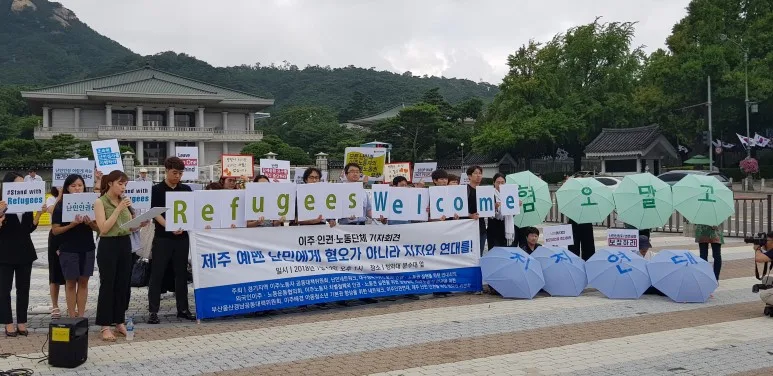
A Message to the Government and Korean Society from Migrant, Human Rights and Labor Organizations Sending ‘Support and Solidarity, Not Hatred, to Yemeni Refugees in Jeju’
“Refugees who have escaped the threat of death
must be welcomed and have their human rights guaranteed
so that we can live together, not met with hatred, exclusion and racial discrimination!”
- Korea is now facing a new situation it has never experienced before regarding the treatment of some 500 refugees. A Blue House petition has gathered about 700,000 signatures, sharp language of hatred and exclusion is raging on social media, news that is inaccurate, sensationally edited, exaggerated and distorted keeps coming, anti-refugee rallies are being held, and there are even demands, made without hesitation, to forcibly send refugees back.
Even if it concerns only a part of the public, it is hard to believe that this is happening in a country that only one year ago won praise from the whole world for holding up candles for peace, justice and human rights. We, the civil society and labor organizations, stand here with complicated feelings and deep concern about the current situation.
- Yemen is a country that has been in civil war for four years. The functions of the state have collapsed, and the foundations of people’s lives have been completely destroyed by the war. According to various sources, more than 10,000 people have died and more than 50,000 have been injured. Cholera has broken out, more than 2,000 people have died, and 1 million suspected cases have occurred. The number of internally displaced people has reached 2 million, and about 200,000 have escaped across the border. About 20 million people, two thirds of the population, survive on relief supplies because of shortages of food and daily necessities, and every day 130 children die of disease and hunger. Seven million people are at risk of dying of starvation.
Government forces, rebels and armed groups harshly suppress political dissent and carry out forced conscription in the areas they control. Expressions such as “the greatest tragedy of the 21st century,” “the current situation in Yemen is like the end of the world,” and “the most miserable place on earth” are no exaggeration. About 500 Yemenis, who barely escaped the crossroads of life and death from that place, which deserves to be called a place of death, came to Korea to survive and applied for asylum. This is a situation in which we should join hands and build warm solidarity.
- However, the vague anxiety that began with the government’s careless measures and lack of information has grown over time to the point where it cannot be persuaded by any fact or any interpretation, and it has turned into a danger that seems real and about to burst into our daily lives, demonizing the refugees.
Without even recognizing that it is discrimination based on racism, opposition to Muslims and refugees, combined with anxiety, is attacking our reason and our sense of solidarity with the weak. We see that the difficulty of finding jobs, unemployment and competitive pressure felt by those in their twenties and thirties, anxiety about women’s safety and the like are being expressed as anger, with strangers made the scapegoat, without an accurate identification of causes or solutions. Is this really justified?
- Excluding refugees does not improve the safety and human rights of Korean nationals.
It does not improve violence against women or the Korean culture that demeans women.
It does not lower the crime rate. Even in Germany, which has accepted more than 1 million refugees, the interior minister recently said that the crime rate was “at its lowest level in more than 30 years (a 9.6% decrease from the previous year) and the crime rate of non-Germans decreased by 22.8%.” Even now, the crime rate of migrants in Korea is lower than that of Korean nationals. There is also no basis for talking about Muslims as if they were a group of sex offenders.
Linking an entire country and religion to terror or crime is not only contrary to the facts but also fosters racist hatred.
Refugees are not taking away jobs either. On the contrary, migrants, including refugees, have worked under poor conditions in the “3D” (dirty, dangerous and difficult) industries that Korean nationals do not want to work in. Statistically, there is no correlation between unemployment and migrants. Korea, the world’s 12th largest economy, is not too small to accommodate the present refugees.
- As many people have already said, refugees are found throughout Korea’s modern and contemporary history. Young Korean men who fled to escape forced labor and conscription under Japanese colonial rule, the Korean War as a civil war, and the tragedy of modern history known as the April 3 incident: through these, the Republic of Korea was a country that produced a great many refugees, and it is even said that more than half of the overseas Koreans now living abroad are descendants of refugees.
It is also worth recalling that the predecessor of the UN Refugee Agency was UNKRA, created to support refugees generated by the Korean War. The knife-like words thrown at Yemeni refugees in Korea are no different from the words thrown at our ancestors a century ago.
- We criticize the government’s careless and irresponsible refugee policy and urge it to establish a proper policy on the human rights of refugees.
Korea’s present situation largely stems from the careless and irresponsible policy of the Korean government. The government has touted the ratification of the international convention on refugees and the enactment of the Refugee Act as its achievements, but it cannot be said to have carried out a careful and considerate refugee policy. The gaps and shortcomings of the refugee policy, such as an extremely low refugee recognition rate, poor support, long screening periods, insufficient assistance for refugees during the screening process, a shortage of specialized personnel, and a lack of policies to raise social awareness of the human rights of refugees and migrants, were fully exposed by the arrival of Yemeni refugees in Jeju.
The measure the Ministry of Justice announced on the 29th as a refugee countermeasure, namely “amending the Refugee Act to prevent cases of abusing the refugee system for economic purposes or as a means of staying in Korea regardless of the need for protection,” is also not an appropriate measure. On the contrary, it will further spread the groundless “fake refugee” logic and foster hatred of refugees.
What the government should do now is to strengthen policies based on the human rights of refugees and to not allow the rampant racist hatred and exclusion. It must also ease the suffering of asylum seekers and make sure sufficient support is provided.
In addition, the government has neglected to enact the comprehensive anti-discrimination law that human rights organizations have persistently emphasized. We demanded the enactment of a law prohibiting racial discrimination to prevent racial discrimination, which has begun to emerge, but the government was again lukewarm. As a result, Korean society has been neither officially defined nor taught what racial discrimination or hatred is. The government’s lukewarm position cannot be said to bear no responsibility for the current situation.
- The Republic of Korea must stand in solidarity, as fellow members of society, as citizens and as workers, with the growing number of migrants in this land and with refugees who have escaped from places of death, and it must confront discrimination and hatred. Refugees who have escaped the threat of death must be welcomed and have their human rights guaranteed so that we can live together, not met with hatred, exclusion and racial discrimination! Fostering hatred and exclusion weakens the rights of the socially vulnerable and destroys solidarity.
Governments have already created, in addition to the international convention on refugees, separate Global Compacts on refugees and on migrants as international commitments to protect the lives and human rights of refugees and migrants, and they are about to adopt them. The Korean government, as a member of the international community, should also resolve the refugee issue more responsibly.
It is not the increase of refugees and migrants that threatens us; rather, the absence of solidarity with them is the crisis of our time and of civic spirit. We, the migrant, human rights and labor organizations, therefore strengthen our solidarity with refugees and migrants in order to advance the human rights and equality of everyone, and we urge the government and our society to do the following.
1. No one wants to become a refugee. We support their escape and settlement for survival.
2. Saying that refugees should be forcibly sent back means pushing them toward a place of death. The demand for forced return must stop immediately.
3. There is no such thing as fake in a situation of war and death.
4. STOP WAR NOT PEOPLE ! It is not people who must stop, but the war.
July 12, 2018
All the migrant, human rights and labor organizations sending ‘Support and Solidarity, Not Hatred, to Yemeni Refugees in Jeju’