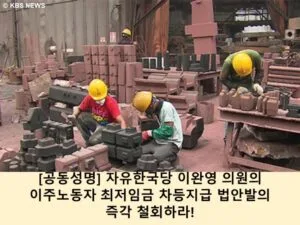
[Joint Statement] Liberty Korea Party Lawmaker Lee Wan-young’s Bill to Pay Migrant Workers Different Minimum Wages
Withdraw it immediately!
We condemn this racist bill that would squeeze the liver out of a flea!
-
On 8 February, Lee Wan-young, a member of the National Assembly’s Legislation and Judiciary Committee from the Liberty Korea Party, introduced as lead sponsor a “Partial Amendment Bill to the Minimum Wage Act” that would pay migrant workers a reduced minimum wage. The core of the bill is that during the first year after a migrant worker enters the country, the employer may cut the minimum wage by 30 percent, and between the first and second year, by 20 percent. In a word, it is an outlandish racist idea of cutting wages by tens of percent only because someone is a migrant worker. For decades Korea has brought in migrant workers to meet the needs of Korean society and the economy, exploited them in what is in effect forced labor, and sent them back as time passes, using them as “disposable workers,” as Amnesty International criticized. How can a member of the National Assembly think of imposing even worse working conditions on these workers, rather than guaranteeing them proper treatment and rights!
-
There is no need to look far: such a bill is not even possible in terms of legal logic. Article 6 (Equal Treatment) of the Labor Standards Act states: “An employer shall not discriminate against workers on the basis of gender, and shall not engage in discriminatory treatment concerning working conditions on the basis of nationality, religion or social status.”
The Discrimination (Employment and Occupation) Convention, 1958 (No. 111) of the International Labour Organization (ILO), which the Korean government ratified in 1998, also prohibits “any distinction, exclusion or preference made on the basis of race, color, sex, religion, political opinion, national extraction or social origin.” The United Nations International Convention on the Elimination of All Forms of Racial Discrimination likewise prohibits discrimination based on “race, color, descent, or national or ethnic origin” and obliges States Parties to take measures to that end. Both domestic and international law strongly provide that discriminatory treatment based on nationality, skin color or race is not permitted.
-
In reality, migrant workers are not even properly receiving the minimum wage. According to a recently published report of the Migration and Human Rights Institute, a simple calculation of migrant workers’ long working hours and wages shows that migrant workers receive, on average, wages below the minimum wage. Lee Wan-young’s statement, made when introducing this racist bill, that companies employing migrant workers are being pushed into marginal status by the rise in the minimum wage is not true. Moreover, since 2017 the Ministry of Employment and Labor (MOEL) has enforced the “Guidelines on Collecting Room and Board Fees,” which have employers deduct 8 to 20 percent of migrant workers’ monthly pay as room and board, so the rise in the minimum wage has little effect on migrant workers. On top of this, employers cut migrant workers’ wages in various ways, such as not counting cleaning time or preparation and wrap-up time as working hours, or reducing overtime pay.
-
Since last year, Liberty Korea Party lawmakers including Kim Hak-yong have been introducing bills to pay migrant workers differential wages. It is no exaggeration to call it a racist party. This is mainly the result of lobbying by employers led by the Korea Federation of SMEs. Employers show a double standard: they want to cut migrant workers’ wages while increasing the scale of migrant worker admissions. To say that more migrant workers are needed because low-wage labor is in short supply, yet that they cannot even be paid the minimum wage, is a shameless act that thoroughly ignores the most basic rights of workers, and it is nothing other than the greed of Nolbu (the miserly brother in a Korean folktale), seeking to maximize labor exploitation. Even if such bills do not pass, the mere act of introducing them works as a mechanism that quietly justifies discrimination against migrant workers, and is meant to cover up the racist oppression and discrimination inflicted on migrant workers in reality. Therefore the very introduction of the bill must be thoroughly condemned and raised as a social problem.
The government must also state its attitude clearly. During the past review of the Korean government under the International Convention on the Elimination of All Forms of Racial Discrimination, the MOEL answered that a differential wage law would conflict not only with domestic labor laws but also with ILO conventions, and could adversely affect the domestic labor market. We strongly urge the government to state immediately and clearly that such a bill cannot become law.
- If wages and working conditions worsen for migrant workers, a socially weak group, the effect acts as downward pressure on most other workers as well and harms working conditions as a whole. Those behind these bills are aiming for this effect when they introduce bills that make no sense. Moreover, as the economy slows further, attacks on workers’ rights will grow fiercer. We strongly oppose this bill, which denies the most basic human rights and labor rights of migrant workers and would set back the working conditions of all workers. The differential wage bills already introduced, including Lee Wan-young’s bill, must be withdrawn immediately. To protect and improve the rightful labor rights of all workers, we will stand in solidarity and fight together with the migrant, labor and social movement camps, and we will surely stop it.
12 February 2019
공익법센터 어필, 아시아의 친구들, 아시아 평화를 향한 이주 MAP,
Solidarity Council for the Realization of Human Rights and Labor Rights of Migrant Workers in Daegu and Gyeongbuk (경산이주노동자센터, 경주이주노동자센터, 대구경북인도주의실천의사협의회, 땅과자유, 민주노총경북본부, 민주노총대구본부, 민중행동, 대구사랑장애인자립센터, 장애인지역공동체, 성서공단노조, 대구이주민선교센터, 대구이주여성인권센터, 인권운동연대, 지구별동무, 대구민주사회를위한변호사모임, 대구북부노동상담소)
Council of Migration and Labor Movements for Foreigners ((사)지구촌사랑나눔중국동포의집, (사)한국이주민건강협회희망의친구들,남양주샬롬의집,부천이주노동복지센터, 서울외국인노동자센터(사)외국인노동자와함께, 아산외국인노동자센터, 아시아인권문화연대, 외국인이주노동자인권을위한모임, 용인이주노동자쉼터, 의정부EXODUS, 인천외국인노동자센터, 파주샬롬의집, 포천나눔의집, 한국이주여성인권센터)
Busan-Ulsan-Gyeongnam Joint Committee for Migrant Human Rights (가톨릭노동상담소, 민주노총부산본부, 양산외국인노동자의집, 울산이주민센터, 이주민과함께, 희망웅상, 김해이주민인권센터, 거제고성통영노동건강문화공간새터, 녹산선교회, 사회변혁노동자당 부산시당)
Joint Action for the Abolition of Discrimination against Migrant Workers and the Realization of Human Rights and Labor Rights (건강권실현을위한보건의료단체연합, 경기이주공대위, 공익인권법재단 공감, 구속노동자후원회, 노동당, 노동사회과학연구소, 노동전선, 노동자연대, 녹색당, 대한불교조계종사회노동위원회, 문화연대, 민주사회를위한변호사모임노동위원회, 민주주의법학연구회, 민주화를위한전국교수협의회, 사회변혁노동자당, 사회진보연대, 아시아의창, 이주노동자노동조합(MTU), (사)이주노동희망센터, 이주노동자운동후원회, 이주민방송(MWTV), 이주민센터 친구, 전국민주노동조합총연맹, 전국빈민연합, 전국철거민연합, 전국학생행진, 정의당, 지구인의정류장, 천주교인권위원회, 필리핀공동체카사마코, (사)한국불교종단협의회인권위원회, 한국비정규노동센터, 한국이주인권센터)
Migrant Human Rights Solidarity (경산이주노동자센터, 경주이주노동자센터, (사)이주민과 함께, 아시아의 창, 안산이주민센터, 양산외국인노동자의 집, 울산이주민센터, 이주민노동인권센터, 이주와 인권연구소, 지구인의 정류장, 천안 모이세, 한국이주인권센터)