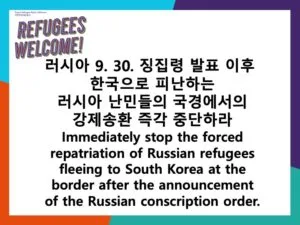
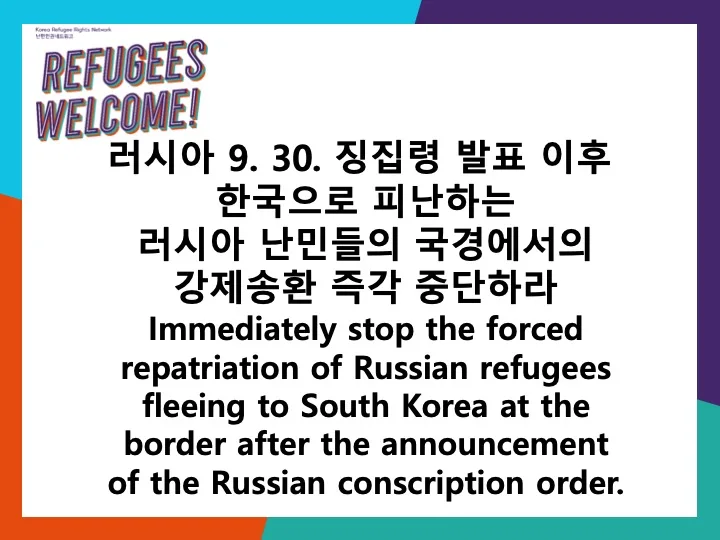
Immediately stop the forced repatriation of Russian refugees fleeing to South Korea at the border after the announcement of the Russian conscription order
Press Reports and Recent Facts
After Russia’s invasion of Ukraine, it became known that on September 30 Putin issued the so-called “partial conscription order,” an “arbitrary conscription order that therefore works in a discriminatory way against the weak.”
Since then, large numbers of potential conscripts have been escaping abroad. Some reports say the number reached 200,000. This matter is not merely a sign of war or a sign of crisis in Putin’s regime in Russia; it is directly tied to whether the refugee protection system works, and escape to neighboring Korea has become known.
Press reports of October 10 and 11 also revealed that more than 20 Russian nationals who arrived by yacht at sea off Donghae and Pohang in order to avoid the conscription order were denied entry and are waiting, and similar things are being repeated at home and abroad and at ports of entry.
Demands
First, immediately and transparently disclose the information on the potential Russian refugee applicants reported in the press and the government’s response measures.
Second, guarantee access to the refugee application procedure and guidance on the procedure to the Russian refugees who have arrived within territorial waters, and promptly make a referral decision on the basis of the Refugee Act.
Third, prepare measures for Russian refugee applicants in Korea (those refusing the conscription order).
Fourth, refugee applications by Russian refugee applicants made after the “issuance of the conscription order” involve a “serious change of circumstances.” When a new application is made, grant a status of stay, conduct airport and domestic examinations on the basis of the Refugee Act, and promptly release detained refugee applicants from detention.
Fifth, educate officials at immigration ports and harbors nationwide, namely immigration, the Coast Guard, and the National Intelligence Service, on the relevant norms, standards, and procedures so that they do not take part in unlawful forced repatriation.
Russian refugees escaping by boat to Korea to avoid Putin’s conscription order?
A. Refugees who escaped the conscription order are refugees under the norms
They are refugees under the Refugee Convention. There are various reasons for escaping a war. Among them, draft evasion is one way of opposing war at the individual level, and it is an escape from persecution consisting of unjust military service on the battlefield or a disproportionate punishment for having avoided it. It amounts to “persecution.”
The causes of draft evasion also vary. It may be “conscience,” it may be “religion,” or it may be “the political opinion of opposing Putin’s war.” Even a case where a person “avoided it merely for the sake of their own life and their family’s safety” is no problem, because it can be covered by “imputed political opinion.” Even with simple draft evasion, in wartime, when a valuable manpower resource flees after being called to fulfill the obligation, the authorities waging the war regard it as “treason,” call the person an “enemy of the state,” and raise the level of conscription.
Even a simple draft evader naturally becomes a refugee where there are objective circumstances in which the flight is regarded as flight with a “political opinion.” The “nexus with the five grounds” under the Refugee Convention is also satisfied. That is why the UNHCR Guidelines on International Protection No. 10 deal with “military service and refugee status.” One-sidedly defending the legitimacy of conscription is only the view of the country of nationality, which is the party committing the human rights violation, and cannot become a normative standard that the country of refuge must follow.
In addition, in the context of Korea, a garrison state where anyone can be conscripted, “draft evasion” is regarded as an escape from the duty to protect the lives of the people and something to be condemned morally, which generally gives rise to the misunderstanding, “What kind of refugee is a draft evader?” However, normative standards cannot be abandoned; the fundamental right to refuse individual military service can be protected by the country of refuge; and because the “legitimacy” of war and conscription differs sharply from one country’s context to another, opposition to an “unjust war,” including opposition to the war itself, and flight because of it can occur in any number of cases. It is self-evident that no one can be expected to take part in Putin’s war.
B. The international community actually keeps these normative standards
In Korea, a press release without legal reasoning, such as “war refugees are not refugees,” has been distributed in the past. But that is not true at all. Take the example of Europe. For example, Syrian refugees. Under the provisions above, many of the men who escaped the “Syrian war” were likewise refugees who avoided being conscripted into the “Assad army.” Germany was where the largest number of refugees headed among first-world countries. In 2015 alone, the number reached about 1.5 million in a year.
The accumulation of rulings of Germany’s Federal Administrative Court made the examination standards clear. There are two lines of cases that overturned the unjust early decisions of Germany’s BAMP. In the first, the question was “What if the region of origin of the man who could be conscripted can be said to be a rebel-held region such as Aleppo?” If so, because “the person could be regarded as having fled out of sympathy with the rebels,” refugee status is recognized on the basis of imputed political opinion. These are the judgment of February 7, 2018, 5A 1245/17.A (Saxon Higher Administrative Court, Germany) and the judgment of June 6, 2018, 3A3040/16.A Verwaltungsgerichtshof Hessen (a ruling of the Higher Administrative Court of the German state of Hesse).
There is also a second line of cases outright. It holds that “whether or not they come from a rebel-held region, all draft evaders are regarded as enemies of Assad as a matter of the country’s conditions, so all of them are refugees on the basis of imputed political opinion.” This is the judgment of June 6, 2018, 3 A 403 / 18.A Verwaltungsgerichtshof Hessen (a ruling of the appellate court of the German state of Hesse). Since then, in practice, BAMP has been granting “refugee status” by examining loosely whether there is a connection to rebel-held regions. It is refugee status, not “humanitarian stay status.”
Besides this approach of considering the reasons for flight of individual refugees, there is another route: where “the war itself, assessed objectively, is a war in which war crimes or crimes against humanity are committed.” It follows an “objective” assessment. “Soldiers who took part in war crimes cannot be protected by the Refugee Convention.” As the opposite of this, in the case of an extremely unjust war in which war crimes and the like are committed, it gives a right to refuse objectively.
“Merely disagreeing with the government about the political legitimacy of a particular military action is not fully sufficient. But if the type of military action is condemned by the international community as contrary to the basic rules of human conduct, punishment for escape or desertion may in itself be regarded as persecution in light of all the other requirements of justice” (1988, US Court of Appeals for the Fourth Circuit, M.A. A26851062).
In the end, people who fled (an unjust war and) conscription can be protected by the Refugee Convention.
C. Depriving people of the opportunity to apply for refugee status at the border is a “violation of the obligation of non-refoulement”
Refusal of entry, bans on entering port, and bans on mooring, carried out without providing procedures and systems that inform potential asylum seekers who have entered Korea’s territory or territorial waters of their opportunity and right to the refugee application procedure and enable them actually to access the asylum system, are all violations of the obligation of non-refoulement that the Refugee Convention prohibits.
Rejection at the border is a violation of the obligation of non-refoulement. The accumulation of numerous rulings that have guaranteed refugee applications and access to the related procedures at airports in Korea clearly supports this.
The forced repatriation of North Korean escapees at sea and similar matters drew numerous criticisms as violations of the obligation of non-refoulement, and the Ministry of Justice also took the same interpretation; halting Russian refugees’ access to the territory and to the procedure is likewise a violation of the obligation of non-refoulement.
D. People who fled to avoid Russian conscription are refugees
They are refugees under the Refugee Convention. All of them fall within the same standards presented above. Both “conscription itself” and “disproportionate punishment in the case of avoiding conscription” amount to persecution. There is also a “nexus with the grounds for refugee status.” The Russian authorities are said to have made a law under which refusing the conscription order is regarded as desertion and punished with 10 years in prison. This legislative intent of the authorities can be interpreted as the basis of persecution on the ground of imputed political opinion against refugees who avoided conscription.
What about an inhumane war? Yes. Although more detailed investigation will be required in the future, evidence of massacres of civilians and evidence of inhumane war crimes is already widely known. In accordance with the right to refuse an “unjust war,” people can refuse the war and flee, and their beliefs are interpreted as a political opinion that must be protected.
E. Russian refugees who have fled to Korea must be protected immediately
As already shown in press reports, refugees who escaped Putin’s conscription order in Russia are also attempting to flee to Korea. It is a place that can be reached by boat. The government must urgently establish relevant measures and make access to the refugee procedure clear so that forced repatriation through Rejection at the Border does not occur. It must promptly issue the relevant instructions so that the regrettable incident of handing people over to the police on the grounds that they attempted illegal entry, in spite of Article 31 of the Refugee Convention, does not occur.
Furthermore, for Russian people already staying in Korea, guidelines on stay and examination must also be promptly prepared for the case where they refuse repatriation to Russia because they fall within the conscription age group (arbitrarily) and apply for asylum from the Korean government.
Like the place of Ukrainian refugees in Korea, Russian refugees who fled Putin’s war are also demanding a response from the Korean government based on mature, human-rights-respecting norms. Korea was dropped yesterday from the membership of the UN Human Rights Council; only prompt and sincere measures, not formalities, are the one way to earn human rights protection and the trust of the international community.
Korea Refugee Rights Network
▣ Korea Refugee Rights Network (as of 2022. 10. 12., the following 32 member organizations and 4 special members)
난민인권네트워크 [TFC(The First Contact for Refugee) 공익법센터 어필, 공익변호사와 함께하는 동행, 공익사단법인 정, 공익인권법재단 공감, 공익인권센터 드림(DREAM), 국제난민지원단체 피난처, 글로벌호프, 난민인권센터, 동두천난민공동체, 동작FM, 민주사회를위한변호사모임 국제연대위원회, 사단법인 두루, 서울온드림교육센터, 수원글로벌드림센터, 순천이주민지원센터, 아시아의 친구들, 아시아평화를향한이주MAP, 이주여성을위한문화경제공동체 에코팜므, 이주민지원공익센터 감동, 의정부 EXODUS, 이주민지원센터친구, 참여연대, 천주교 제주교구 이주사목센터 나오미, 재단법인 동천, 재단법인 화우 공익재단, 제주평화인권연구소 왓, 파주 EXODUS, 한국이주인권센터]