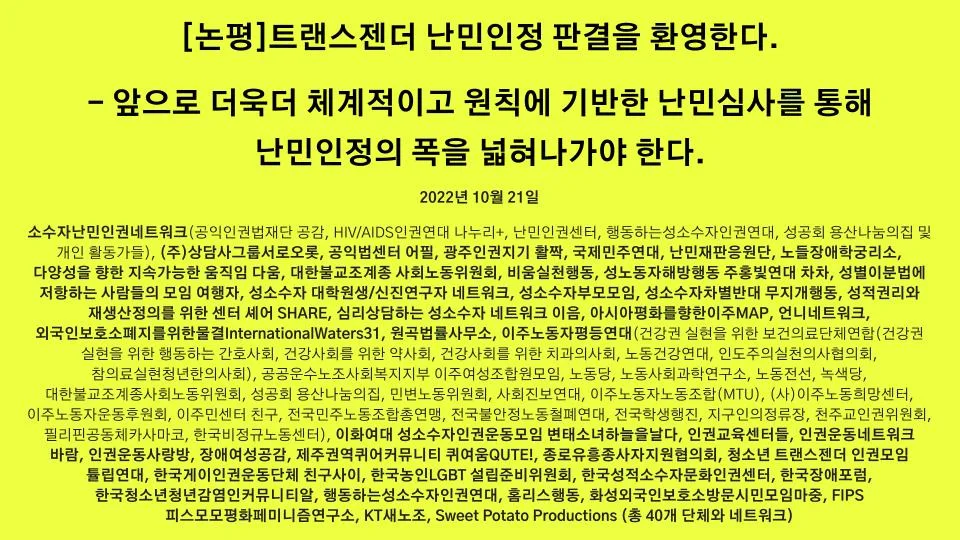
We must widen the scope of refugee recognition through increasingly systematic and principle-based refugee status determination.
We must widen the scope of refugee recognition through increasingly systematic and principle-based refugee status determination. On the 18th, the Seoul High Court revoked the disposition of non-recognition of refugee status that the Administrative Court had ruled on in its judgment of March 15, 2019. The party to this case, A, came to Korea and applied for refugee status to escape persecution experienced while living as a transgender person in the home country. A high court in Korea has for the first time issued a ruling recognizing a refugee on the basis of persecution over gender identity.
The Seoul High Court stated that, as the basis for accepting A’s refugee application, it judged the refugee recognition requirements by referring to the [UNHCR Guidelines on International Protection No. 9: Claims to Refugee Status based on Sexual Orientation and/or Gender Identity within the context of Article 1A(2) of the 1951 Convention and/or its 1967 Protocol relating to the Status of Refugees], which UNHCR issued as interpretive guidance for the Refugee Convention and Protocol.
The guidelines can be summarized as follows.
✔️ Gender identity, as distinct from sexual orientation, is “each person’s deeply felt internal and individual experience of gender, which may or may not correspond with the sex assigned at birth. It includes the personal sense of the body and other expressions of gender, including dress, speech and mannerisms.”
✔️ Because transgender persons do not fit the binary notion of male or female, they may be perceived as threatening social norms and values. Because of this non-conformity, transgender persons are exposed to harm. Transgender persons are prone to being very marginalized in society, and in the course of refugee applications the experiences of severe physical, psychological or sexual violence they have suffered sometimes come to light. Transgender persons are especially at risk when the gender and appearance they declare for themselves do not match the legal gender shown on official documents and identity cards.
✔️ As confirmed by the positions adopted by many countries, sexual orientation or gender identity is a core element of identity that is innate or unchangeable, or that a person should not be forced to renounce or conceal.
✔️ Everyone has the right to seek and enjoy asylum in another country to escape persecution, including persecution related to sexual orientation or gender identity. A state must not transfer, expel or extradite a person to a country if that person may face a well-founded fear of torture, persecution, or other cruel, inhuman or degrading treatment or punishment on the ground of sexual orientation or gender identity in that country.
✔️ Confining a person in a psychiatric institution or similar facility on the ground of gender identity alone violates international covenants that prohibit arbitrary deprivation of liberty, and may generally amount to persecution.
The Seoul High Court confirmed that in A’s home country, where A was born and had lived, a religious court exists separately from the ordinary courts and has strong power to enforce religious doctrine, and that the general criminal law also has provisions prohibiting “unnatural sexual intercourse” and “sexual intercourse between men”. It also confirmed that transgender persons are prosecuted for behaving inappropriately in public places and that there are extreme human rights violations in detention facilities. A had been arrested and prosecuted in the home country for wearing clothing for women that did not match A’s official identity, and had received a fine and a custodial sentence. The court also confirmed that this situation in the home country has not improved to date. In light of these points, it recognized that A had a “well-founded fear of being exposed to persecution on returning to the country of nationality”.
This ruling leaves several challenges.
First, refugee recognition is still mostly granted only where the applicant has official evidence of persecution, and in this ruling too, the fact that the applicant held a criminal judgment appears to have worked as an important factor. However, most refugees flee in haste and cannot bring evidence, or suffer persecution by private persons such as family rather than by religious police or state authorities, so it is often difficult for them to present material evidence. Moreover, even though the persecution defined by the Refugee Convention and the Refugee Act can be sufficiently confirmed through country-of-origin reports, a standard of evidence comparable to criminal trials is adopted. This is the error of mistaking a refugee recognition ruling for a criminal investigation. Refugee status determination and recognition standards should not be limited to the presence or absence of official documents, and the burden of proof on the applicant should be lowered by applying the principle of good-faith interpretation, under which doubtful matters are interpreted in the applicant’s favor.
Second, the two factors that became the criteria of the Supreme Court’s 2016 judgment on recognition of sexual minority refugees must change in the future. At that time the Supreme Court took the past experience of persecution and the possibility of concealing sexual orientation and gender identity as criteria. But the existence of past persecution is not a precondition for being recognized as a refugee under the 1951 Convention. The “well-founded fear of being persecuted” defined in the Refugee Convention should be interpreted as fear of the risk of future persecution, and the existence of past persecution experience should not be the basis for that interpretation. Nor should it be presumed that persecution can be avoided by concealing or “suppressing” sexual orientation and gender identity, because that in itself amounts to being forced to give up the protection that the Refugee Convention guarantees. Because of this narrow interpretation, many sexual minority refugees in Korea end up unrecognized and must set out, risking their lives, to find another country of asylum.
Third, domestic legislation also needs to be improved in order to carry out refugee status determination and refugee recognition trials properly. The government of the Republic of Korea needs to officially declare not only UNHCR Guidelines on International Protection No. 9 on the persecution that sexual minorities may experience as refugees, but also the continually developing international standards on the human rights of sexual minorities, and apply them to everyone living in Korean society. For this, as the UN human rights system also continues to emphasize, a comprehensive anti-discrimination act that expressly names sexual orientation and gender identity as grounds for prohibited discrimination must be enacted. Only if the prohibition of discrimination based on sexual orientation and gender identity is made clear can refugees afterward live safely in Korean society. Such a society is also one worth living in for sexual minorities who were born and live in Korea.
Including the Rainbow Refugee Network, the organizations issuing this commentary will continue to demand changes in the standards and methods of refugee status determination, on the basis of the goal that all sexual minorities living in Korean society can live a humane life, safe from discrimination, humiliation, violence and persecution, and respected. We will also continue to stand in solidarity and fight to secure the labor rights, right to education, right to health, and sexual and reproductive rights necessary to win the equal rights by which the lives of sexual minorities, including A, are substantively respected.
October 21, 2022
소수자난민인권네트워크(공익인권법재단 공감, HIV/AIDS인권연대 나누리+, 난민인권센터, 행동하는성소수자인권연대, 성공회 용산나눔의집 및 개인 활동가들), (주)상담사그룹서로오롯, 공익법센터 어필, 광주인권지기 활짝, 국제민주연대, 난민재판응원단, 노들장애학궁리소, 다양성을 향한 지속가능한 움직임 다움, 대한불교조계종 사회노동위원회, 비움실천행동, 성노동자해방행동 주홍빛연대 차차, 성별이분법에 저항하는 사람들의 모임 여행자, 성소수자 대학원생/신진연구자 네트워크, 성소수자부모모임, 성소수자차별반대 무지개행동, 성적권리와 재생산정의를 위한 센터 셰어 SHARE, 심리상담하는 성소수자 네트워크 이음, 아시아평화를향한이주MAP, 언니네트워크, 외국인보호소폐지를위한물결InternationalWaters31, 원곡법률사무소, 이주노동자평등연대(건강권 실현을 위한 보건의료단체연합(건강권 실현을 위한 행동하는 간호사회, 건강사회를 위한 약사회, 건강사회를 위한 치과의사회, 노동건강연대, 인도주의실천의사협의회, 참의료실현청년한의사회), 공공운수노조사회복지지부 이주여성조합원모임, 노동당, 노동사회과학연구소, 노동전선, 녹색당, 대한불교조계종사회노동위원회, 성공회 용산나눔의집, 민변노동위원회, 사회진보연대, 이주노동자노동조합(MTU), (사)이주노동희망센터, 이주노동자운동후원회, 이주민센터 친구, 전국민주노동조합총연맹, 전국불안정노동철폐연대, 전국학생행진, 지구인의정류장, 천주교인권위원회, 필리핀공동체카사마코, 한국비정규노동센터), 이화여대 성소수자인권운동모임 변태소녀하늘을날다, 인권교육센터들, 인권운동네트워크 바람, 인권운동사랑방, 장애여성공감, 제주권역퀴어커뮤니티 퀴여움QUTE!, 종로유흥종사자지원협의회, 청소년 트랜스젠더 인권모임 튤립연대, 한국게이인권운동단체 친구사이, 한국농인LGBT 설립준비위원회, 한국성적소수자문화인권센터, 한국장애포럼, 한국청소년청년감염인커뮤니티알, 행동하는성소수자인권연대, 홈리스행동, 화성외국인보호소방문시민모임마중, FIPS 피스모모평화페미니즘연구소, Sweet Potato Productions (총 40개 단체와 네트워크)