The school year system 📕
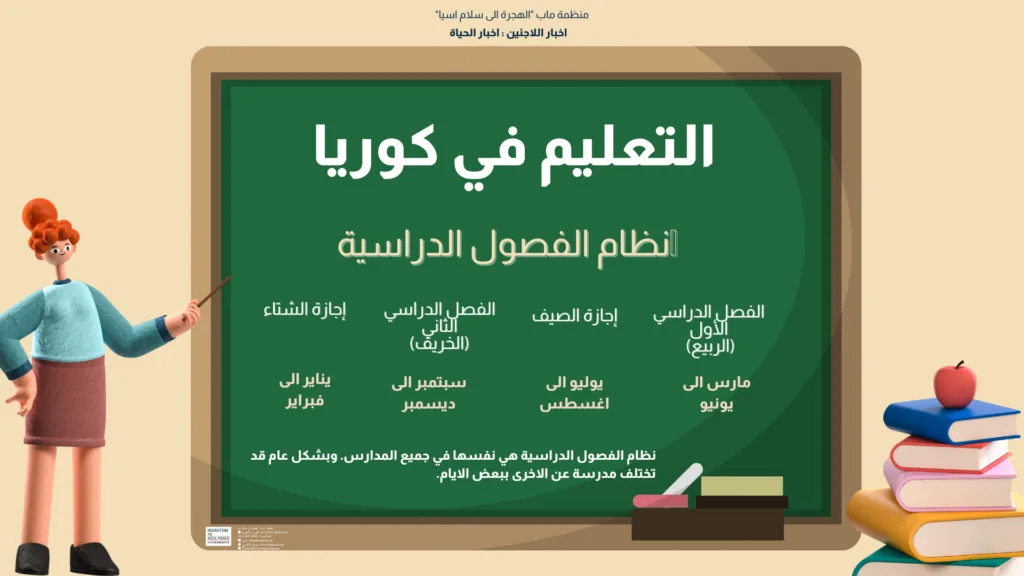
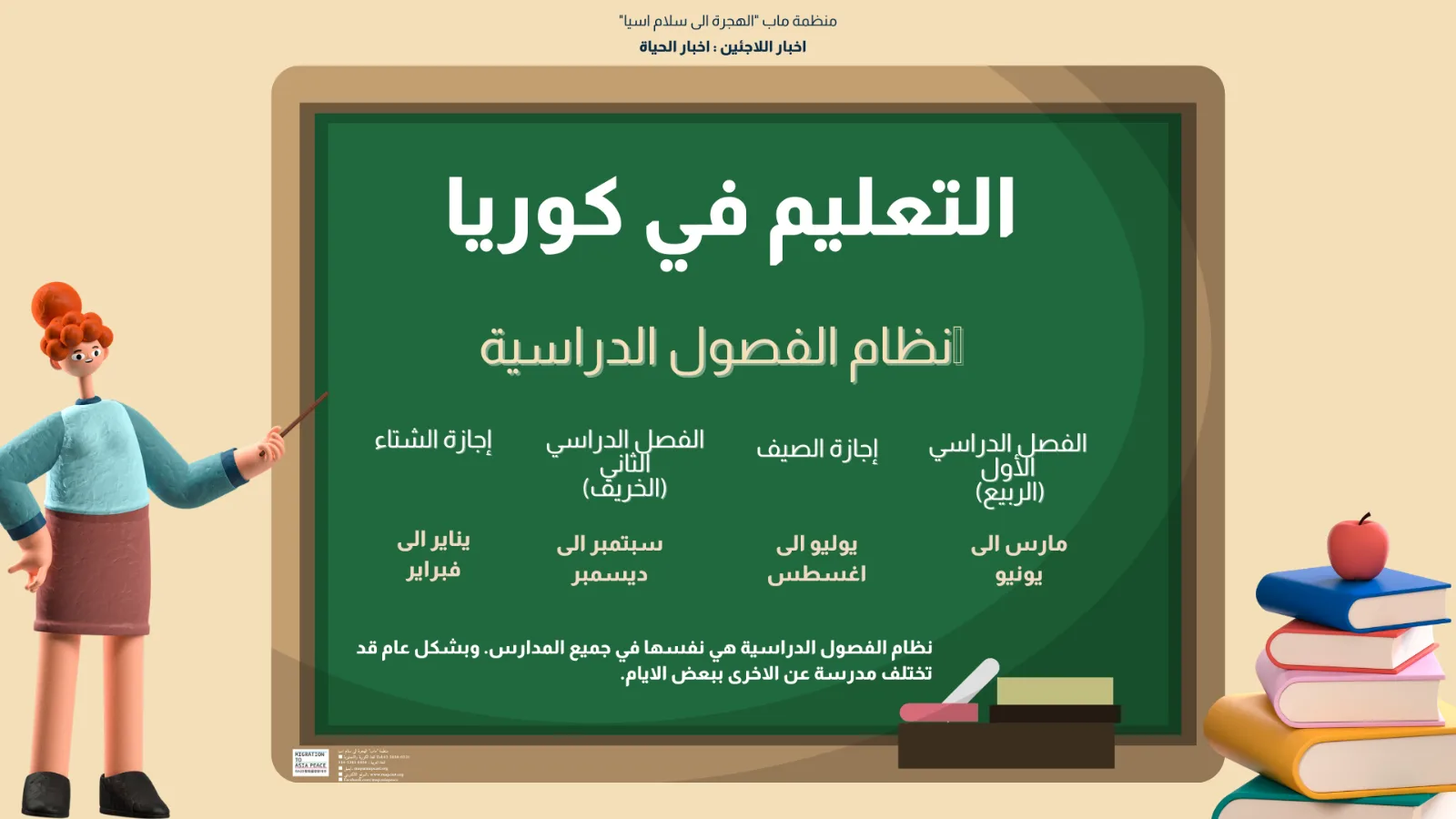
1- Semesters
| Winter break | Second semester (Autumn) | Summer break | First semester (Spring) |
| January to February | September to December | July to August | March to June |
The semester system is the same in all schools. In general, one school may differ from another by a few days.
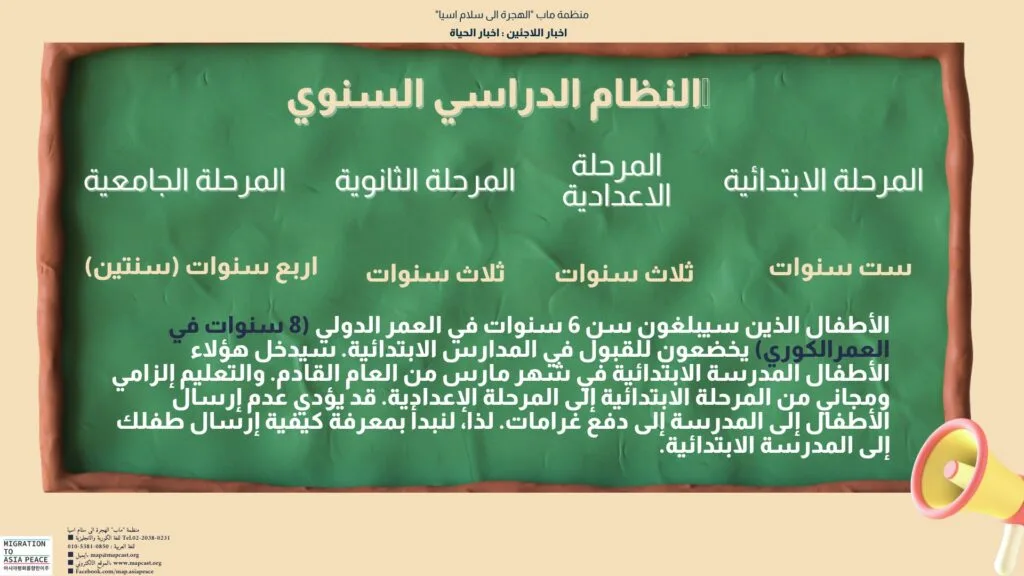
2- The annual school system
| University level | High school level | Middle school level | Elementary school level |
| Four years (two years) | Three years | Three years | Six years |
Children who will turn 6 in international age (8 in Korean age) are subject to admission to elementary school. These children will enter elementary school in March of next year. Education is compulsory and free from elementary school to middle school. Failing to send children to school may result in fines. So, let us start by learning how to send your child to elementary school.
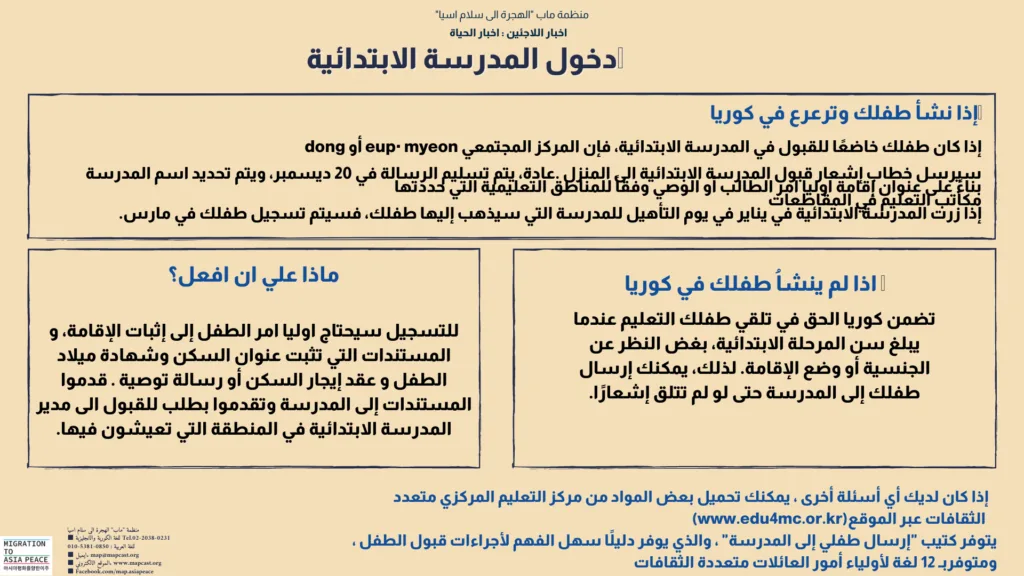
📙 Entering elementary school
If your child was born and raised in Korea
If your child is subject to elementary school admission, the community center
(eup, myeon or dong)
will send an elementary school admission notice letter to your home. Usually, the letter is delivered on December 20, and the name of the school is determined by the address of the student’s parents or guardian according to the school districts set by the
district offices of education
If you visit the elementary school in January on the orientation day for the school your child will attend, your child will be registered in March
2- If your child was not raised in Korea
Korea guarantees the right of your child to receive education when he or she reaches elementary school age, regardless of nationality or status of residence. Therefore, you can send your child to school even if you have not received a notice.
For registration, the child’s parents will need proof of residence, documents that prove the home address and the child’s birth, and a housing lease contract or a letter of recommendation. Bring the documents to the school and apply for admission to the principal of the elementary school in the area where you live
If you have any other questions, you can download some materials from the National Center for Multicultural Education through the website
The booklet “Sending My Child to School,” which provides an easy-to-understand guide to the child admission procedure, is available in 12 languages for parents of multicultural families.
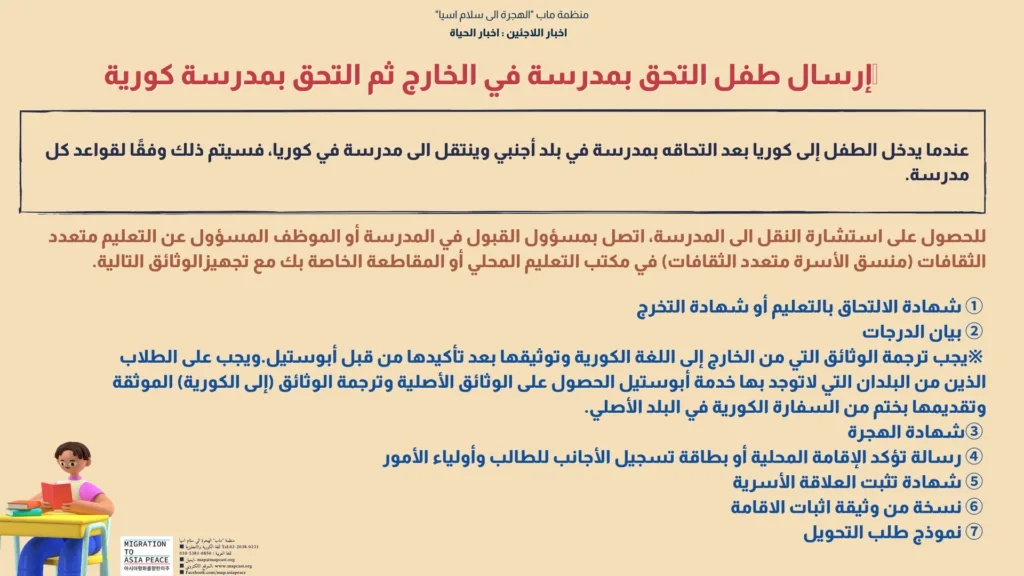
📗 Sending a child who attended school abroad to a Korean school
When a child enters Korea after attending a school in a foreign country and transfers to a school in Korea, this is done according to the rules of each school.
For transfer consultation, contact the school’s admissions officer or the officer in charge of multicultural education (multicultural family coordinator) at your local or district office of education, with the following documents prepared.
① Certificate of enrollment or certificate of graduation
② Transcript
※ Documents from abroad must be translated into Korean and notarized after being confirmed by an apostille.
Students from countries where an apostille service is not available must obtain the original documents and notarized translations (into Korean) and submit them with the stamp of the Korean embassy in the country of origin.
③ Immigration certificate
④ A letter confirming local residence, or the alien registration card of the student and parents
⑤ Certificate of family relationship
⑥ A copy of the resident registration
⑦ Transfer application form
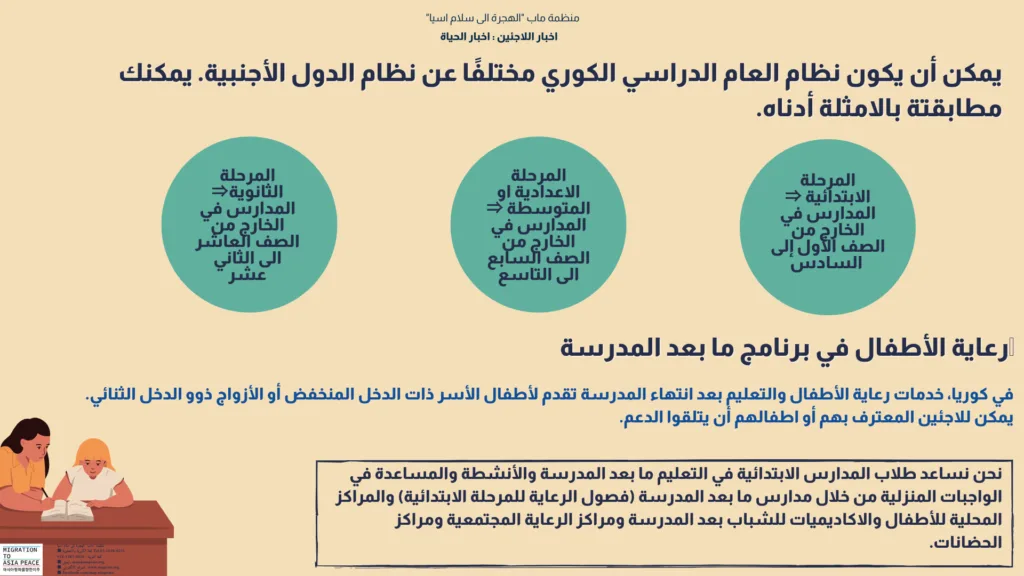
The Korean school year system may differ from that of foreign countries. You can match it using the examples below.
- Elementary school ⇒ schools abroad, grades 1 to 6
- Middle school ⇒ schools abroad, grades 7 to 9
- High school ⇒ schools abroad, grades 10 to 12
📘 Childcare in the after-school program
In Korea, childcare and education services after school are provided for children of low-income families or dual-income couples. Recognized refugees or their children can receive the support.
We help elementary school students with after-school education, activities and homework assistance through after-school schools (elementary care classes), local children’s centers, youth after-school academies, community care centers and day care centers.
Families facing financial difficulties can join these institutions free of charge through consultation.
🔺Be sure you know the following!
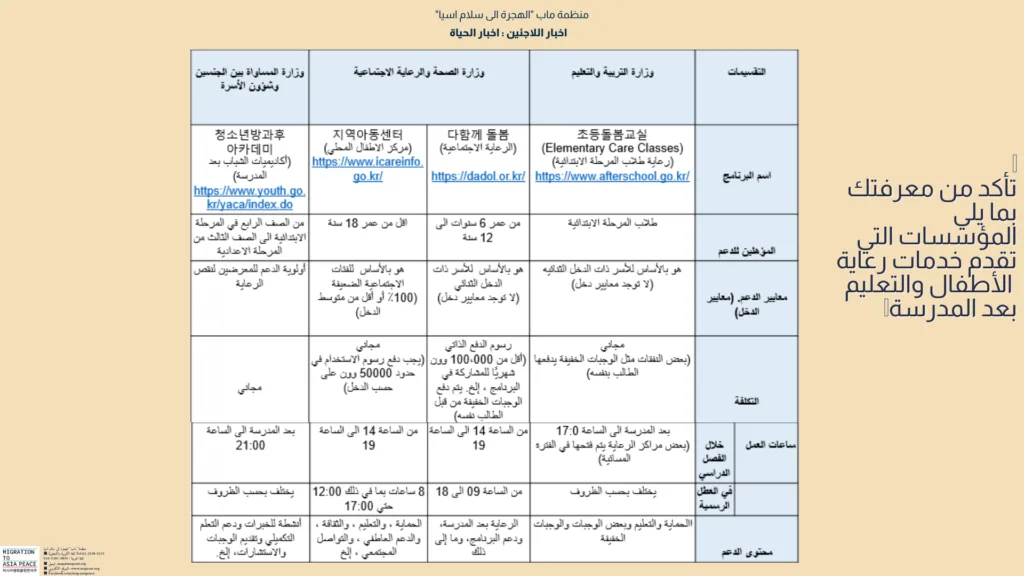
Institutions that provide childcare and after-school education services
| Ministry of Gender Equality and Family | Ministry of Health and Welfare | Ministry of Education | Divisions | ||
| Youth after-school academieshttps://www.youth.go.kr/yaca/index.do | Local children's centerhttps://www.icareinfo.go.kr/ | Community care https://dadol.or.kr/ | Care for elementary school students (Elementary Care Classes)https://www.afterschool.go.kr/ | Program name | |
| From 4th grade of elementary school to 3rd grade of middle school | Under 18 years of age | From 6 years of age to 12 years of age | Elementary school students | Eligible for support | |
| Priority for those at risk of neglect | Mainly for vulnerable social groups (100% or less of median income) | Mainly for dual-income families (no income criteria) | Mainly for dual-income families (no income criteria) | Support criteria (income criteria) | |
Free | Free (a usage fee of up to 50,000 won must be paid depending on income) | Self-pay fee (less than 100,000 won per month for participation in the program, etc.; snacks are paid for by the student) | Free (some expenses such as snacks are paid for by the student) | Cost | |
| After school until 21:00 | From 14:00 to 19:00 | From 14:00 to 19:00 | After school until 17:00 (some care centers open in the evening) | During the semester | Operating hours |
| Varies depending on circumstances | 8 hours, including 12:00 to 17:00 | From 09:00 to 18:00 | Varies depending on circumstances | During official holidays | |
| Experience activities, supplementary learning support, meals, counseling, etc. | Protection, education, culture, emotional support, community connection, etc. | After-school care, program support, etc. | Protection, education, some meals and snacks | Support content |