This is a contribution by Director Kim Youngah, published in the June 2022 issue of the webzine
https://www.humanrights.go.kr/webzine/webzineListAndDetail?issueNo=7608090&boardNo=7608100
Field Issue [2022.06] “Everyone, Everywhere, at All Times, Every Person Has the Right to Seek Safety.”
By Kim Youngah (Director of Migration to Asia Peace (MAP))
List of articles in this issue
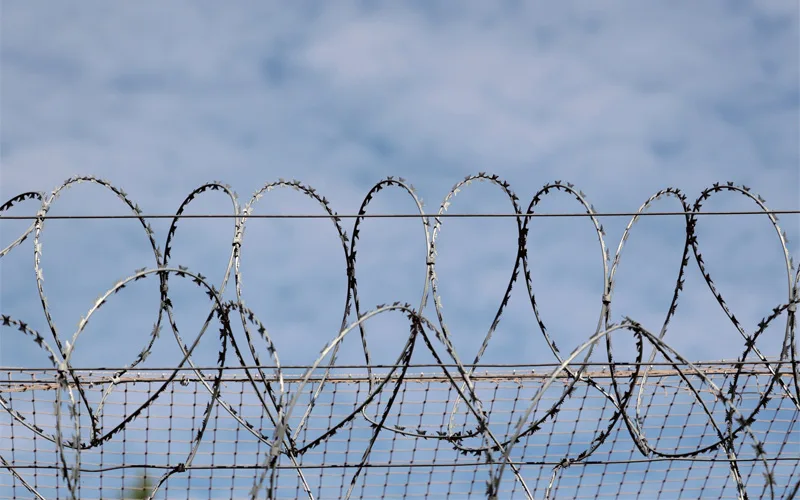
Barbed wire installed on the Polish border to keep out Belarusian refugees. _ September 27, 2021
Every year on June 20, the whole world marks World Refugee Day. It is a day to honour the strength and courage of people who were forced to flee their home countries to escape conflict and persecution. It is also a day to recognise and celebrate the efforts of local communities that have helped refugees start their lives again through support and inclusion. Designated an international day by the UN General Assembly in December 2000, it was first observed in the following year, the 50th anniversary of the 1951 Convention relating to the Status of Refugees (hereafter “the Refugee Convention”). The UN Refugee Agency announces a campaign theme for World Refugee Day every year. This year, the 71st anniversary of the Refugee Convention, the theme of World Refugee Day is neither a celebratory message nor an encouraging slogan.
“Everyone, everywhere, at all times, every person has the right to seek safety.”
The background against which the UN Refugee Agency has had to reaffirm Article 14 of the Universal Declaration of Human Rights, adopted in 1948, “the right to seek and to enjoy asylum,” is bleak. Over the past ten years the number of refugees and displaced people has more than doubled, reaching 100 million. This is due to conflicts and unstable politics in various countries. The United Nations has failed to achieve its purpose of peacefully adjusting or resolving international disputes and situations. Conflicts are prolonged, and bad dictatorial governments openly pass themselves off as states. 85% of the world’s refugees live in middle- and low-income countries that face their own economic and development problems. There, refugees are despised and exploited, live below the poverty line, and are often at risk of forced return. Developed countries strengthen border defences and build walls to keep refugees confined within their regions of origin. They catch refugees who arrive by sea, confine them on islands, and send them to refugee camps in other low-income countries. They even send coast guards that obstruct the sailing and landing of rubber boats, and at airports they use electronic information received in advance to identify passengers who seem likely to apply for asylum and pressure airlines to refuse to issue tickets before check-in. In a world where everything crosses borders, whether goods, services or people, the only ones who are refused and pushed back at the border are refugees.
Pushback, which blocks asylum applications at the source, is not only a story of Europe and the United States. In mid-March, five Ethiopians arrived at Incheon Airport and expressed their wish to apply for asylum. They explained that their lives had been threatened by the conflict between the Ethiopian federal government and the Tigray region and by ethnic conflict within Ethiopia. However, the Incheon Airport Immigration Office decided not to refer them to refugee examination. In other words, they were told they could not apply for refugee status. They could not return, and their stay sleeping at the airport began. In the end, after the immigration authorities accepted a court recommendation to cancel the decision not to refer them to examination, they obtained the right to apply for refugee status and entered Korea two months later. But what would have happened if a lawsuit had not been filed with the help of public interest lawyers? There is also a family that stayed in the transit area of Incheon Airport for 287 days from the end of December 2018 to receive an opportunity for refugee examination. It was a couple of Angolan nationals from the Congo, with four children under the age of 10. This family was recognised as refugees in October 2019.
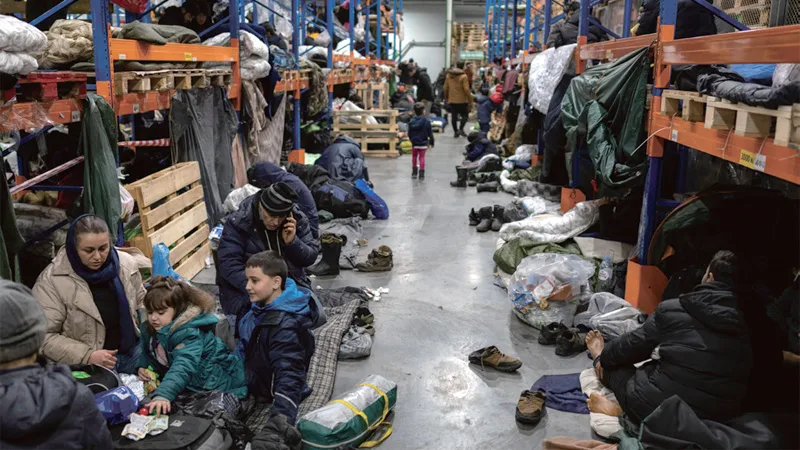
Belarusian refugees gathered in a logistics centre. _ November 19, 2021.
30 years since Korea joined the Refugee Convention and 10 years since the enactment of the Refugee Act
The Korean government has emphasised that it enacted the first law in Asia to implement the Refugee Convention, in order to escape requests from the international community to share the responsibility of refugee protection and criticism at home that refugee rights are not guaranteed. Compared with the earlier period, when a few provisions were placed in the Immigration Act and the right to refugee status examination and treatment was operated through Ministry of Justice directives and guidelines, putting the refugee recognition examination procedure in order and specifying treatment and rights by law with the enforcement of the Refugee Act was a step forward.
However, over the past nine years many problems have been revealed in the operation of the Refugee Act. It became possible to apply for refugee status at ports of entry, but the majority of people returned without even being able to apply for asylum. Although recording of the first refugee interview was made mandatory, there was manipulation of interpretation and interview records for Arabic-speaking refugee applicants. Although the principle of non-refoulement was stipulated, departure orders that are no different from forced deportation orders are issued indiscriminately, and detention is carried out to prepare for forced return. There is a provision on the right to be assisted by a lawyer, but it exists in name only.
Employment can be permitted six months after applying for refugee status, but the administration of work permits has become a factor that makes it difficult to find work even in the simple-labour, minimum-wage labour market that is permitted. A plan to build a centre to support the housing, living and education of refugee applicants and resettled refugees was pursued, but it cannot accommodate even 1.5% of the more than 25,000 refugee applicants. Living expense and medical expense support for refugee applicants was introduced, but because it is a “may” provision, it is not an obligation of the state. Living expenses, which can be applied for and received only during the six months after applying for refugee status, are sought by few applicants, and only 4% of those receive support.
Among refugee applicants there is anxiety that they cannot receive a fair examination because of their country of origin, religion or method of entry. In a situation where refugee applicants are not guaranteed the basic right to live humanely, examination periods that are repeatedly delayed threaten their survival.
A refugee recognition rate that is among the lowest in the world gives no hope to endure the long waiting time. Some refugees leave for a third country before completing the refugee examination procedure because their passport expiry date is approaching. This is because there is a high risk of being stuck in Korea without being recognised as a refugee. Refugees who barely arrive in a third country without being denied boarding sometimes receive refugee recognition at the airport, or within three or six months. Unless a fair and swift examination is guaranteed in the Refugee Act, the right to seek asylum will continue to be challenged.
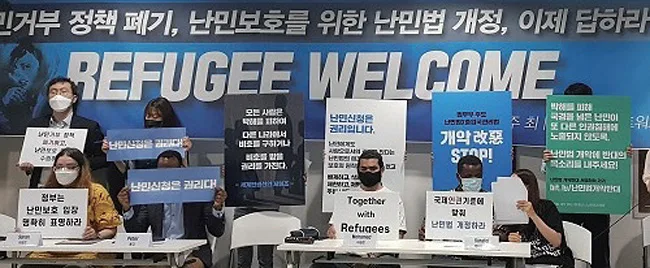
A press conference by the Korea Refugee Rights Network urging amendment of the Refugee Act for refugee protection. _ June 18, 2020. (Courtesy of Dongcheon Foundation)
Whatever the threat was, whether war, violence or persecution, people are entitled to protection
By the end of 2021, the number of people granted refugee status was 1,163, and the number granted humanitarian stay status was 2,436. Since the Refugee Act came into force in 2013, the refugee recognition rate has continued to fall from 9.7%, and since 2018 it has stayed below 1%.
By contrast, the number of people with humanitarian stay status, which was lower than the number of recognised refugees before the Refugee Act was enacted, has increased greatly. In Korea, humanitarian stay status tends to be granted to war refugees and victims of gender-based persecution, and an absurd situation has arisen in which the Refugee Act is used as the basis for not granting refugee status to war refugees. The Refugee Act reflects the grounds for refugee status under the 1951 Refugee Convention, and the logic is that apart from race, nationality, religion, membership of a particular social group and political opinion, war is not among them.
When interpreting and applying the Refugee Convention, persecution related to the above grounds can become more severe in a conflict environment, so that risk should be assessed in individual examinations, but the refugee examinations of Syrians and Yemenis did not do so.
In the international community, the 1951 refugee protection system has been supplemented by granting international protection status to refugees who must be protected on the grounds in the 1951 Convention, and granting complementary protection status to refugees who must be protected on grounds that were not foreseen when the Convention was concluded, without making a large difference in the rights attached to the two statuses. Humanitarian stay status in Korea can be regarded as complementary protection status. In the data of international organisations including the World Bank and of migration data research institutes, the figure given for refugee protection in Korea is the sum of recognised refugees and people with humanitarian stay status. Even so, Yemeni asylum seekers who entered through Jeju suffered the stigma of being “fake refugees” or abusers of the visa-free entry system even after receiving humanitarian stay status. The current Refugee Act defines persons with humanitarian stay status but leaves protective measures blank.
Apart from permission for employment activities, there are no provisions on the content of asylum or on family protection. As a result, the lives of people with humanitarian stay status are as precarious as those of refugee applicants and other foreigners on temporary stay. Only the period of the residence permit changed from six months to one year, and the visa remains in the “other” category. They still need to obtain work permits, and only simple-labour occupations are permitted. Except for gaining eligibility for regional health insurance only in 2019, through the reform of the foreigner health insurance system, they remain outside the social security system. They are also not safe from the threat of departure orders and forced return.
Can refugees in Korea bring their refugee situation to an end?
It is said that on average it currently takes 20 years worldwide for a refugee to leave a refugee situation. Efforts must be made to resolve the conflicts and human rights violations that generate refugees, but within the refugee protection system there are the acquisition of citizenship or nationality by the refugee and the resettlement of refugees to a contracting state. The current Refugee Act contains nothing on encouraging the naturalisation of refugees. Under the Nationality Act, refugees must meet requirements such as length of residence, language, and income and property in order to apply for naturalisation. These are the same conditions as when a foreigner who has a home country to protect them applies for nationality. Among the facts checked to correct various misunderstandings about refugees, it is emphasised that granting refugee status does not mean granting nationality, but the Refugee Convention stipulates that contracting states shall make every effort to expedite naturalisation proceedings and to reduce as far as possible the charges and costs of such proceedings. When a refugee who has lost a state to protect them acquires nationality and comes to have rights and duties in a society, human rights are realised and the refugee can also contribute to society, but this perspective remains in the background of the discussion.
The Refugee Act laid the basis for a system of resettling refugees from overseas to Korea. In December 2019 at the Global Refugee Forum, the Korean government representative announced a pledge to continue collective efforts with the international community to find solutions to protracted refugee situations, citing as concrete efforts that Korea was the second country in Asia to start a refugee resettlement pilot programme in 2015 and that it had doubled the number of resettled refugees. Looking closely, 22 people were resettled to Korea in 2015, followed by 34 (2016), 30 (2017), 26 (2018), 37 (2019) and 17 (2020), and in 2021 it was suspended because of COVID-19. Considering that the number of refugees resettled worldwide in 2019 was 107,800, this is a scale that is embarrassing to present as an achievement. Moreover, refugees resettled to Korea, although they had already spent time in a protracted refugee situation, receive no consideration with regard to permanent residence and naturalisation, just like recognised refugees in Korea, so their refugee situation is prolonged in Korea as well.
The basic human rights of refugees cannot be protected by the Refugee Act alone. Birth registration, proof of family relations, protection from discrimination, civil and political rights, and economic, social and cultural rights require the revision of related laws and measures by the relevant ministries. However, the rights that people hold because they are refugees, namely the right to seek asylum, the right to be examined fairly and without discrimination, the right not to be arbitrarily detained or forcibly returned, and the right to live with family and to be protected from trafficking for the sake of human dignity, must be guaranteed by the Refugee Act. The assessment of refugee protection in Korea and the discussion of amending the Refugee Act should be centred on these rights. In addition, a future amended Refugee Act should include the government’s obligations on social integration and encouragement of naturalisation, and on securing the funds needed for refugee examination and settlement support.
Forms of refugee protection within Korea’s Refugee Act: recognised refugees (international protection status)
Humanitarian stay status (complementary protection status); resettlement (resettled to Korea and given recognised refugee status)
Cumulative refugee figures (as of 2021): total of 1,156 recognised refugees
Total of 2,412 persons with humanitarian stay status
Total of 78,383 refugee applications (1994–2021)
Refugee recognition (international protection status) rates of G20 countries, 2010–2020
1st Brazil 67.0%, 18th Russia 2.7%, 19th Korea 1.3%, 20th Japan 0.3%
Refugees resettled to Korea, 2015–2021: 166 people
2019: 37 people (*107,800 worldwide) 2020: 17 people (*34,400 worldwide)
Forms of refugee protection outside Korea’s Refugee Act
Special humanitarian stay measures: Myanmar, Ukraine; persons of special merit: Afghanistan
Korea’s donations to the UN Refugee Agency in 2022: 29th for the private sector, 31st for the government, 26th for per-capita donation