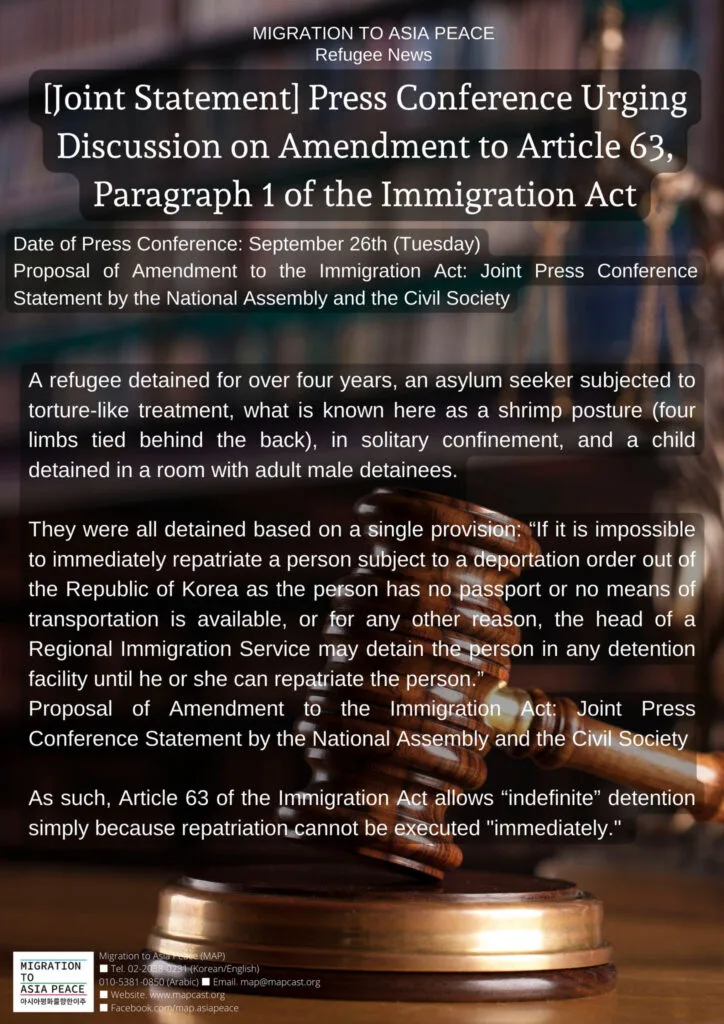
Date of Press Conference: September 26th (Tuesday)
Proposal of Amendment to the Immigration Act: Joint Press Conference Statement by the National Assembly and the Civil Society
A refugee detained for over four years, an asylum seeker subjected to torture-like treatment, what is known here as a shrimp posture (four limbs tied behind the back), in solitary confinement, and a child detained in a room with adult male detainees.
They were all detained based on a single provision: “If it is impossible to immediately repatriate a person subject to a deportation order out of the Republic of Korea as the person has no passport or no means of transportation is available, or for any other reason, the head of a Regional Immigration Service may detain the person in any detention facility until he or she can repatriate the person.”
As such, Article 63 of the Immigration Act allows “indefinite” detention simply because repatriation cannot be executed “immediately.”
Whether detention is necessary is not assessed or decided. Also, whether to detain a person and for how long is entirely up to the administrative office that enforces the deportation order. In practice, a detention order automatically follows a deportation order.
It does not require a decision to be made by comparing and judging the necessity of detention and the harm caused by detention. Due consideration is not given to whether the person has a disease or disability, is pregnant, has family members in need of care in Korea, or whether detention is expected to be prolonged because refugee status screening or remedy procedures against rights violation is in progress.
As a result, situations have arisen repeatedly where migrants in vulnerable positions, such as asylum seekers who cannot return to their home countries and cases in which domestic relief procedures are in progress due to non-payment of wages, find themselves with their detention extended without any fault of their own.
Restricting physical freedom is already on the verge of infringing upon human dignity, even if it is justified. Therefore, regardless of the purpose, the enforcement of detention should be reduced to the necessary minimum and be carried out in accordance with strict requirements and procedures. In particular, unlimited detention cannot be justified under any circumstances.
In 2015, the UN Human Rights Committee (UNHRC) recommended that the South Korean government limit the duration of immigration detention and ensure that detention is used only as an appropriate last resort. The UN Committee on the Elimination of Racial Discrimination (UNCERD) also recommended in 2019 that the lawfulness of the detention be regularly reviewed by an independent mechanism; that the detention of asylum seekers be considered only as a measure of last resort and for the shortest possible period of time; that a time limit for the detention of migrants be established and the use of alternative measures to detention be prioritized; and that the detention of children and minors be avoided. The ending of child detention is advocated widely. The UN Committee on the Rights of the Child (UNCRC) recommended that the detention of children be expeditiously and completely ceased, stating that the detention of children for immigration related purposes cannot be justified under any circumstances.
Countries around the world ensure the review of immigration detention by an independent and neutral body while absolutely limiting the period of detention. Under the European Union Return Directive, the EU Member States limit immigration detention to a maximum of 12 months after initial 6 months, while France sets the maximum detention limit at 90 days, Taiwan at 100 days, and South Africa at 120 days.
The Constitutional Court of Korea had three opportunities to rule unconstitutional that detention under Article 63 of the Immigration Act could be carried out too easily and arbitrarily. At the time of the second unconstitutionality suit, the majority of the opinion deemed it unconstitutional, but the six-member quorum was not reached, so the decision was made to be constitutional, and the ball was transferred back to the National Assembly. However, while the legislative body just sat on its hands, the opportunity returned to the Constitutional Court with the Suwon District Court’s request to rule on the constitutionality of the article, and on March 23rd, 2023, the Constitutional Court confirmed that Article 63 of the Immigration Act was not in accordance with the Constitution and assigned the National Assembly a task of amending the Immigration Act to conform to the Constitution.
A proposed amendment to the Immigration Act, initiated by Representative Park Joo-min, stipulates the requirements for detention for executing deportation orders, ensuring that detention would be used only as a last resort. It limits the period of detention, and allows the comparison between the necessity of detention and the harm it may cause based on the situation of the migrants subject to the deportation order. It allows the migrants to appeal to the court against detention. It also stipulates the minimum legal safeguard to prevent arbitrary detention by requiring court review if the initial detention period of 20 days is to be extended.
As the Constitutional Court temporarily maintains the effect of Article 63, Paragraph 1 of the Immigration Act until May 31, 2025, arbitrary detention of migrants persists despite the ruling on its unconstitutionality. Recently a 3-year-old child was detained with adult males in a windowless room for 19 days. We sincerely hope that the amendment will be quickly passed to put an end to unconstitutional detention.