[No. 25-13 HR#10]
-
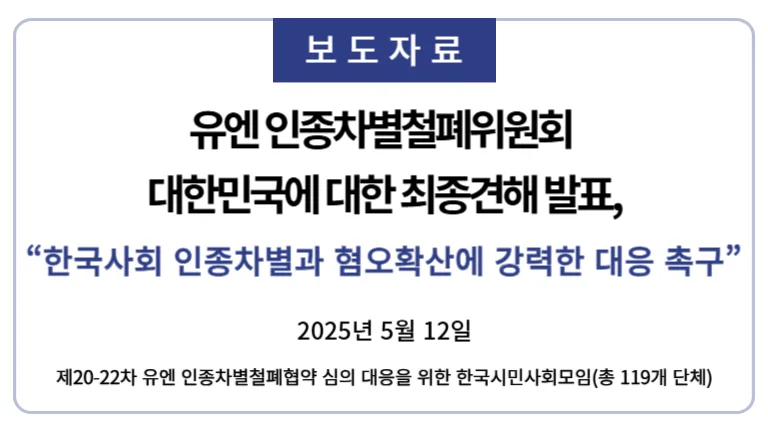
On May 7, the UN Committee on the Elimination of Racial Discrimination (hereinafter the “Committee”) released its Concluding Observations on the Republic of Korea’s 20th–22nd periodic reports. In the Concluding Observations, the Committee pointed out that discrimination and hatred against migrants in Korean society are increasing but that the government of the Republic of Korea has failed to take appropriate measures to stop them. It criticized the institutional response to racial discrimination and the effective protection system as markedly inadequate, and urged the government to promptly take substantive institutional measures to improve them. The Committee’s review of the Republic of Korea was held in Geneva, Switzerland, on April 29 and 30, 2025 (local time), for the first time in seven years since 2018, and examined the implementation of the Republic of Korea’s 「International Convention on the Elimination of All Forms of Racial Discrimination」 (hereinafter the “Convention on the Elimination of Racial Discrimination”). In the Concluding Observations, the Committee made the following recommendations to the government of the Republic of Korea.
-
The Committee expressed regret that “the Republic of Korea has not adopted comprehensive legislation that defines and prohibits all forms of racial discrimination (including direct, indirect and intersectional discrimination) as set out in article 1 of the Convention.” It stressed in particular that legislation to guarantee the rights of foreigners, migrants and non-citizens is urgently needed. The Committee urged the Republic of Korea to “immediately introduce legislation that explicitly prohibits racial discrimination in both the public and private spheres,” and requested that discriminatory provisions against non-citizens in existing laws also be reviewed in line with international standards.
-
The Committee expressed concern about the increase in hate speech and hate crimes, and pointed out that hate speech against migrants and minorities is spreading both online and offline. In particular, it directly mentioned cases such as the opposition to the construction of a mosque in Daegu and the online circulation of videos showing the detention and assault of undocumented migrants, and pointed out that the government’s response has been passive. The Committee recommended that “hate speech by public figures, including politicians, must be firmly condemned and punished, and it is urgent to amend the law so that a racist motive is reflected as an aggravating factor in criminal punishment.” It also recommended efforts to promptly remove hate content from the media, the internet and social media platforms, and to sanction and punish it.
-
On the rights of migrant workers, the Committee pointed out widespread discrimination, including restrictions on changing workplaces, minimum wage, high rates of industrial accidents, unpaid wages and the right to housing. It expressed concern that “Korea’s Employment Permit System seriously restricts the rights of migrant workers and leads to harms such as wage exploitation, industrial accidents and violations of the right to housing.” In particular, it noted that the industrial accident fatality rate of migrant workers is twice that of Korean nationals, and that they are concentrated in dangerous sectors such as agriculture and fishing. The Committee recommended granting migrant workers the right to change workplaces autonomously, allowing family accompaniment regardless of whether they are skilled or unskilled, and revising labor laws as a whole to guarantee substantive equality. It also recommended expanding sustainable support for counseling and interpretation services and improving housing.
-
On undocumented migrants, the Committee pointed out that policy must shift from a deterrence-centered approach to a human-rights-centered approach. The Committee diagnosed that “the lack of regular migration channels, short visa terms and excessive penalties for loss of status of stay are structural causes of the increase in undocumented migrant workers.” It also expressed serious concern about violence and deaths during crackdowns, and about the reality that victims hesitate to report because of the “duty to notify immigration authorities.” The Committee clearly urged that “stability of residence be guaranteed to those who report rights violations, and the use of the term ‘illegal resident’ in official documents be prohibited.”
-
On refugees and humanitarian status holders, the Committee pointed out that procedural delays and restrictions on rights raise concern about violations of international human rights norms. It also pointed to a shortage of refugee examiners, the abuse of non-referral decisions at ports of entry, the absence of livelihood support, and concerns about forced return, and assessed that “Korea’s refugee recognition rate is excessively low.” It stated that more than 98 percent of refugee applicants do not receive livelihood support and face substantive barriers in work permits, health care and education. The Committee urged the Republic of Korea to expand the capacity of the refugee status determination system and to guarantee family reunification and basic rights for humanitarian status holders as well.
-
On education and social security, the Committee pointed out that migrant children must be guaranteed the right to education without discrimination. It pointed out that financial requirements and administrative barriers are excessive in migrant children’s access to education, especially in entering high school and university. It also expressed concern that the Framework Act on Education still does not include non-citizen children among those subject to compulsory education, and recommended measures to improve this. As for the social security system, it raised as a problem that many non-citizens are excluded from health insurance and Emergency Aid and Support, and in particular the eligibility restrictions for persons with disabilities and children. It emphasized that the principle of reciprocity cannot be a legitimate ground for denying the basic human rights of vulnerable groups.
-
The Committee pointed out problems of birth registration, citizenship and statelessness, stating that the registration of every child must be guaranteed and a path to citizenship must be provided to long-term residents. The Committee took seriously the fact that there are cases in which children born to foreign-born parents are excluded from birth registration. It also pointed out that there is a lack of substantive pathways for long-term resident migrants and their children to acquire citizenship. There is also no legal basis for the recognition and treatment of stateless persons. The Committee recommended urgently pursuing universal birth registration, granting legal status to children without status of stay, and legislation to protect stateless persons.
-
Recalling its repeated earlier recommendations, the Committee also recommended improving the system so that marriage migrants can stay regardless of the grounds for the dissolution of the marriage, child-rearing and similar circumstances. It pointed out that trafficking in persons for labor and sexual exploitation still exists as a serious problem in the Republic of Korea, and recommended strengthening the law, punishing perpetrators, and training relevant agencies and public officials. It also expressed concern about the long-term detention of migrants, including refugee applicants, and recommended amending the current legal provision that allows refugee applicants to be detained for up to 20 months, securing the independence of the Foreigner Protection Committee, and prohibiting the detention of all children.
-
In addition, the Committee pointed out that serious problems are arising in the functioning and effectiveness of the National Human Rights Commission of Korea, and expressed concern over reports that its relationship with civil society organizations is deteriorating. It is the first time that the UN Committee on the Elimination of Racial Discrimination has explicitly pointed out problems of the National Human Rights Commission of Korea in its Concluding Observations on the Republic of Korea, which is highly unusual.
-
In its follow-up and request for the next report, the Committee designated six areas as “recommendations of particular importance” for the Korean government: ▲ enactment of an anti-discrimination law ▲ regulation of hate speech ▲ protection of undocumented migrants ▲ improvement of migrant detention ▲ guarantee of refugee rights ▲ expanded access to citizenship. It asked the government to report specific implementation in the next periodic report (due by January 2030). It also separately asked the government to submit to the Committee, within one year, an interim report on progress in securing the independence of the National Human Rights Commission of Korea, resolving the delayed construction of the mosque in Daegu, and adopting a universal birth registration bill.
Attachments
-
Concluding Observations on the 20th–22nd reports of the Republic of Korea, UN Committee on the Elimination of Racial Discrimination (English)
-
Unofficial Korean translation
Korea Civil Society Coalition for Responding to the Review of the 20th–22nd Reports under the UN Convention on the Elimination of Racial Discrimination (119 organizations in total)
*The attached files can be found at this link.