Our Demands to the New Government Human Rights Organizations’ Ten Proposals for Protecting Refugee Rights
Korean society recently achieved a change of government through the power of its citizens against martial law and authoritarianism. This change is not limited to the restoration of domestic democracy; it also brings a responsibility to expand the values of human rights and peace through solidarity with the international community. The new government must realize the aspirations of the citizens who fought against authoritarianism and violence, and at the same time must pursue policies that actively protect and show solidarity with refugees and migrants facing the same crisis.
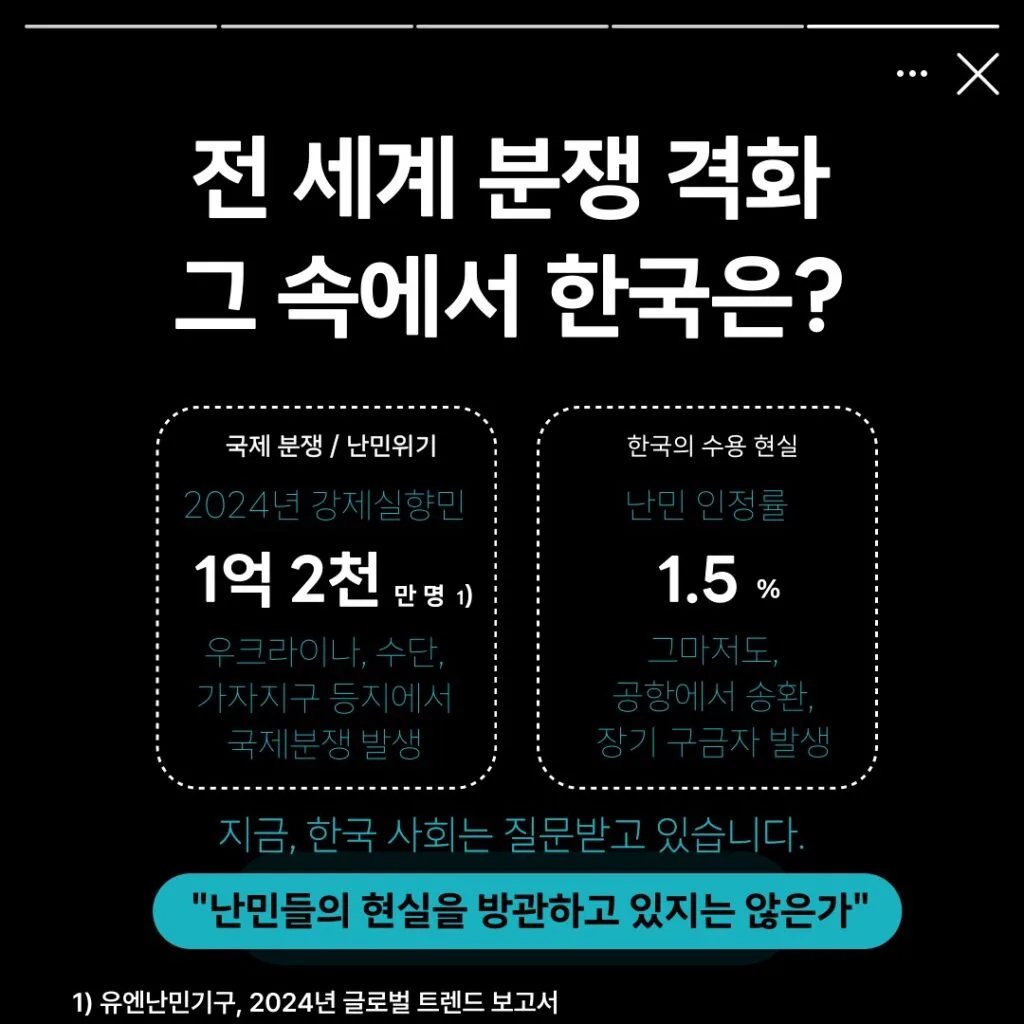
We witness every day the horrific international conflicts and humanitarian crises taking place in Ukraine, Sudan, the Gaza Strip, and elsewhere. In Ukraine, millions of people have lost their homes in a prolonged war, and in Sudan, a military coup and civil war have subjected countless civilians to forced displacement and violence. Because of Israel’s bombardment of the Gaza Strip and extreme hunger, most Palestinians have repeatedly fled their homes and their survival is under threat. Although Korea must fulfill the responsibility the international community has assigned to it toward refugees who came to Korea to escape persecution from Ethiopia, Yemen, Myanmar, Afghanistan, China, and other places around the world, the Korean government has so far been in a hurry to restrict and reduce the rights of refugees and drive them out, rather than guarantee and expand their civic lives.
Refugees abroad have found it hard to seek shelter because of the Korean government’s visa policy that prevents them from setting foot on Korean soil, and refugees who managed to arrive in Korea were returned after receiving a non-referral decision at the airport, without even being given an opportunity for examination. Even those who set foot on Korean soil have been pushed to leave on their own, forcibly returned, or have left because they could not endure long-term detention, amid the absence of basic livelihood and housing support and with an unstable status of stay. The very few refugees who passed through the 1 percent needle’s eye and obtained status have been pushed outside the social safety net and are crushed by poverty and the weight of life, amid trauma, language and cultural barriers, the absence of government policies to support settlement, society’s view of refugees as strangers, and the voices of groups that reproduce this as hatred. People who are not recognized as refugees and live for a long time as humanitarian status holders, a form of stay that is effectively temporary, experience emotional isolation from being separated from their families for years, and their families remaining in their home countries suffer hardship from persecution and family breakup. The government, which stood by while this reality unfolded, has gradually and openly pursued policies of rejecting refugees and has steadily pushed legislation that restricts refugee recognition, expels refugees, and limits opportunities to apply for refugee status. In the process, it has branded most asylum seekers as abusive applicants and incited hatred.
The UN Committee on the Elimination of Racial Discrimination, in its 2025 concluding observations on the Republic of Korea, also pointed out problems including the low refugee recognition rate, the lack of sufficiently trained examiners, the insufficient independence and capacity of the Refugee Committee, the abuse of non-referral decisions against asylum seekers at ports of entry such as airports and the lack of access to legal assistance, the issuance of forced return orders against recognized refugees, the lack of livelihood support, work permits, and medical support for asylum seekers, and the failure to guarantee family reunification for humanitarian status holders and their restricted access to basic services. The Committee strongly recommended that the government make substantive improvements, such as strengthening refugee examination capacity, guaranteeing fair and transparent procedures, disclosing statistics, expanding employment, medical, and basic livelihood support, and guaranteeing the right to family reunification.
We once again demand that the new government faithfully implement the recommendations of international organizations and immediately take substantive measures to build a society in which all refugees can live with dignity. We strongly urge the government to establish, even now, a refugee policy based on the principles of human rights and equality so that refugees can enjoy civic lives as equal members of Korean society, and we make the following demands.
-
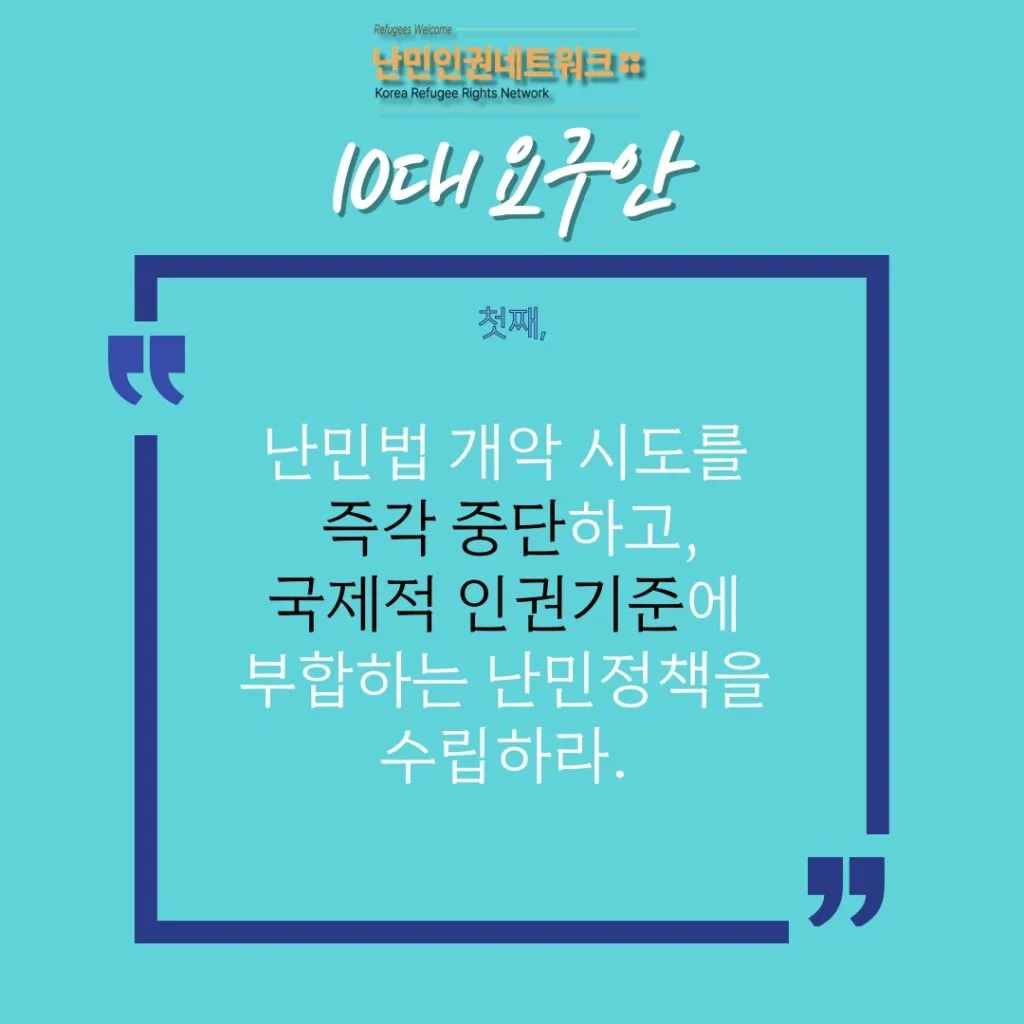
Immediately stop attempts to worsen the Refugee Act, and establish a refugee policy that conforms to international human rights standards.
-
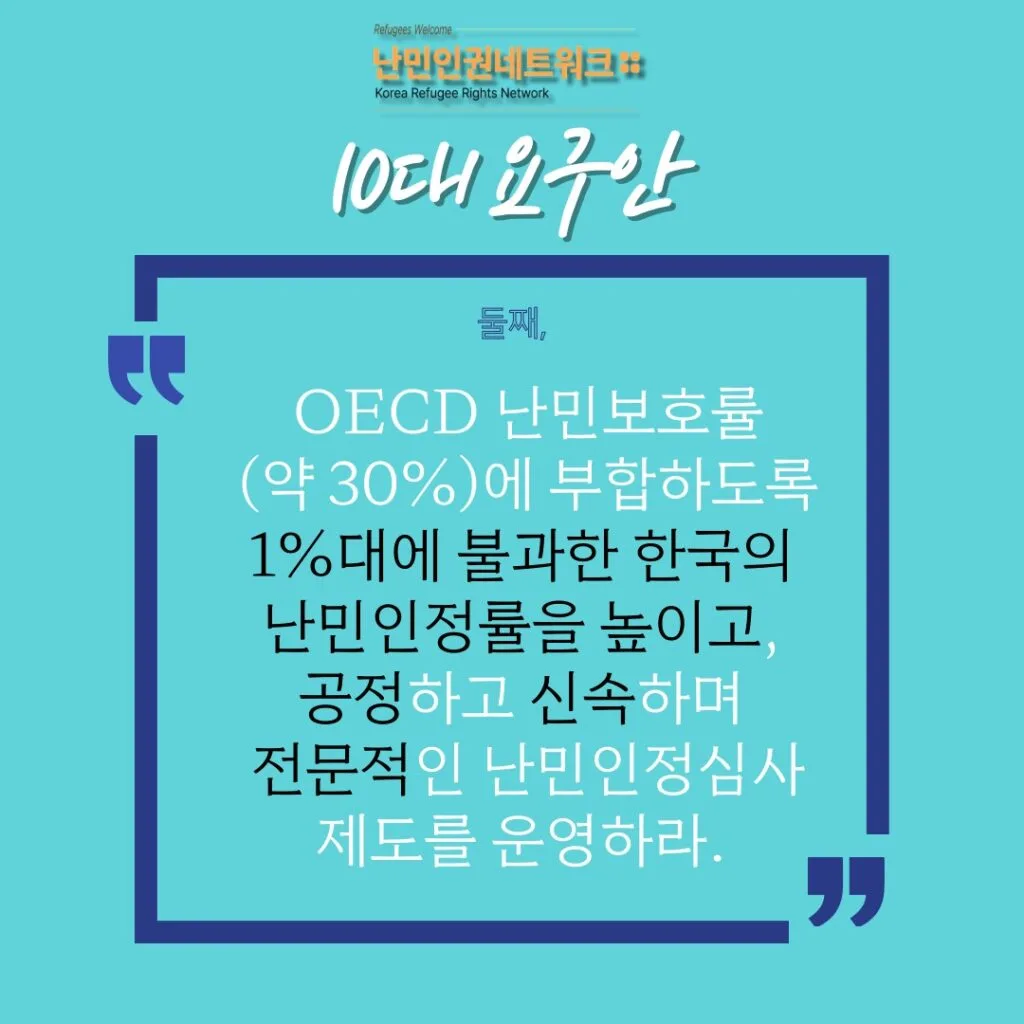
Raise Korea’s refugee recognition rate, which is only around 1 percent, to match the OECD refugee protection rate (about 30 percent), and operate a fair, prompt, and professional refugee status determination system.
-
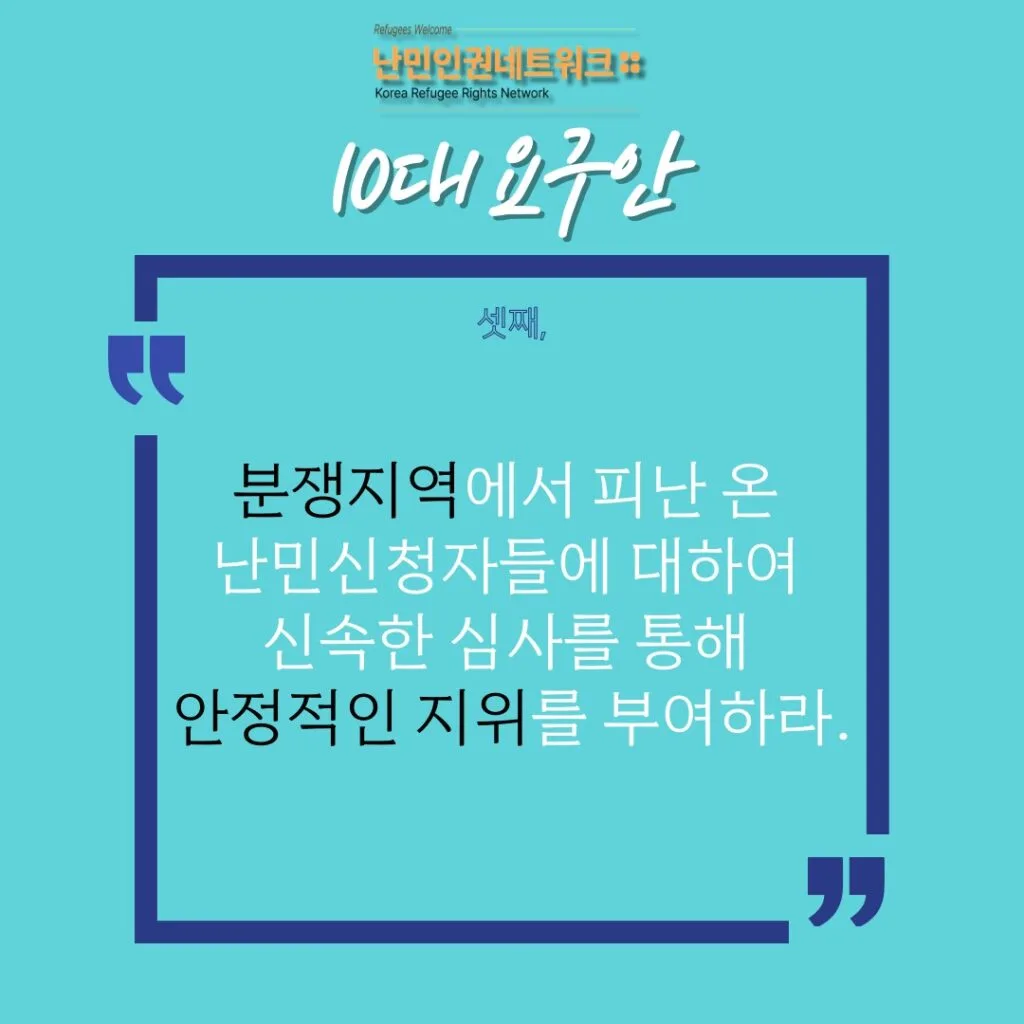
Grant stable status through prompt examination to asylum seekers who have fled from conflict areas.
-
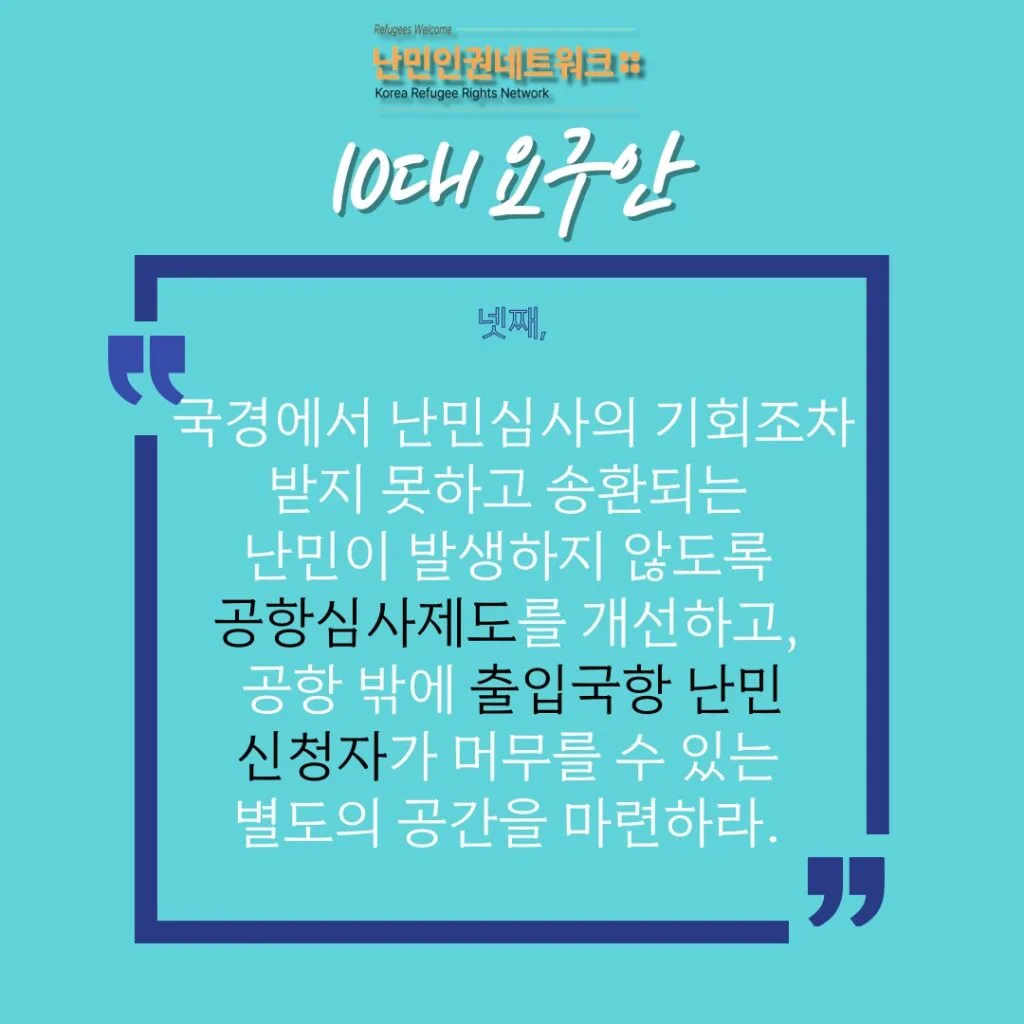
Improve the airport screening system so that no refugees are returned without even receiving an opportunity for refugee examination at the border, and provide a separate space outside the airport where asylum seekers at ports of entry can stay.
-
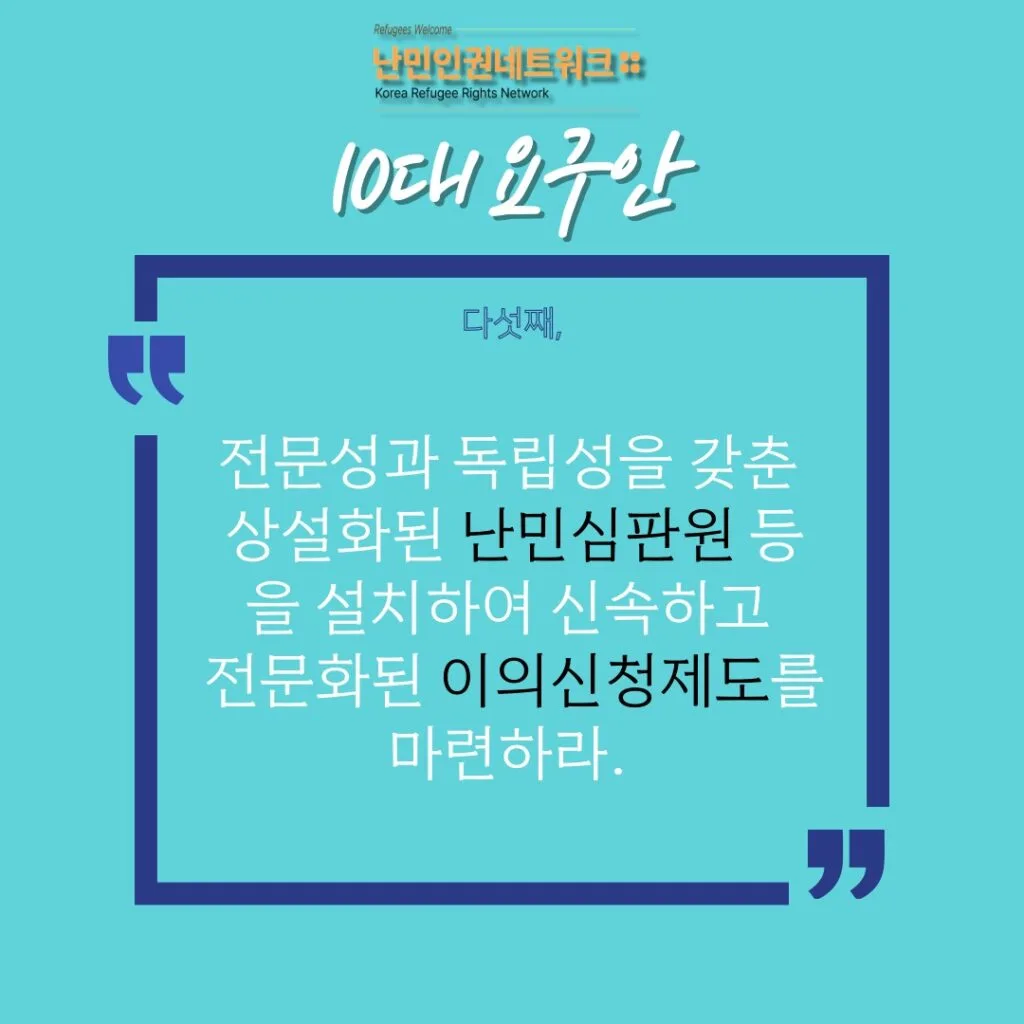
Establish a permanent refugee tribunal with expertise and independence, and put in place a prompt and specialized appeal system.
-
The amended Immigration Act, which allows asylum seekers to be detained for up to 20 months, is unconstitutional. Operate the Foreigner Protection Committee as an independent body with a substantive role, prepare alternatives to the detention of asylum seekers, and prohibit the detention of children.
-
Improve the work permit procedure for asylum seekers and guarantee their labor rights. Expand the livelihood support budget and make livelihood support mandatory for asylum seekers in vulnerable situations. Provide housing support for asylum seekers and expand medical support, including mental health care for refugees.
-
Abolish the current guideline that, from the perspective of “abusive refugee applications,” denies status of stay to certain asylum seekers, and guarantee the right of all asylum seekers to stay.
-
Guarantee humanitarian status holders the right to family reunification, labor rights, and basic livelihood, and grant them a stable status of stay. Establish systems to support the settlement of refugees and humanitarian status holders, including Korean language education, social integration, and vocational training.
-
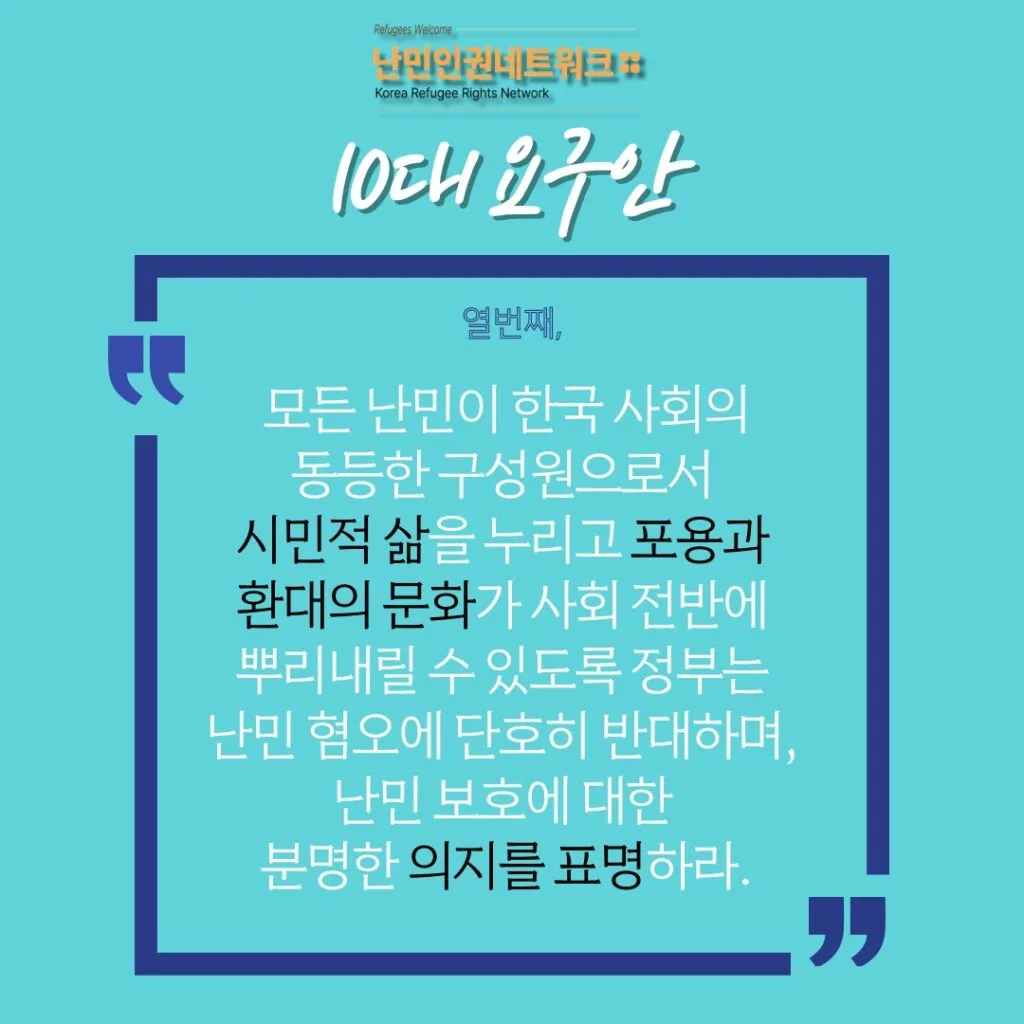
So that all refugees can enjoy civic lives as equal members of Korean society and a culture of inclusion and hospitality can take root throughout society, the government should firmly oppose hatred against refugees and clearly express its will to protect refugees.
-
-
경기이주평등연대(공감직업환경의학센터/노동당경기도당/노동해방을위한좌파활동가경기결집/노무법인약속/다산인권센터/민주노총경기도본부/민주노총수원용인오산화성지부/민주사회를위한변호사모임노동위원회/반월시화공단노동조합‘월담’/수원이주민센터/오산이주노동자센터/이주노동법률지원센터소금꽃나무/지구인의정류장/화성노동안전네트워크/화성외국인보호소방문시민모임‘마중’/한국노동안전보건연구소), 광주전남이주노동자인권네트워크, 국제난민지원단체 피난처, 국제민주연대, 난민인권네트워크(TFC(The First Contact for Refugee), 공익법센터 어필, 공익변호사와 함께하는 동행, 공익사단법인 정, 공익인권법재단 공감, 공익인권센터 드림(DREAM), 국제난민지원단체 피난처, 글로벌호프, 난민인권센터(NANCEN), 동두천난민공동체, 동두천가톨릭센터, 동작FM, 민주사회를 위한 변호사모임 국제연대위원회, 비영리단체 겨자풀, 사단법인 두루, 성가소비녀회 의정부관구 동두천 베타니아, 성가소비녀회 의정부관구 파주 베타니아, 수원글로벌드림센터, 순천이주민지원센터, 아시아의친구들, 아시아평화를향한이주MAP, 이주여성을위한문화경제공동체 에코팜므, 이주민지원공익센터 감동, 외국인이주노동자인권을위한모임, 의정부 EXODUS, 이주민센터 친구, 천주교제주교구이주사목센터 나오미, 재단법인 동천, 재단법인 화우공익재단, 제주평화인권연구소 왓, 참여연대, 파주EXODUS, 한국이주인권센터), 난민인권센터, 대구이주민선교센터, 비영리단체 겨자풀, 소수자난민인권네트워크, 이주구금대응네트워크((사)한국알트루사 난민과 함께살기, DLG공익인권센터, 공익법단체 두루, 공익법센터 어필, 공익인권법재단 공감, 난민인권센터, 대한불교조계종 사회노동위원회, 소수자난민인권네트워크, 아시아평화를향한이주MAP, 외국인이주·노동운동협의회, 이주노동자인권·노동권실현을 위한 대구경북지역연대회의, 이주노동자평등연대, 이주민지원공익센터 감사와 동행, 이주여성인권포럼, 천주교인권위원회, 화성외국인보호소방문시민모임 ‘마중’), 이주노동자 인권·노동권 실현을 위한 대구경북지역연대회의(경북북부이주노동자센터, 경주이주노동자센터, 노동해방을위한좌파활동가대구결집, 대구경북인도주의실천의사협의회, 대구사람장애인자립생활센터, 대구이주민선교센터(북부), 대구이주민선교센터(현풍), 땅과자유, 무지개인권연대, 민주노총경북지역본부, 민주노총대구지역본부, 민주사회를위한변호사모임대구지부, 성서공단지역지회, 이주민 건강권 실현을 위한 동행, 이주와가치, 인권운동연대, 장애인지역공동체, 노동당경북도당, 노동당대구시당, 녹색당대구시당, 정의당대구시당, 진보당대구시당, 기본소득당 대구시당), 이주노동자평등연대(건강권 실현을 위한 보건의료단체연합, 공공운수노조사회복지지부 이주여성조합원모임, 노동당, 노동사회과학연구소, 노동전선, 녹색당, 대한불교조계종사회노동위원회, 성공회용산나눔의집, 민변노동위원회, 사회진보연대, 이주노동자노동조합(MTU), (사)이주노동희망센터, 이주노동자운동후원회, 이주민센터친구, 인권운동네트워크 바람, 전국민주노동조합총연맹, 전국불안정노동철폐연대, 지구인의정류장, 천주교인권위원회, 필리핀공동체카사마코, 한국비정규노동센터), 이주민센터 친구, 이주민지원공익센터 감동, 이주여성인권포럼, 인권운동네트워크 바람, 인권운동사랑방, 전진상우리집(국제가톨릭형제회), 제주평화인권센터, 트랜스보더링랩 Trans-boder-ing Lab, 한국이주여성인권센터, 한국이주인권센터