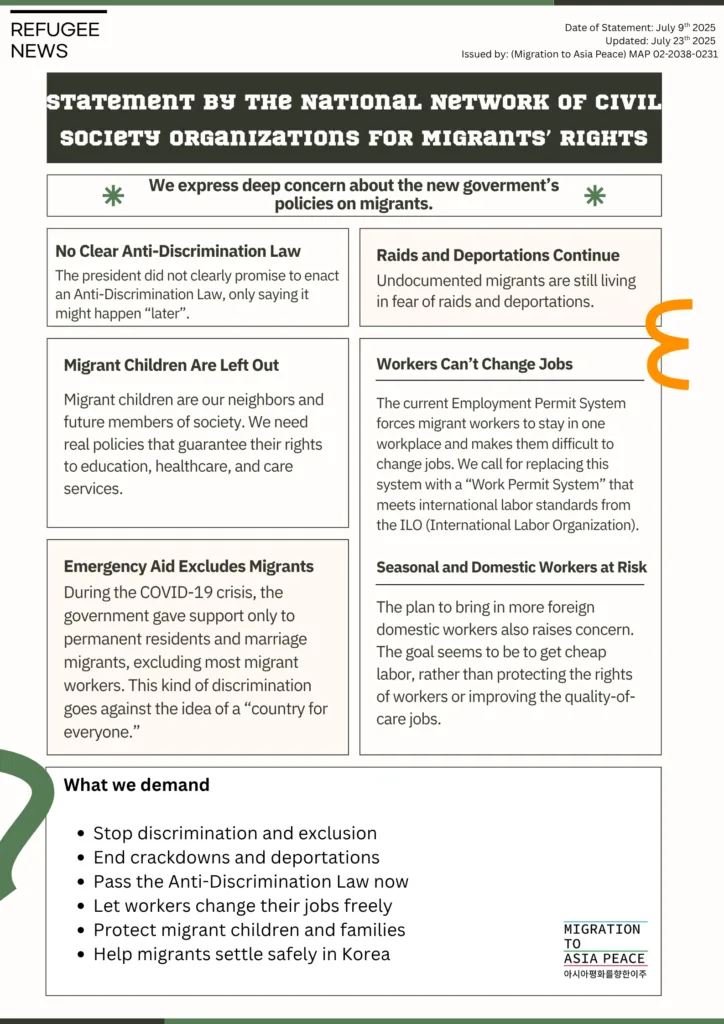
We express deep concern about the 21st People’s Sovereignty Government’s policies on migrants.
On July 3rd, President Lee Jae-myung held a press conference marking 30 days since taking office. As organizations that have worked for many years to protect the human rights of migrants, we found the content of the press conference deeply disappointing and worrying.
In particular, the president did not clearly promise to enact an Anti-Discrimination Law, only saying it might happen “later.” Moreover, the new government continues the policy of cracking down on and deporting undocumented migrants. This brings renewed despair to many migrants, migrant workers, and their families living in Korea.
Anti-Discrimination Law Cannot Be Delayed Any Longer
After former President Yoon Suk-yeol declared martial law unlawfully, we witnessed growing discrimination and hatred against migrants and migrant workers in Korean society. Some politicians made the situation worse by encouraging racism or ignoring it.
In this environment, a law that clearly bans discrimination-especially based on race-is essential. By saying “later” about the Anti-Discrimination Law, the president dismissed the rights of not only migrants but all minorities in society.
Countries around the world consider anti-discrimination laws to be a basic requirement for protecting human rights. If the government truly values people’s well-being and social harmony, it must explain when and how it will pass the law-and show strong commitment to do so.
This law is necessary to meet international human rights standards. It is also a starting point for building a society where people can live together with respect, even if they are different.
The Policy of Crackdowns and Deportations Must Change
We hoped the new government would take a new approach and respect the rights of migrants. However, undocumented migrants are still living in fear of raids and deportations. These policies violate migrants’ human rights and push them further into isolation. The government must create policies that allow undocumented migrants to stay in Korea legally and support them to adapt and live safely in society.
For example, in places like Maseok, the Ministry of Justice and police broke into the homes and workplaces of migrant workers without warning or permission. These raids felt like criminal investigations-violent and frightening. Authorities arrested people without checking their identity, took away families raising children, and entered personal living spaces, causing great shock. In some cases, migrant workers were injured or even died while trying to escape.
In addition, government bodies like the Immigration Detention Review Committee make decisions without listening to the people affected or human rights groups. They do not provide clear information about how decisions are made.
These violent and secretive crackdowns do not follow international standards and cannot be justified. A policy focused on arrests and deportation treats migrants like criminals and makes their lives worse.
According to basic human rights, “no person is illegal.” The government must shift to policies that provide legal status and help people live together with dignity.
There is no society without migrants. There is no economy without migrant workers. The government must stop pushing people out and instead protect their rights.
Migrant Children Must Have Equal Rights
According to the UN Convention on the Rights of the Child, all children must have the same rights-no matter their nationality or immigration status.
To meet this standard, the government must:
- Create a system that allows all children to register their birth.
- Make sure children can access basic services like daycare, school, and hospitals.
- Never detain or deport children just because they are undocumented.
But so far, policies for undocumented children and their families living in Korea for a long time exist only in name, with little real support. Migrant children are our neighbors and future members of society. We need real policies that guarantee their rights to education, healthcare, and care services.
Also, young people from migrant backgrounds need support to live independently and adjust well to society. They should have access to job training, counseling, and opportunities to make friends.
Labor Policies for Migrants Must Focus on Human Rights
The current Employment Permit System forces migrant workers to stay in one workplace and makes it difficult to change jobs. This leads to discrimination and violates workers’ rights.
We call for replacing this system with a “Work Permit System” that meets international labor standards from the ILO (International Labor Organization). Migrant workers must have the freedom to choose their workplace to work with dignity.
New laws under discussion in the National Assembly include:
- Creating a legal basis for the Seasonal Worker Program
- Improving working conditions and human rights protection
- Blocking illegal brokers
- Requiring insurance for unpaid wages, illness, and death
However, many seasonal workers still face serious rights violations-some like human trafficking, because their rights are not fully protected. These problems happened because the government did not provide enough support for rural communities.
The government must fix this by creating proper systems and supporting the rural areas in need.
The plan to bring in more foreign domestic workers also raises concern. The goal seems to be to get cheap labor, rather than protecting the rights of workers or improving the quality-of-care jobs.
Even though Seoul City’s pilot program with Filipino domestic workers failed, the government still wants to expand it. This is not a way to improve public care services, but a way to depend on cheap labor. In the end, such policies lower the quality of care and fail to protect migrant workers’ rights.
Stop Excluding Migrants
Recently, the government announced an extra budget of 30.5 trillion KRW to help people recover from economic difficulties. This includes payments of 150,000 to 500,000 KRW per person, with more given to lower-income individuals.
However, during the COVID-19 crisis, the government gave support only to permanent residents and marriage migrants, excluding most migrant workers. This kind of discrimination goes against the idea of a “country for everyone.”
The government must create a fair support system that includes all migrants.
We Demand the Following:
- Stop discriminating against and excluding migrants. Make fair, human rights-based policies for all.
- Immediately stop crackdowns and deportations. Give undocumented migrants a legal path to stay.
- Enact the Anti-Discrimination Law now.
- Guarantee migrant workers the right to change their workplace freely.
- Create real systems that help undocumented children, and their families live safely and stably.
- Make policies that help refugees become independent and live securely in Korean society.
- Support marriage migrants to settle well and protect their human rights.