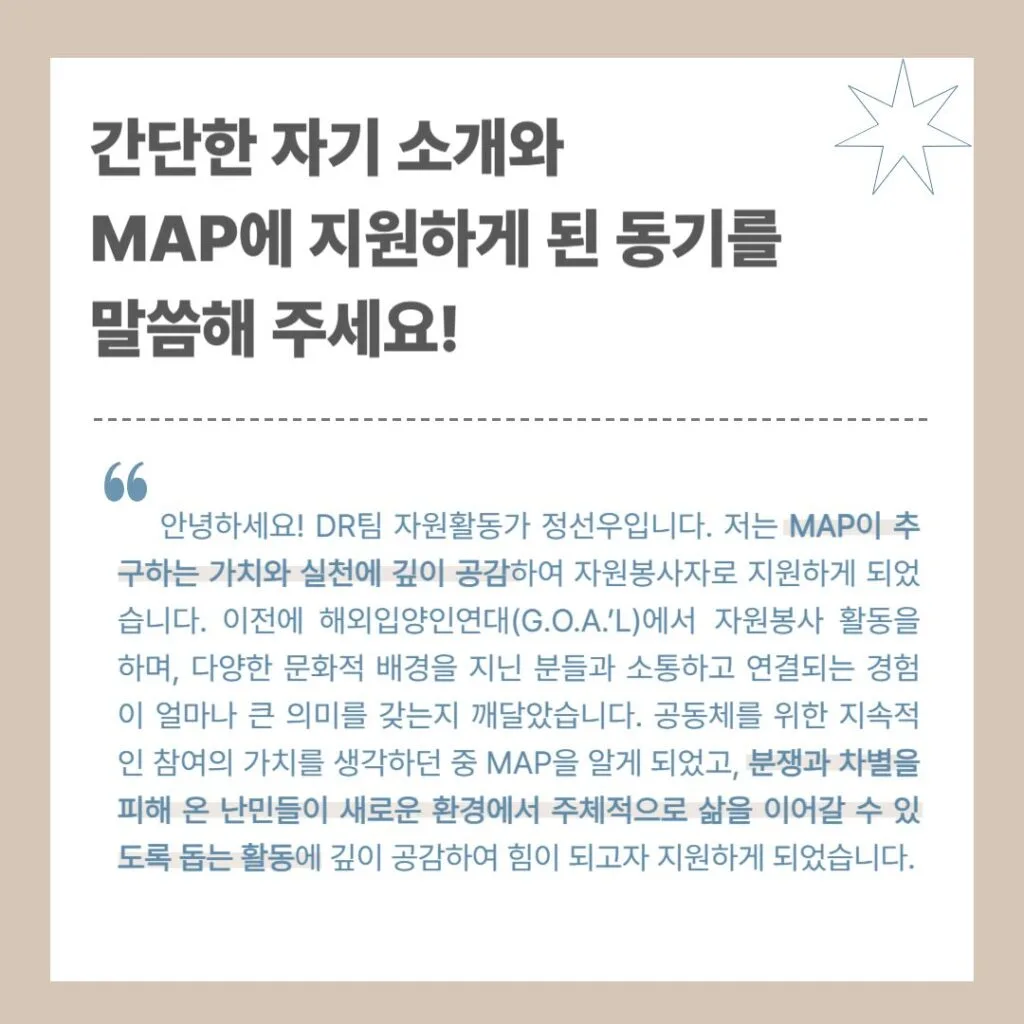
Q1. Please give us your self-introduction and your reason for applying.
Hello! I am Jung Seon-u, a volunteer on the DR Team. I applied as a volunteer because I deeply sympathize with the values and practice that MAP pursues. Earlier, while volunteering with the Global Overseas Adoptees’ Link (G.O.A.‘L), I realized how meaningful it is to communicate and connect with people from various cultural backgrounds. While thinking about the value of continued participation for the community, I learned about MAP. I deeply sympathized with its work of helping refugees who have fled conflict and discrimination to continue their lives on their own initiative in a new environment, and I applied hoping to be of help.
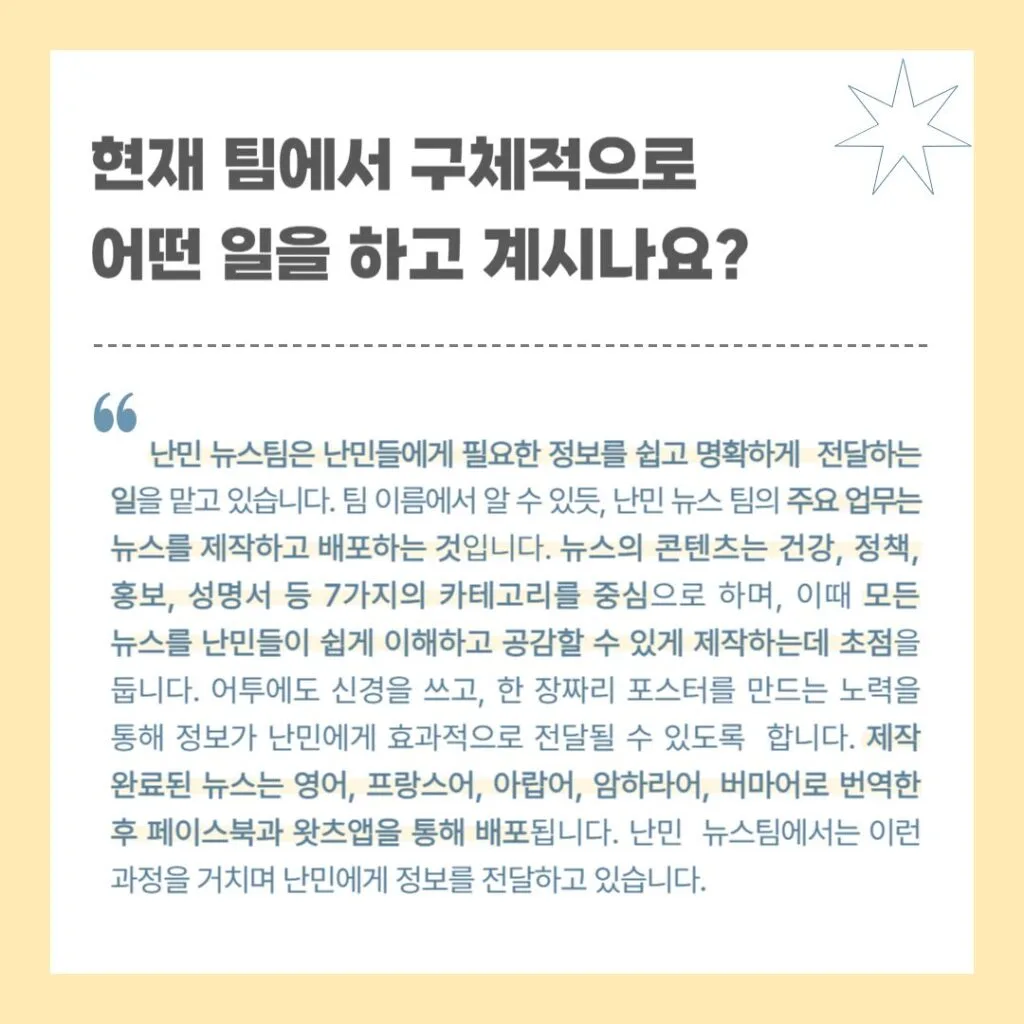
Q2. What exactly do you do on your current team?
On the DR Team, I am currently in charge of running and preparing the
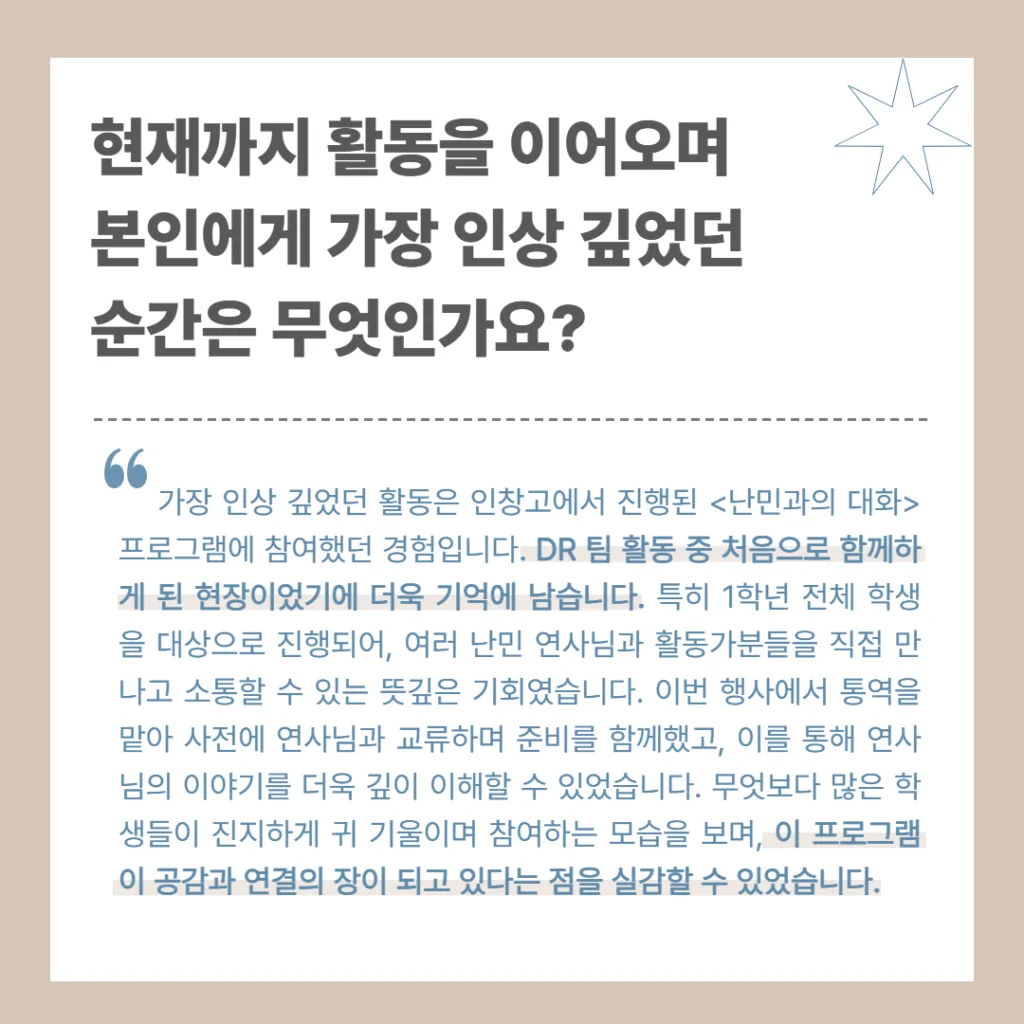
Q3. What has been the most memorable moment or activity for you so far?
The most memorable activity was taking part in the
Q4. What do you think our society needs most in order to live together with refugees?
In Korean society, the refugee issue still often feels like a story from far away. But as the “Dialogue with Refugees” program shows, the experience of meeting and talking directly has a more powerful effect than you might expect. Therefore, I think we should expand the places for continued meetings and experiences to build interest in and understanding of the refugee issue. At the same time, so that this change does not remain a one-time event but becomes sustainable, I think an institutional foundation must be put in place that allows refugees to settle as members of society.
Q5. What “change” have you felt while volunteering at MAP? And what “change” do you want to make in the future?
Through my work at MAP, I was able to feel in reality the value of solidarity that I had pursued only vaguely. Through “Dialogue with Refugees,” I experienced firsthand how powerful the moments are when people from different backgrounds gather in one place, talk, and communicate. Meeting people who work in many places outside of school was itself a very meaningful time for me, and I feel I have come to look at society with a wider view than before. In the future, based on what I have learned at MAP, I want to contribute to creating places where members of diverse communities can connect with one another and grow together.
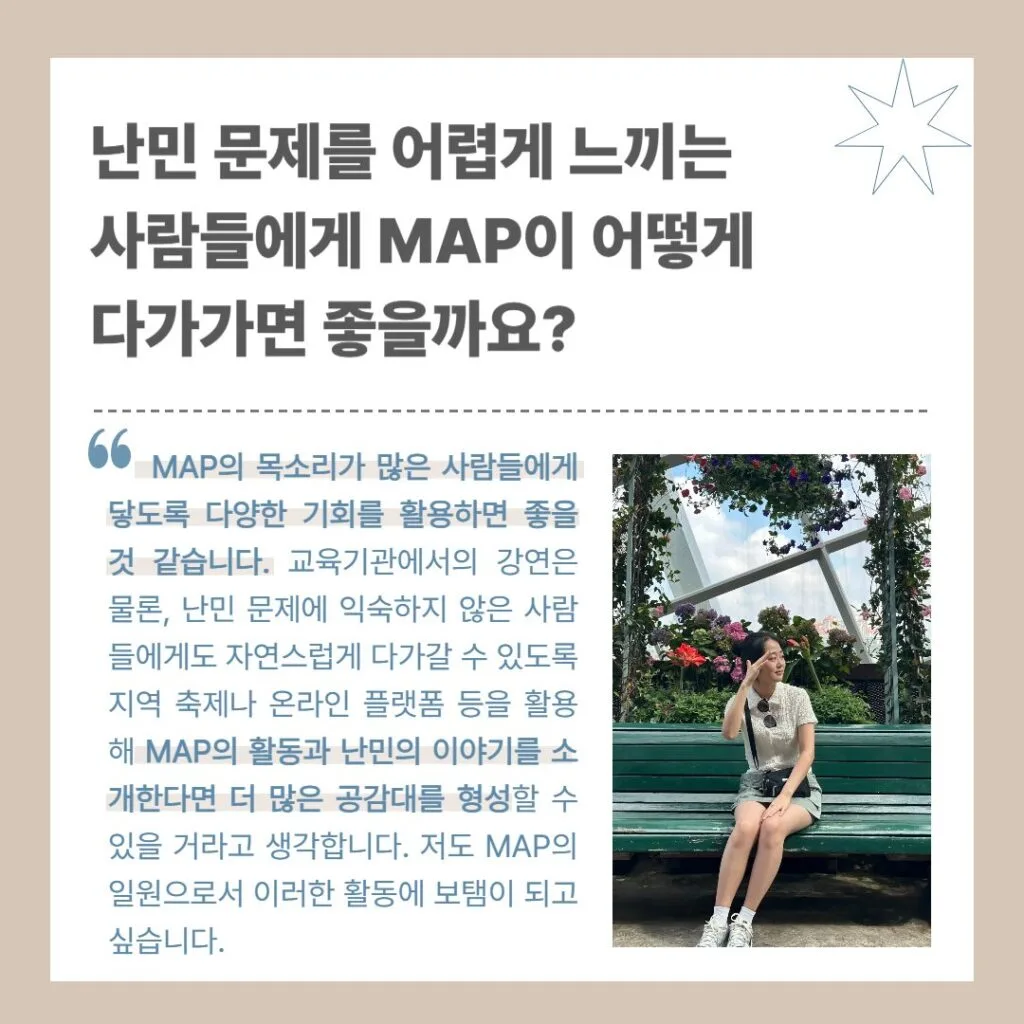
Q6. How should MAP approach people who find the refugee issue difficult?
I think it would be good to use a variety of opportunities so that MAP’s voice reaches more people. In addition to lectures at educational institutions, if we introduce MAP’s activities and the stories of refugees through local festivals and events and online platforms, so that people who are unfamiliar with the refugee issue can also encounter them naturally, I think we can build more common ground. As a member of MAP, I also want to help with these activities.