Q1. Please give us your self-introduction and your reason for applying.
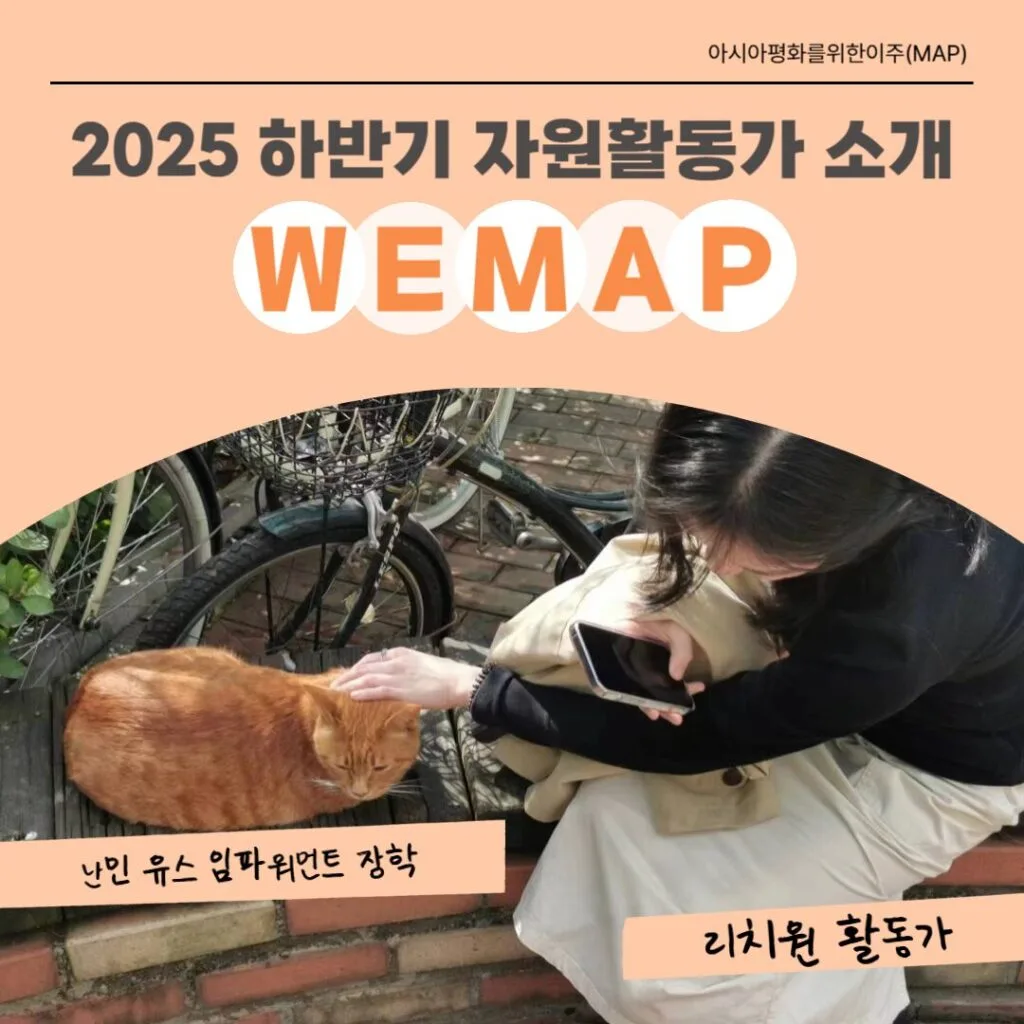
Hello. I am LI QIWEN (리치원), a migrant and international student from China who completed my undergraduate and master’s studies in Korea. I completed a master’s degree in the Department of Social Welfare at Seoul National University, and I am preparing to enter a doctoral program with the aim of directly supporting, in the field, the many difficulties that migrants, including myself, face in Korean society. I have volunteered at a Family Center, where I mainly planned and ran programs for marriage migrant women and their children. Through this experience, I came to think deeply about what kind of lives migrants who have not settled in Korean society are living and what kind of support they need in the field. Based on this awareness, I continue research and practice as an “insider researcher” aimed at practically improving the lives of migrants. In my master’s thesis, I analyzed the effect of social support on career decidedness among multicultural youth, and I found that teacher support at the school level was especially important. This led me to my current work on the YES Team, which supports the empowerment of refugee youth, where I help young people become independent and grow.
Q2. What exactly do you do on your current team?
I am currently in charge of running and preparing the
Q3. What has been the most memorable moment or activity for you so far?
The activity I remember most is the “Refugee Youth and Young Adult Empowerment Storytelling Forum” held on November 8. I am majoring in the practice field in my master’s program in social welfare, and I have done internships and volunteer work at several social welfare organizations, so I thought I was already familiar with program planning itself. However, this was the first program in which two of us took responsibility together for the entire process, from planning to execution to documentation. Until the day before the event, I prepared the questionnaire design and the facilitation plan with Jin-byeol, and I felt a great deal of worry and pressure. But on the day itself, seeing the young adults who took part actively share their thoughts and experiences, I felt great fulfillment and a sense of accomplishment. This experience taught me how important a participant-centered approach is in the field, and that practice is completed through cooperation.
Q4. What do you think our society needs most in order to live together with refugees?
The biggest problem I feel in the field is that the administrative system for migrants, including refugees, operates from the perspective of “management” rather than “support.” Within a centralized system led by the Ministry of Justice (MOJ), the actual support is carried out, each in its own role, by local governments’ foreign resident centers, Family Centers, and private nonprofit organizations. However, because this system is not organically connected, it still feels like a complicated and fragmented support environment from the point of view of the people concerned. So above all, I think a structural reorganization of the administrative system is needed, that is, a practical linkage system in which the central and local levels and the public and private sectors can cooperate. Also, prejudice against refugees and migrants lasts longer as a problem of “perception” than as a problem of policy. In a reality where biased media reports easily distort public opinion, civic groups and support organizations must work together and continue steady education and campaigns to change the perceptions of long-term residents. I believe such change will go beyond simple institutional improvement and become the starting point for Korean society to view diversity from the perspective of “coexistence” rather than “management.”
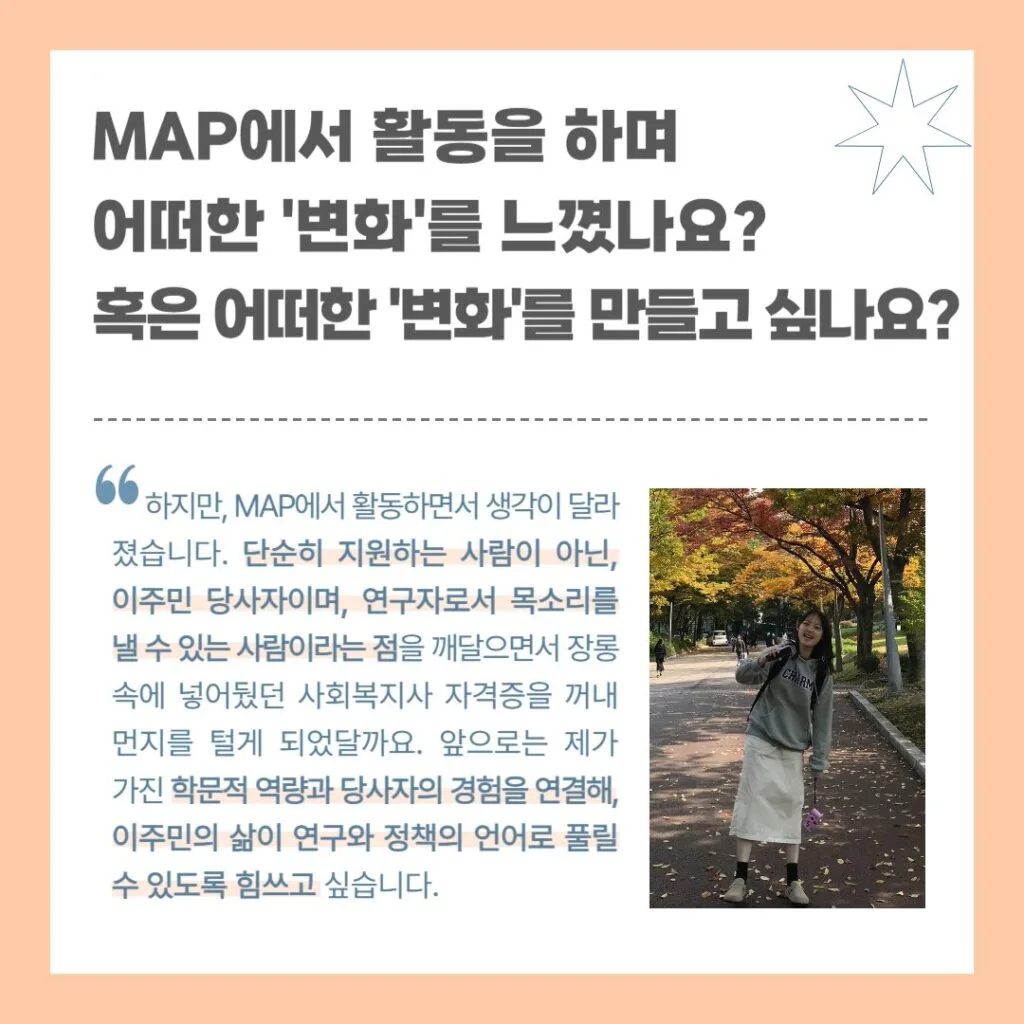
Q5. What “change” have you felt while volunteering at MAP? And what “change” do you want to make in the future?
Through my work at MAP, I took out again my identity as a “paper-license social worker” (a social worker who holds a license but does not practice). I had studied social welfare and moved within the “delivery system” through internships and volunteer work in various places, but in the field I felt again that there are far too many people, especially migrants and refugees, who are not included in that system. Because Korea’s immigration administration and social welfare services still operate within a framework of publicness, migrants often become objects of management rather than support. So I found it regrettable that, even academically, migrants remain “exceptional beings” rather than a “research topic.” But while working at MAP, this thinking changed. “I am not simply someone who supports; I am someone who can speak up as both a migrant and a researcher.” Realizing this, I took out the social worker license I had put away in a wardrobe and dusted it off, so to speak. In the future, I want to connect my academic capacity with my experience as an insider so that the lives of migrants can be expressed in the language of research and policy. MAP was a place that let me rediscover “myself as a practitioner,” and it was the first step in translating migrants’ stories into the language of society.
Q6. How should MAP approach people who find the refugee issue difficult?
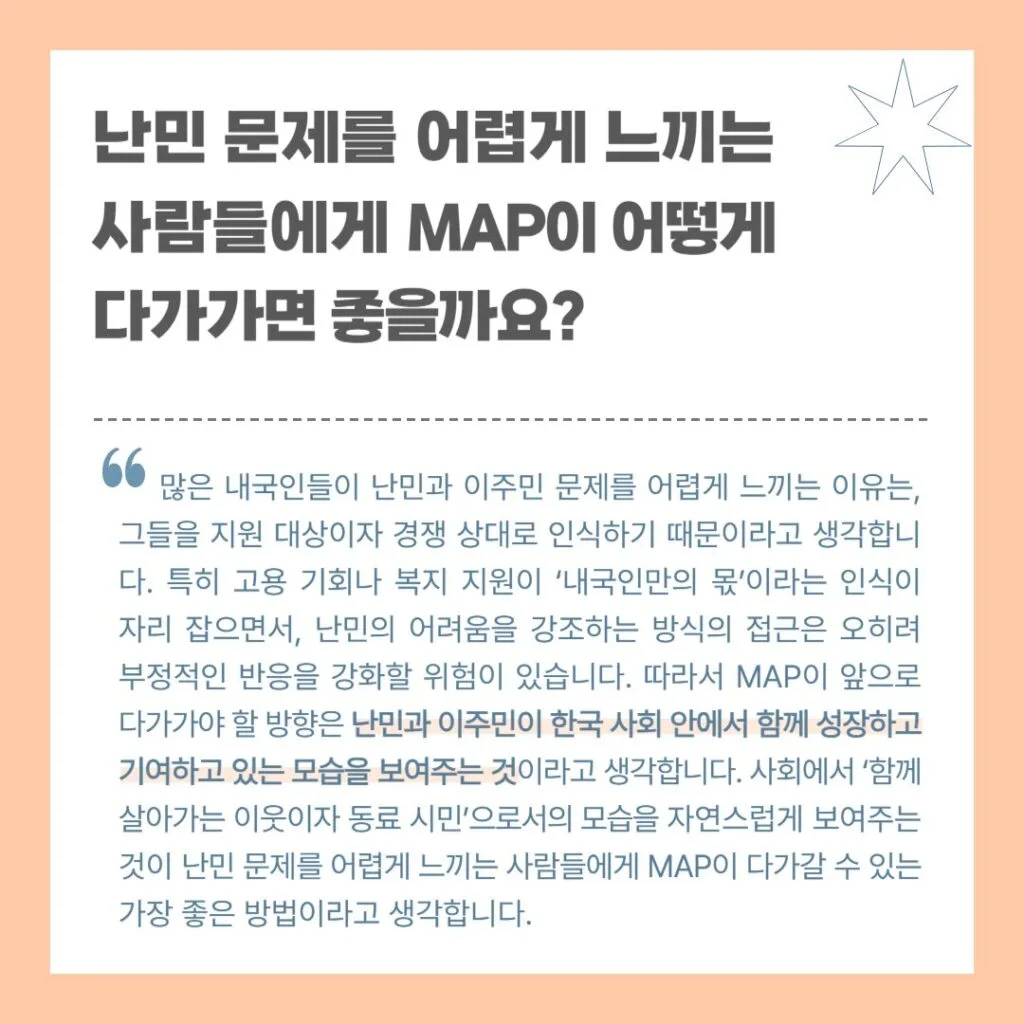
I think the reason many Korean nationals find the issues of refugees and migrants difficult is that they see them as “objects of support” and “competitors.” In particular, as the perception that employment opportunities and welfare support are “only for Korean nationals” has taken hold, an approach that emphasizes the hardships of refugees risks strengthening negative reactions instead. So the direction MAP should take from now on is, rather than centering the story on “the difficulties of refugees,” to show refugees and migrants growing and contributing together within Korean society. For example, I think we need channels that share the stories of refugees who study, work, and contribute to their local communities in various forms such as videos, interviews, and exhibitions. In other words, I think the best way for MAP to reach people who find the refugee issue difficult is to naturally show refugees not as “people who need help” but as “neighbors and fellow citizens who live together with us.”