
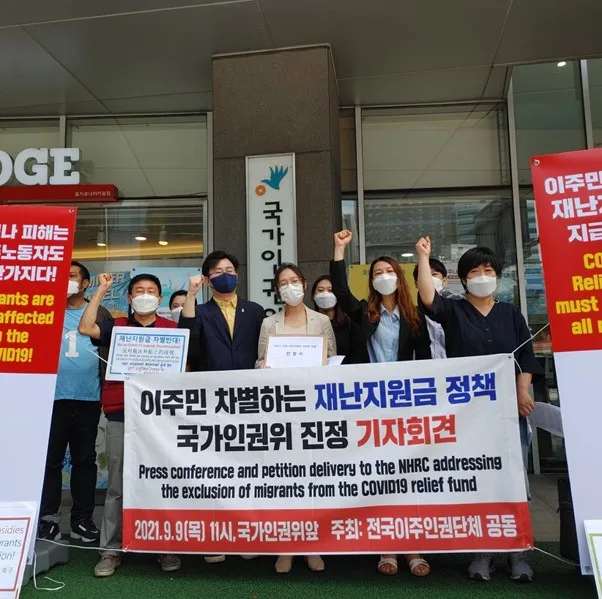
On September 9, migrant human rights organizations across the country including the Korea Refugee Rights Network held a joint press conference in front of the National Human Rights Commission of Korea (NHRCK) and submitted a complaint to the Commission regarding government emergency relief fund policies that are discriminatory towards migrants and refugees.
The respondents are the Minister of Economy and Finance, Minister of the Interior and Safety, and Minister of Health and Welfare that are the heads of the government task force for COVID-19 relief funds. Seven migrants, including migrant workers, a Korean-Chinese, an international student, and a family member of a humanitarian status holder, participated in filing the complaint. Most of them are enrolled in health insurance. The complainants saw the Korean government’s relief fund policy as violating human rights and principles such as human dignity and values and the right to the pursuit of happiness (Article 10 of the Constitution), the right to a life worthy of human beings (Article 34 of the Constitution), and the principle of non-discrimination under international human rights laws.
A complaint can be made to NHRCK when human rights under the provisions of Article 10 through 22 of the Constitution are violated or any discriminatory act is taken by a state agency. Investigation begins after the Commission’s investigators are assigned to the case. If the Commission determines on the basis of its investigation findings that human rights violations or discriminatory acts occurred, it may recommend remedial measures, or rectification or improvement of related laws, policies or practices to the respondent. Complaint handling process generally takes about three months.
The complaint filed this time against the 5th round of COVID-19 relief fund policy highlights that the right to equality should be guaranteed especially for families with children and refugees. The following excerpt speaks about refugees and humanitarian status holders.
Previously, on 9 November 2020, the committee had expressed its opinion to the Minister of the Interior and Safety that “In the time of COVID-19 pandemic, [We] expect that emergency relief fund schemes include refugees who are treated equally as citizens according to the Refugee Act and the United Nations Convention Relating to the Status of Refugees, and that length of stay, contribution to the country and society, and other elements should be taken into account to include more foreigners.”
Article 30 of the Refugee Act stipulates that Notwithstanding other Acts, a recognized refugee residing in the Republic of Korea shall be treated in accordance with the Refugee Convention. Article 23 of the Refugee Convention stipulates that the contracting states shall accord refugees lawfully staying in their territory the same treatment with respect to public relief and assistance as is accorded to their nationals.
The implementation plan of the current 5th COVID-19 relief fund excludes everyone who is involved in refugee claims – those who are granted refugee status, humanitarian status holders, and asylum seekers – from those eligible for the fund. While none of the complainants holds refugee status, it should be noted for the committee’s deliberation and decision on the complaint that its previous recommendation was not duly considered by the state.
On 10 June 2021, to promote the human rights of humanitarian status holders in Korea, the committee also recommended the Minister of Justice to revise related laws so that the status and treatment of humanitarian status holders may conform to the purpose of subsidiary or complementary protection, and to revise guidelines with regard to treatment of humanitarian status holders prior to the revision of the laws.
As the Commission’s previous recommendation recognizes the applicability of subsidiary protection to humanitarian status holders in Korea, and considering that UNHCR guideline, EU directive, and various overseas cases indicate that subsidiary protection is meant to ensure those who receive such status are given stable residence status and access to rights like those who are granted international refugee status, the 5th COVID-19 relief fund should include humanitarian status holders, as well as refugees, in order to relieve financial difficulties arising from the prolonge**d COVID-19 situation.