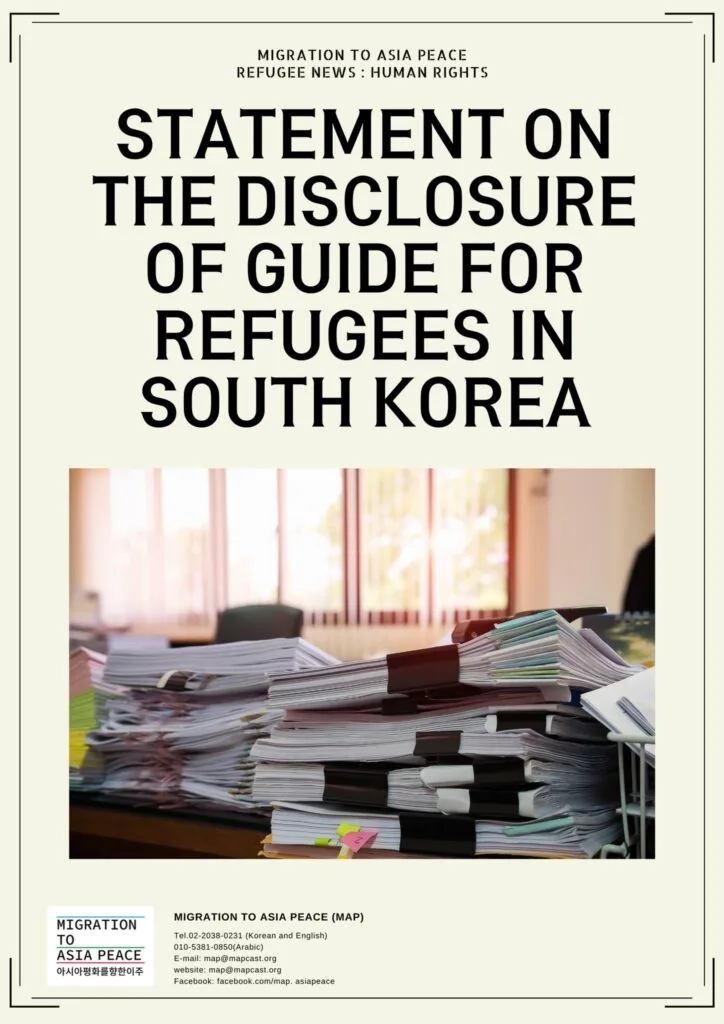
In the latest legal case of disclosure of the Guide for Refugees, the Seoul High Court has made judgments on the 30th of March to require the Minister of Justice to disclose the entity of refugee guidelines. The guidelines on forged passports and smuggling, and the guidelines on residence permit for smugglers are exempt from the disclosure requirement. Since the confirmation of judgment, the Refugee Rights Center has requested for the disclosure of the entity of refugee guidelines on the 14th of April. The judiciary has partially disclosed the requested guidelines on the 27th, and refused the disclosure at large in concerns of damaging the fairness and integrity of immigration and refugee recognition administrations.
The disclosed refugee guidelines include those on the review of criminal history, humanitarian stay, recognized refugees and their residence management in act since April, 2020.
Due to the recent disclosure, the refugee applicants, humanitarian stayers, and recognized refugees have been guaranteed access to the basic information on the entrance and exit of the country, including those on residence permit(extension, alteration etc), work permit application(extension), family reunification, criminal offender standards and more. This disclosure finally has enabled the approach to such critical information that deeply concerns the stability and consistency of one’s basic rights and daily life. Thus, such guidelines allow the monitoring and control over relevant administrative processes and the arbitrary abuse of administrative authorities, possibly leading to the violation of Refugee Act, Refugee Convention, Immigration Control Act, and other relevant international refugee rights standards.
However, the recent disclosure failed to establish an overarching revelation of the entity of relevant guidelines; the guide on refugee screening is yet to be shared with the public, the reason being that concerned lawsuits are yet to be concluded. In place, only the outdated guidelines from 2 years ago were opened. This is against the court decisions requiring the disclosure of refugee guidelines for the purpose of administrative transparency, fairness, and predictability. Such passive uncooperation of the judiciary is leading to repetitions of disclosure requests and fragmented revelations of guidelines, with the elongated process itself serving as proof to the exclusivity of the current immigration administration.
Rather, the unveiling of Guide of Refugees has made it clear that the immigration administration has so far been highly dependent on discretion. Under such a system, the designated public officials have often arbitrarily used their discretion. For instance, as opposed to how refugee applicants are allowed a maximum of 1 year stay by the refugee guideline, most refugee applicants are staying with a residence permit of 6 months in reality. In some cases, their residence extensions are only accepted for a short time period of 1 or 3 months, leading to high instability in refugee applicants’ rights to life and residence. Additionally, the guideline clearly states that even those for which 6 months haven’t passed since their refugee application can exceptionally receive work permits in cases that require humanitarian assistance. However, the only de facto case this guideline has been applied was the acceptance of Yemen refugees through Jeju in the year of 2018, for political purposes, and in no other cases had refugees been informed of such a possibility.
Thus, this disclosure has also revealed the discriminatory and unlawful practices of immigration administration. For those reapplying refugees that have stayed for more than 1 year, and with 4 months or less until the expiration of legal stay, many have illegitimately been denied their reapplication and received a departure order. Thus, although the Refugee Act sets the deadline for refugee screening at 6 months, 1-2 years of delay is commonly being witnessed. In several such cases, the refugee applicants are held responsible for the delay and charged relevant administrative fees. The cancellation of humanitarian stay is conflicting with international humanitarian law such as the Torture Convention, and the guideline that allows a forcible departure order in the process of refugee recognition has high probability of conflicting with the non-refoulment policy.
The network aims to regularly monitor the refugee guidelines to ensure their fair and transparent, most importantly lawful enaction. Further, the network plans to publish guidelines to guarantee the basic rights of refugees to keep track of the basic information on their refugee status. The judiciary must abide by the court decisions of constantly providing the latest updates on relevant policies to the refugees, and reviewing whether the refugee guidelines are in line with applying laws and international standards. To add, the Immigration must cut off their illegitimate administrative practices that exceed the extent of their discretion.
2022.05.03.
Refugee Rights Network, Minority Refugee Rights Network