
Incheon Yesong Elementary School
-
Purpose: Within the curriculum hours on solving global problems and conflict management dialogue, students meet a refugee, confirm that the world and the place where they live, and the past and the present, influence one another, and develop the qualities and abilities needed as global citizens.
-
Guidelines a. The program is run in connection with the operation of a democratic school centered on the 2020 curriculum. b. Parts of the sixth-grade curriculum, such as social studies (solving global problems) and Korean language (conflict management dialogue), are reorganized into a “refugee” activity. c. Because of COVID-19, the program is held online, and three instructors, an interpreter, a human book (a refugee) and a facilitator, each enter the online class room of the class concerned. d. The staff member in charge (Democratic Citizenship Education Department) takes part as time allows to assist the session, and prepares and provides the class with materials for the lesson content (books, videos and so on). e. Each class has a two-hour human book meeting, with a pre-survey and a post-survey for confirming and sharing what students learned and felt. f. As a preliminary educational activity, students read the books “The Journey” and “Me and Fear” in the sixth-grade English class and think about “safety,” “fear” and “relationships.”
-
Details a. Overview
- Theme: Refugees (global citizenship education)
- Target participants: students in five sixth-grade classes
- Name of the educational activity: Human Library, Meeting Refugees
- Activity goals: As global citizens and democratic citizens, students understand why refugees are created and how they are protected, and through the experience of talking directly with a refugee they build the community’s ability to welcome refugees.
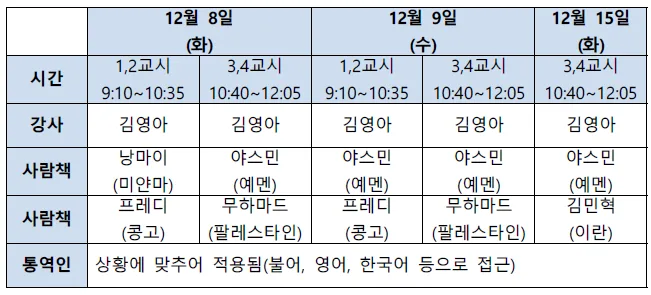
- Period and dates: Tuesday, December 8, 2020, periods 1-4; Wednesday, December 9, periods 1-4; Tuesday, December 15, periods 3-4
- Method: online video class (each class is expected to use Zoom)
- Instructors: Migration to Asia Peace (peace@mapcast.org), with an interpreter, human books and others
- Teachers and supporting department: homeroom teacher of each class and the Democratic Citizenship Education Department
b. Education schedule
c. Detailed learning objectives
- Understand who refugees are and why refugees are created in this world.
- Understand how the international community protects refugees.
- Empathize with the experiences and feelings of children who have to leave home.
- Learn how to approach a classmate as a friend when a student who transfers into our class is a refugee.
d. Related human rights instruments: Article 14 of the Universal Declaration of Human Rights, the UN Refugee Convention, the UN Convention on the Rights of the Child, the 2030 Agenda for Sustainable Development, the Global Compacts on Migrants and Refugees
e. Detailed lesson plan
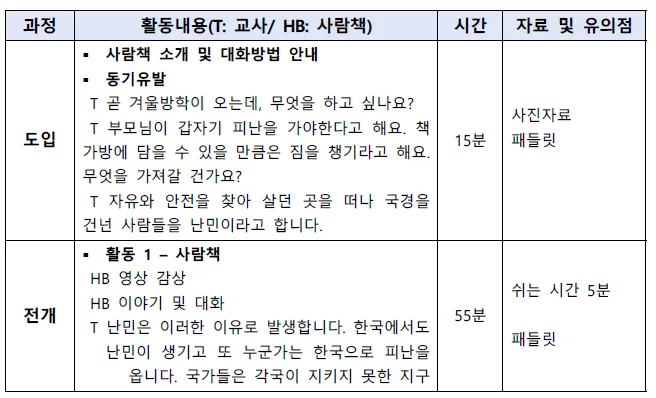
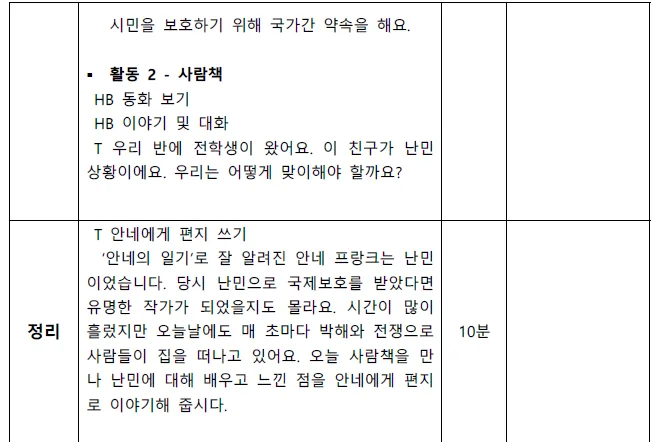
f. Materials: related YouTube videos and books (attached separately)
g. Evaluation (using the pre-survey and post-survey questionnaires)
- Think about what I can do first to solve global problems, and put it into practice.
- Think about what change the efforts to resolve conflicts in everyday life will make when I grow up as a citizen in society, and strive to put it into practice in a positive direction.
h. Other
- The instructor mainly speaks in Korean, and the human book speaks in English or their mother tongue.
- The human book, Mr. Kim Minhyuk, can speak in Korean.
- The interpreter is provided by Migration to Asia Peace (MAP).
- Expected effects a. Help learners think about the connection between refugees and themselves. b. Help learners think for themselves about the actions and practices they can take as democratic citizens for refugee protection or for their refugee neighbors.